Gandikota Fort guides: avoiding common tour traps and fees
The most common mistake at Gandikota is not taking the wrong road to the fort; it is assuming that every charge presented near the entrance is an official monument fee.
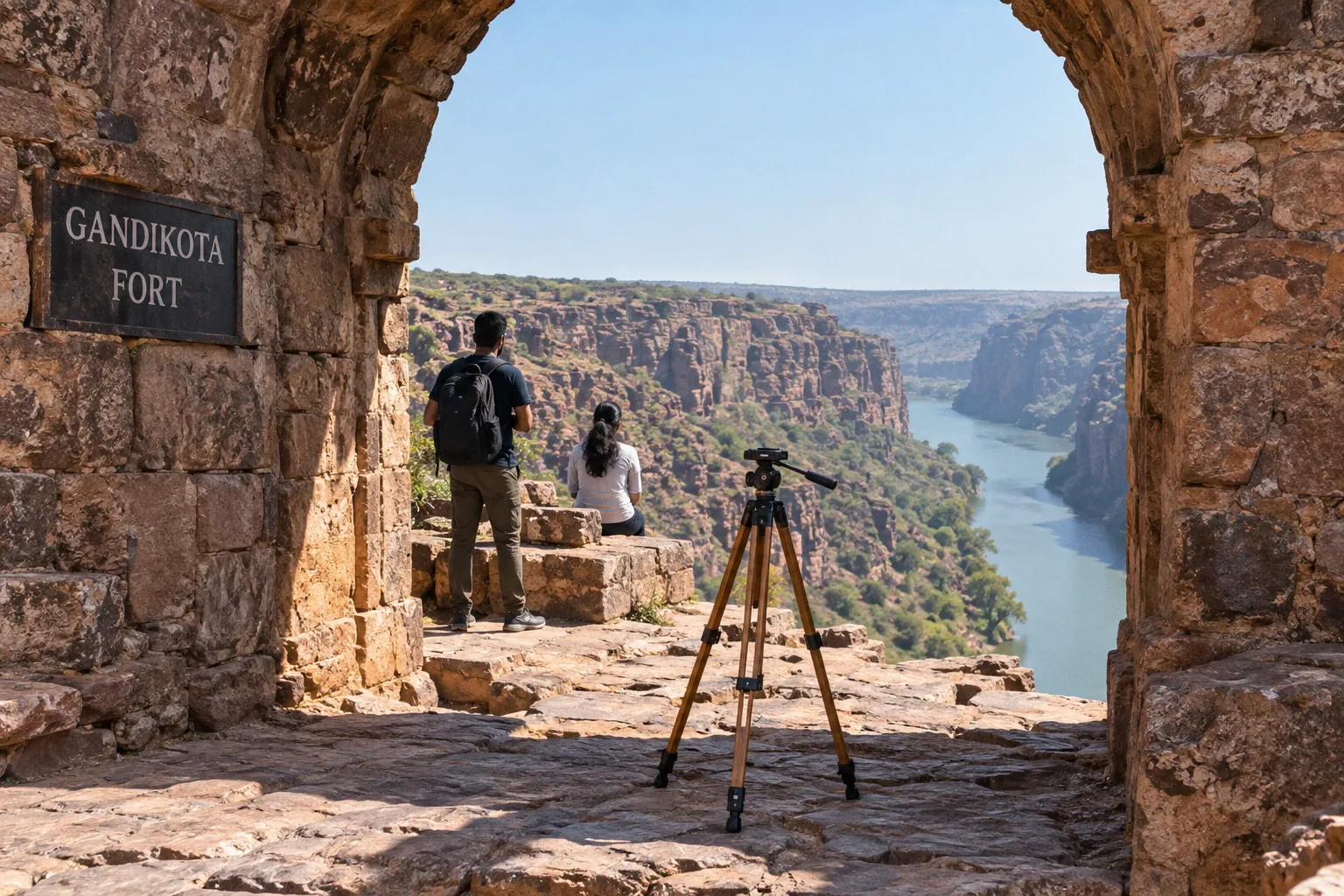
Gandikota Fort and the Penna River canyon viewpoint are open to visitors without an entry ticket, with official visiting hours from 8:00 AM to 6:00 PM. Yet the approach road can quickly fill with extra costs: unsolicited guiding, bundled transport, private camping, and adventure activities described as though they were part of the fort visit.
A clear map of what you are paying for makes the difference. You are entering a historic fort complex, not purchasing a single package that automatically includes a guide, a canyon excursion, climbing, a boat ride, or a room for the night. These are separate decisions, taken at different points around the site, and the landscape itself helps us keep them separate.
Gandikota sits along the deeply cut Penna River gorge in Andhra Pradesh, where the fort walls follow the canyon edge rather than enclosing a perfectly regular town plan. The monuments are spread across a broad, exposed area: gateways, bastions, temples, granaries, the old mosque, and the canyon-facing viewpoints do not all sit beside one another. That spatial arrangement makes a guide potentially useful, especially if you want the architectural history explained, but it also creates room for confusion when a local service is presented as an unavoidable part of admission.
The myth of paid entry: what official access includes
Walking into Gandikota Fort and reaching the Penna canyon viewpoint is free. The official visiting window is 8:00 AM to 6:00 PM daily, and standard handheld photography and video shooting are permitted without an additional fee.
That first distinction should remain in your mind as you pass through the approach area:
- Fort entry: free of charge.
- Canyon viewpoint access within the fort area: free of charge.
- Standard photography and video: permitted without an extra photography fee.
- Guiding: a separate service, and no standard government-regulated tariff list is publicly established at the gate.
- Adventure activities: separate charges.
- Camping and accommodation: separate charges.
- Belum Caves: a different attraction with its own admission ticket.
The fort’s free access does not mean that everything around it is free. It means only that a visitor should not be asked to buy an official entrance ticket in order to walk through the fort premises or look out over the gorge. If somebody combines several services into one verbal amount, ask for the components before handing over money.
The historic layers are worth seeing without rushing past this practical question. A sand fort was associated with the Kakatiya period in the early twelfth century, while the stronger stone fortification developed later, particularly under the Pemmasani Nayakas in the sixteenth century. The surviving enclosure, often described through its many towers and bastions, is therefore not one compact monument with one single visual story. You are traversing a defensive landscape shaped by changing political power, local stonework, religious architecture, and the natural protection of the gorge.
This is why a useful guide should help you interpret the relationship between places: how the fort wall flanks the canyon, where the temples sit within the former settlement, and how the open ground between structures would have functioned. A person who merely walks you to the viewpoint is providing navigation, not necessarily a heritage tour.
At Gandikota, the entrance is free; the confusion begins when unrelated services are made to sound like admission.
How to identify guide traps without treating every local guide as a problem
Hiring local guides at Gandikota can be worthwhile, but you should decide what kind of help you want before agreeing to a price. The absence of a published official guide tariff means that there is no reliable universal amount we can present as the government rate for a fort tour. A guide may offer a private interpretation of the site, a short walk to the main monuments, transport between separated points, or a longer circuit that includes nearby attractions. Those services are not interchangeable.
The first warning sign is pressure without definition. If a person approaches you and says that a guide is compulsory, that you cannot enter without assistance, or that the canyon viewpoint requires a paid escort, the claim does not match the stated access conditions. Guides are not mandatory for entering Gandikota Fort, and free entry is not conditional on booking a tour.
The second warning sign is a price that changes as the route expands. A conversation may begin with a small amount for showing one monument and gradually become a charge for the fort, the viewpoint, transport, waiting time, and a return journey. This is especially easy to miss when the site is hot, distances appear short on a phone map, and the driver or guide is already waiting beside you.
Before accepting, establish four points in plain language:
1. What area is included? Ask whether the service covers only the main temples, the canyon edge, the mosque, or the wider fort circuit.
2. How long does it last? A walking tour and an all-day vehicle arrangement should never be priced as though they were the same service.
3. Who is being paid? Clarify whether the amount is for a guide, an auto-rickshaw, a driver, or a combined arrangement.
4. Are there additional charges? Ask directly about waiting time, return transport, parking, meals, or a trip to another attraction.
You do not need to turn the conversation into an argument. A calm request for the total price and the exact route usually exposes whether the arrangement is transparent. If the answer remains vague, decline and continue toward the fort entrance or the accommodation area, where you can make a decision with more time.
Official versus unofficial fort guides
The practical distinction is not always between a good person and a bad person. It is between a service that is clearly described and one that relies on urgency, authority, or ambiguity.
| What is being offered | What you should expect | What to clarify |
|---|---|---|
| Independent local guide | A privately arranged explanation of the fort and its monuments | Route, duration, group size, total fee |
| Auto-rickshaw transfer | Transport between the station, fort, hotel, or nearby sites | One-way or return trip, waiting time, fuel and full-day terms |
| Adventure operator | A separately billed activity near the gorge | Safety arrangements, activity duration, inclusions |
| Camping provider | Tent accommodation, often with meals in a package | Tent type, bedding, meals, washroom access, cancellation terms |
| Government or public monument access | Free entry to the fort and canyon viewpoint during visiting hours | No admission payment should be bundled into another service |
There is no officially published tariff board at the fort gate establishing a standard guide rate, so be wary of anyone using the language of a fixed government fee without showing a clear official basis. At the same time, the lack of a tariff does not mean every privately agreed guide fee is illegitimate. A knowledgeable local who gives you an agreed walking tour is offering a service; the problem arises when that service is misrepresented as compulsory access or when the amount is expanded after the tour begins.
Transport is where a small journey can become an expensive one
Gandikota is easier to understand on a map than on the ground. The fort occupies a wide area, the monuments are not arranged in one neat sequence, and the nearest railway access is through Jammalamadugu, roughly 15–18 kilometres away. If you arrive without a prearranged transfer, an auto-rickshaw may become your first negotiation of the day.
Local transport rates from Jammalamadugu railway station can range from around ₹300 to ₹1,000 or more for broader or full-day arrangements when the price is not fixed in advance. The range reflects different expectations: a single transfer is not the same as a vehicle waiting while you visit the fort, and a journey that adds Belum Caves is not simply a ride to Gandikota.
The important question is not whether a quoted amount is automatically fair from a distance. It is what the amount covers. Before leaving the station, state the route in sequence:
- Jammalamadugu railway station to Gandikota Fort;
- waiting time, if the driver is expected to remain with you;
- return to the station or transfer to accommodation;
- any extension to Belum Caves or another site;
- whether the vehicle is being hired for one journey or for the day.
Write the agreed amount in your phone or repeat it aloud so that everyone in the group hears the same figure. If the driver proposes a different itinerary later, treat it as a new negotiation rather than allowing the original fare to absorb every extra stop.
The same principle applies inside the fort. A driver who transports you between distant monuments may be useful in the heat, but that service should not be folded into a supposed monument fee. Gandikota rewards slow orientation: from the main access area, identify the broad defensive wall and the open interior first, then locate the principal religious structures before moving toward the gorge edge. When a vehicle takes you directly to a viewpoint, you may save time but lose the spatial relationship that explains why the fort was built where it was.
Adventure costs are not part of fort sightseeing
The red quartzite gorge invites a different kind of visit from the one focused on temples, bastions, and historic masonry. Rock climbing, rappelling, and kayaking are separate adventure activities, with typical listed rates of approximately ₹200, ₹400, and ₹500 respectively. Those charges do not become part of the free fort admission simply because the activities are advertised in the same destination.
This separation matters when an operator offers a combined verbal package. Ask whether the quoted amount includes equipment, instruction, access to the activity area, and the full duration of the session. The available figures describe typical activity rates, not a universal guarantee covering every operator or every season, so the final arrangement still needs to be made directly with the provider.
You should also distinguish a gorge viewpoint from a technical activity zone. Looking across the Penna canyon is part of the fort visit and does not require an adventure ticket. Climbing down a route, rappelling, or entering the water is a separate physical undertaking, with its own safety implications and possible weather restrictions.
A useful way to keep the day legible is to divide it into two itineraries:
1. Heritage circuit: fort entrance, gateways, bastions, temples, mosque, granary structures, and canyon viewpoint.
2. Adventure circuit: the separately booked activity, equipment arrangements, briefing, and return to the designated meeting point.
Do not allow an operator to suggest that you need to purchase an adventure session in order to reach the canyon. You do not. Nor should a person offering to guide you through the monuments imply that their fee includes climbing or kayaking unless those activities have been specifically discussed.
The gorge is one landscape, but it is not one invoice: heritage access, transport, activities, and accommodation belong to different lines.
Camping, hotels, and the cost of staying near the rim
Overnight plans create a second layer of hidden-cost risk because camping packages often appear to simplify everything. Basic canyon camping packages commonly range from ₹900 to ₹1,500 per person per night, generally with meals included. That is not an entry charge and not a mandatory way to experience Gandikota; it is an accommodation package whose value depends on what is actually provided.
Before booking a tent, ask about the physical arrangement rather than relying on the word camping alone. A low-cost package may mean a basic tent with shared facilities, while another may include bedding, meals, a managed campsite, and a more substantial washroom arrangement. Confirm:
- whether the rate is per person or per tent;
- which meals are included;
- whether bedding and lights are provided;
- where the washrooms are located;
- how far the camp is from the fort and the canyon edge;
- whether transport to the fort is included;
- what happens if weather disrupts the stay.
The location is particularly important. A campsite described as being near Gandikota may not be positioned beside the monument entrance. If you are planning sunrise or sunset photography, the distance and return transport can affect the experience more than a modest difference in the room rate.
The state-run APTDC Haritha Hotel is another option, with room charges reported at approximately ₹1,100 to ₹1,680 per night before taxes. A room gives you a more defined base, while a campsite may offer a closer relationship with the open canyon environment. Neither should be presented as part of fort access, and neither removes the need to plan transport if you arrive through Jammalamadugu.
For a group, compare the total rather than the advertised starting price:
| Overnight option | Typical quoted basis | Questions that change the real cost |
|---|---|---|
| Basic canyon camping | ₹900–₹1,500 per person per night, often including meals | Shared facilities, bedding, transport, meal schedule |
| APTDC Haritha Hotel | About ₹1,100–₹1,680 per room per night before taxes | Room occupancy, taxes, meals, availability, transport |
| Same-day visit | No accommodation charge | Early transport, return timing, heat, and daylight |
If your main purpose is the fort, arrive with enough daylight to traverse the site rather than choosing a late arrival because a camping package appears convenient. The official visiting hours end at 6:00 PM, and a tent reservation does not extend monument access beyond that window.
Belum Caves is a separate stop, not an extension of the fort ticket
Belum Caves lies roughly 60–65 kilometres from Gandikota Fort, far enough that the visit should be planned as a separate leg rather than treated as a nearby add-on. Entry is separate: the listed ticket is ₹50 for Indian nationals and ₹300 for foreign visitors.
This distance is one of the easiest places for an informal transport arrangement to become unclear. A driver may quote a single full-day amount for Gandikota and Belum, but you should still ask whether the figure includes the return journey, waiting time at both sites, and any overnight transfer. If a guide says that the cave ticket is included in a fort tour, request a breakdown; the two attractions do not share one admission system.
The heritage relationship between the sites is meaningful, but it does not erase the practical distinction. Gandikota is an open fort-and-canyon landscape dominated by defensive architecture and the Penna gorge. Belum is an underground cave system with its own management, route, admission, and time requirements. You are crossing a substantial stretch of the Kadapa heritage corridor, not simply walking from one monument enclosure to another.
Plan the order around light and heat. Gandikota’s canyon edge is most legible when the sun is not directly flattening the stone and when you have enough time to move between the structures. Belum Caves are a different visual environment altogether, and their visit does not need to be forced into the narrowest part of the fort’s opening window.
Photography rules: free cameras, prohibited drones
Standard photography and video shooting with a handheld camera or phone are allowed at Gandikota Fort without an additional fee. Drone cameras, however, are strictly prohibited inside the fort premises. Do not assume that the open canyon, broad sky, or lack of visible crowds makes aerial filming acceptable.
This is not an area where a guide’s casual permission substitutes for official authorization. If someone offers to arrange drone footage on the spot, treat the offer as a serious warning rather than a convenient upgrade. The fact that a device can physically take off does not establish that its use is permitted.
For ordinary photography, stay attentive to the monument rather than only the horizon. The canyon viewpoint is naturally magnetic, but the fort’s architectural evidence is distributed across thresholds, wall junctions, bastions, and the way religious buildings sit within the defensive enclosure. A guide who explains these relationships is more useful than one who simply points toward the gorge and asks for an additional fee.
If you are filming commercially or planning professional production, do not assume that a private guide can settle the permit question. The exact permit fee schedule for commercial filmmaking is not clearly established in the available information, so formal permission should be confirmed through the relevant authorities before equipment and crew are committed.
A route that keeps the day—and the budget—under control
We can avoid most Gandikota monument tour traps by making the route explicit before we begin. Start at the fort access point during the 8:00 AM–6:00 PM visiting window, and first orient yourself to the enclosure rather than accepting the first available ride or tour. Locate the principal built landmarks, then move toward the canyon-facing edge, where the wall and the landscape intersect most clearly.
A practical sequence looks like this:
1. Confirm free entry at the outset. Do not pay an admission amount for walking into the fort or reaching the canyon viewpoint.
2. Choose whether you want interpretation. If you hire a local guide, agree on the route, time, and total fee before the walk begins.
3. Separate transport from guiding. A driver may take you around the spread-out site, but transport is not an official fort charge.
4. Price activities independently. Rock climbing, rappelling, and kayaking are optional, separately billed experiences.
5. Check the overnight package line by line. Confirm what meals, bedding, washrooms, and transfers are included.
6. Treat Belum Caves as another attraction. Allow for its separate distance and admission ticket.
7. Keep drones out of the fort. Handheld photography is allowed; drone cameras are prohibited.
You can also reduce negotiation pressure by carrying enough water, arriving with a charged phone, and keeping the accommodation address written down. These are small preparations, but they prevent a guide or driver from becoming your only source of information when the afternoon heat rises and the site’s distances become more apparent.
The best time to finish the canyon-facing portion is when the light begins to travel across the gorge rather than striking the red quartzite directly from overhead. Late afternoon generally gives the fort wall, bastions, and opposite canyon face more readable relief, although you must leave enough time to return through the complex before the 6:00 PM closing hour. If you are staying overnight, use the last daylight for orientation and reserve the most careful photography for the softer light, when the fort’s position along the Penna is easiest to understand.
Gandikota does not require a paid gatekeeper to reveal itself. You need a route, a clear separation between services, and enough patience to ask what every fee actually covers. Once those boundaries are in place, a local guide can become what a good guide should be: a companion through a complicated heritage landscape, not another obstacle between you and the monument.