Gandikota camping styles: choosing your canyon stay
Gandikota camping is not one product. It is a range of overnight setups with different levels of exposure, sanitation, security, and thermal control.
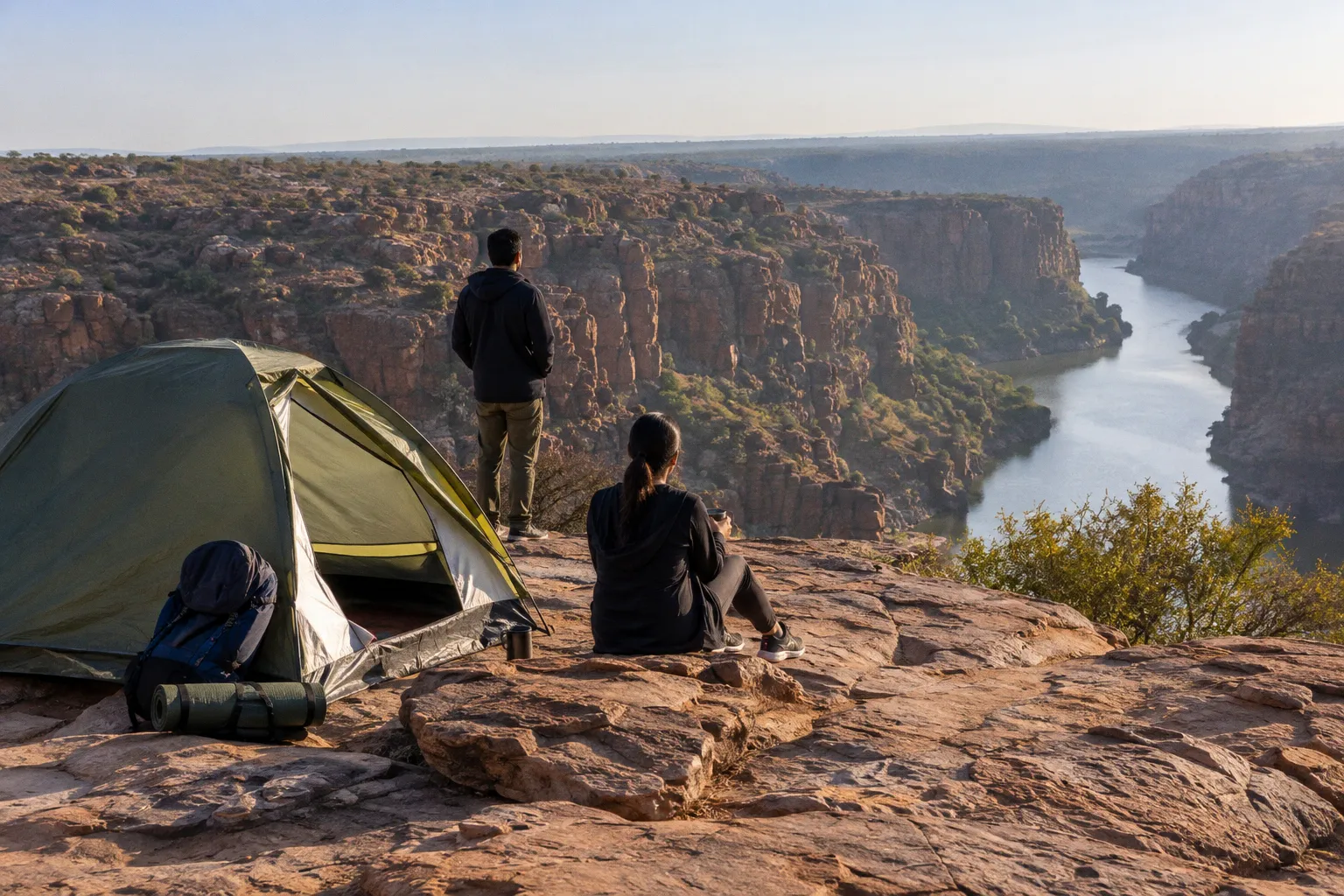
A basic dome tent may cost ₹900–₹1,500 per person per night and usually includes dinner, breakfast, and campfire access. An AC Swiss tent or attached-washroom room can cost ₹1,899–₹2,199 per person for family or group occupancy. A bare tent allocation may start around ₹500, but that price usually excludes food and activities.
The correct choice depends on how much equipment you carry, how much heat you tolerate, whether children are travelling with you, and how close you intend to sleep to the canyon edge. Gandikota is not a controlled resort environment. The red sandstone gorge, exposed camp areas, uneven ground, limited nearby transport, and early check-out schedule all affect the decision.
These are the main Gandikota camping options for families and solo travelers:
| Stay type | Typical price | Included setup | Best suited to | Main limitation |
|---|---|---|---|---|
| Basic dome tent | ₹900–₹1,500 per person | Shared tent, dinner, breakfast, campfire access | Budget travellers, solo visitors, short overnight trips | Basic privacy and common washrooms |
| Alpine tent allocation | From about ₹500 | Tent space or basic tent arrangement, usually without meals | Travellers carrying their own equipment or arranging food separately | More planning and fewer included services |
| AC Swiss tent | ₹1,899–₹2,199 per person | Enclosed AC tent, usually for family or group occupancy | Families, couples, hot-weather travellers | Higher cost and less minimalist |
| AC room with attached washroom | ₹1,899–₹2,199 per person | Solid room, private washroom, climate control | Children, older travellers, low-tolerance campers | Not a fully exposed camping experience |
| Self-pitched or informal outdoor stay | Variable | Your own shelter and supplies | Experienced outdoor users with local permission | Regulations, security, water, sanitation, and site access are uncertain |
The price bands are operational estimates from organized camping and lodging offers, not a permanent tariff. Confirm the current inclusions before payment. The difference between a listed tent rate and the final bill can be food, bedding, activities, transport, or occupancy rules.
Budget dome tents: the standard Gandikota camp
The budget dome tent is the default choice for travellers who want an overnight stay near the canyon without carrying a complete camp system. Operators typically provide a two- or three-person tent allocation, dinner, breakfast, and access to a campfire. Common washrooms and basic site staff are part of the arrangement. The setup is functional rather than private.
This option works because it removes the most difficult parts of a remote overnight stay:
- You do not need to transport a tent, sleeping mat, stove, or cooking fuel.
- Dinner and breakfast are handled at the campsite.
- Site staff provide basic orientation and operating rules.
- The camp remains within an organized private compound rather than an unstructured roadside location.
- Solo and female travellers have a defined place to check in, sleep, and leave their equipment.
The tent itself is not a substitute for a sleeping system. Ask what the operator supplies before arrival. A fabric shelter with a mattress may still require a personal sleeping bag or liner, especially if you are sensitive to dust, insects, or shared bedding. A compact headlamp remains necessary even when the campsite has common lighting. Camp power can be intermittent or limited to communal areas.
What the dome package usually does not solve
A budget package is not a complete answer to heat, wind, noise, or sanitation. It provides a bed and a managed campsite. It does not guarantee a private washroom, air-conditioning, uninterrupted electricity, or a quiet view of the gorge.
The common failure points are predictable:
1. Late arrival. Check-in commonly runs from about 12:00 PM to 5:00 PM. Arriving after dark complicates navigation, tent allocation, meals, and vehicle parking.
2. Incorrect occupancy assumptions. A low per-person rate may depend on two- or three-person sharing.
3. Unclear bedding. Mattress, blanket, pillow, and sheet policies vary.
4. Overstated canyon access. A campsite near Gandikota is not automatically positioned on a safe cliff edge or directly beside the Pennar River.
5. Activity bundling. Rappelling, kayaking, and other outdoor activities may be separate from the overnight tariff.
The best tent spots in Gandikota canyon are not defined only by the view. A usable site needs level ground, a controlled approach to the edge, access to sanitation, and enough distance from vehicle movement and campfire smoke. Do not select a tent solely because it is closest to the gorge. A few metres of additional setback is a reasonable trade for reduced fall exposure and better night movement.
The cheapest Gandikota tent is useful only when the package removes more problems than it creates.
For solo travellers, the dome option is efficient if the campsite has a staffed reception, controlled gate, and clear tent allocation. For families, it is acceptable when children can sleep comfortably in shared space and the washroom arrangement is known in advance. It is a poor fit for travellers who need uninterrupted sleep, private sanitation, or climate control.
Glamping and AC stays: balancing comfort with exposure
AC Swiss tents and AC rooms sit at the opposite end of the local camping range. They are not wilderness shelters. They are managed accommodation units placed within an outdoor destination. That distinction matters.
At approximately ₹1,899–₹2,199 per person for family or group occupancy, the upgraded options buy three practical advantages:
- Reduced heat load during rest periods.
- Better control over dust, insects, and night-time discomfort.
- More predictable sanitation when an attached washroom is included.
An AC Swiss tent preserves some of the visual identity of camping while reducing the physical penalty. An AC room provides the most controlled sleep environment. Neither should be described as wild camping. You are still operating inside a private or organized property with staff, meal schedules, access rules, and fixed check-in and check-out times.
Gandikota glamping versus wild camping
The comparison is not simply comfort against authenticity. It is managed logistics against unmanaged risk.
| Operating factor | Organized glamping | Informal or self-pitched camping |
|---|---|---|
| Shelter | Provided and installed | Carried, pitched, and secured by you |
| Food | Often included or available on site | Must be carried, purchased, or cooked |
| Water | Common site supply or facility access | Must be confirmed before arrival |
| Sanitation | Common washrooms or attached facilities | Your responsibility |
| Security | Staffed, gated campsite may be available | Depends on location and local permission |
| Canyon-edge control | Site rules and designated areas | You must assess the exposure yourself |
| Cost structure | Higher per person, clearer package | Variable, but equipment and transport add cost |
| Night movement | Fixed access and common lighting | Requires your own lights and navigation plan |
| Legal certainty | Usually clearer inside organized property | Public-land rules and local permission may be uncertain |
Do not assume that a flat patch near the fort or gorge is available for unrestricted tent pitching. The exact current rules for self-pitched camping outside private gated sites are not established here. Obtain local permission before setting up. Do not pitch directly on ancient fort structures or architectural ruins.
For travellers who want photographs, a sunset view, and a controlled night, glamping is the more efficient option. For a group carrying its own equipment, the basic tent allocation may be sufficient. For an independent expedition, the unresolved questions around water, toilet access, security, and permission make informal camping a planning issue rather than a romantic upgrade.
Safety and logistics for solo and family travellers
Gandikota is accessible, but accessibility does not eliminate field hazards. The canyon edge is not a balcony. The ground can be uneven, loose, and poorly defined after dark. Children, intoxicated adults, and anyone walking without a light create avoidable risk.
A safe overnight stay begins before the vehicle leaves the main road. Use a campsite with a known address, a functioning contact number, and a defined arrival procedure. Confirm whether the property is gated and whether staff remain on site overnight.
Solo travellers
Solo visitors should prioritize controlled logistics over the lowest advertised rate. The minimum useful arrangement includes:
- A staffed or gated private campsite.
- A confirmed single-occupancy or shared-tent policy.
- A known route from the parking area to the tent.
- Common washroom access within the property.
- A charging arrangement or personal power bank.
- A clear check-in contact if arrival is delayed.
- A personal headlamp with spare batteries.
Organized campsites can make Gandikota accessible for solo and female travellers because they provide a defined sleeping area, site staff, and basic security procedures. This does not mean the location is risk-free. Avoid leaving phones, wallets, cameras, and vehicle keys unattended in an open tent. Keep valuables in a small zipped pouch beside your sleeping position.
Do not walk to the canyon edge alone after drinking. Do not treat a campfire, group presence, or phone flashlight as a safety system. Carry your own light.
Families
Family suitability depends less on the view than on the facilities. Before booking, establish four details:
- Is the toilet inside the unit or shared?
- Is bedding supplied for every listed occupant?
- Is the tent floor raised, insulated, or directly on the ground?
- Is the sleeping unit positioned away from vehicle movement and open edges?
Families with young children usually gain more from an AC room or attached-washroom unit than from a cheaper dome tent. The price difference buys thermal control, easier night-time toilet access, and fewer problems if a child wakes repeatedly. Older children can use a dome tent if the campsite has level paths and controlled access to the gorge.
Keep children inside the designated camp area after dark. The canyon should be treated as an exclusion zone unless a marked or staff-approved viewpoint is available.
Activity risk
Rappelling and kayaking may be offered as add-on activities. They should be evaluated separately from the overnight stay. Ask who operates the activity, what equipment is supplied, whether helmets and buoyancy aids are mandatory, and whether the session is cancelled under unsafe conditions.
A tent booking does not automatically include adventure activities. It also does not establish that conditions are suitable on the day. Water levels, wind, visibility, and operator staffing can change the plan.
Arrival, check-in, and the Pennar Gorge timetable
Gandikota is a destination where arrival planning affects the quality of the stay. The nearest railway station is at Jammalamadugu, approximately 15–18 km away. Road distances are substantial: roughly 280–340 km from Bangalore, 370–380 km from Chennai, and around 380 km from Hyderabad.
Those distances make a same-day drive possible for a prepared driver, but they leave little margin for delays, fuel stops, navigation errors, or a missed check-in window. Organized camps commonly use a check-in period from approximately 12:00 PM to 5:00 PM. Check-out is often between 7:00 AM and 9:00 AM the following morning.
The schedule has direct consequences:
- A late afternoon arrival can leave you setting up, eating, and orienting yourself in fading light.
- A night arrival may mean no immediate access to the intended viewpoint.
- An early check-out limits sunrise photography and long morning activities.
- A train arrival at Jammalamadugu still requires a transfer for the final 15–18 km.
- Public transport should not be assumed to operate frequently throughout the night.
If you are driving, plan to reach the campsite before the final check-in hour rather than treating 5:00 PM as a target arrival time. Fuel and food options become less predictable as you move away from larger towns. Carry drinking water for the approach even when the campsite provides water on arrival.
A practical arrival sequence is:
1. Confirm the property location. Do not rely only on a broad map pin labelled Gandikota.
2. Call before leaving the final major town. Verify that the gate, staff, and booking record are active.
3. Reach during daylight. This allows you to identify the tent, washroom, parking area, and safe walking route.
4. Inspect the sleeping unit. Check the floor, bedding, ventilation, lighting, and door or zip function.
5. Locate the washroom and emergency route. Do this before dinner and before alcohol is served.
6. Set a hard movement boundary. Keep the group away from unmarked cliff edges after dark.
7. Secure valuables and charge devices. Do not wait until the campsite goes quiet.
8. Pack for early departure. An early check-out is easier when bags are closed the previous night.
The Pennar gorge is a major part of the destination, but a riverside position is not automatically a better camp. The river area may be harder to reach, less serviced, and more exposed to changing ground conditions. Use a designated operator site unless you have confirmed access, permissions, water, and sanitation for an alternative location.
Camping gear requirements for Gandikota
A package reduces the equipment burden but does not remove it. The correct kit is compact, redundant, and suited to walking on rough ground at night.
For a managed dome tent, carry:
- A headlamp producing roughly 150–300 lumens.
- One spare battery set or a charged backup light.
- A power bank and charging cable.
- A personal sleeping bag liner or lightweight sheet.
- Closed footwear with a firm sole.
- Two litres of drinking water per person for the travel day.
- Sun protection: hat, sunglasses, and sunscreen.
- A light insulating layer for night use.
- Personal medication and a basic first-aid kit.
- Small rubbish bags for packing out personal waste.
- A face covering or cloth for dust if travelling by open vehicle.
For self-supported camping, the equipment requirement increases sharply. Add a tent rated for local wind exposure, a groundsheet, sleeping mat, sleeping bag, stove system if permitted, water storage, food, cooking utensils, repair tape, cordage, and a navigation light. Do not arrive with a shelter but no sanitation plan. A tent is the simplest part of an overnight field system.
Avoid packing heavy decorative camping equipment that has no operational value. Large lanterns, fragile glassware, and open-flame accessories create more handling problems than they solve. A headlamp is superior to a phone flashlight because it leaves both hands free and preserves battery power.
Wind is another reason to inspect the tent location. Secure loose bags, clothing, and tent flaps. Do not leave a lightweight shelter open when you are away from it. Keep footwear inside or under a protected cover. Dust and insects are minor problems during daylight and major problems when you are trying to sleep.
Stargazing and night sky viewing at the canyon edge
Gandikota is well suited to night-sky viewing because the campsite experience is not built around urban infrastructure. There is no major city directly adjacent to the gorge, and the canyon rim is far enough from dense settlement that direct glare is limited. However, no verified Bortle classification for Gandikota is established in available material. Treat any specific dark-sky rating as marketing rather than measurement until it is independently confirmed.
The useful variables for a working stargazing session are practical, not atmospheric certification:
- Light sources inside the campsite itself. A dome camp with a bright communal light near the tents will compress your dark-adaptation window regardless of how dark the sky is one hundred metres away.
- Moon phase and timing. A full moon over the gorge rim will dominate the visible sky. Plan around the lunar calendar if faint objects are the goal.
- Horizon line. The canyon rim itself blocks a portion of the lower sky. Choose a viewing position with the widest unobstructed arc, typically away from the gorge edge rather than directly on it.
- Cloud and dust. Dust in the air during certain seasons reduces transparency and star count visibly.
- Personal dark adaptation. Allow fifteen to twenty minutes away from white light before judging sky quality.
Best stargazing spots within the camp zone
The best tent spots in Gandikota canyon for night-sky viewing are those with the fewest competing light sources nearby. A tent pitched away from the kitchen area, away from vehicle headlights, and away from a permanent floodlit viewpoint will outperform a tent with a better daytime view. The trade-off is straightforward: more sky usually means a longer walk to the washroom and a less immediate sunrise.
Position yourself with your back to the brightest visible light. Let the gorge rim serve as a horizon marker. Do not walk to the canyon edge at night for stargazing; the same uneven ground and fall exposure that affects daytime movement is worse after dark, even with a headlamp.
Managing light discipline
A single white headlamp set to high mode will erase your dark adaptation in seconds. Use the lowest setting that still allows safe movement. Cover the lamp with a red filter or a layer of cloth for chart reading and tent finding. Avoid checking a phone screen on full brightness; if you must use a phone, switch it to a red-light mode before stepping outside the tent.
For photography, a small tripod, a wide-angle lens, and a manual exposure of roughly ten to twenty seconds at a high ISO will produce usable images of the Milky Way in good conditions. Adjust based on the moon, the lens aperture, and the ambient glow from the campsite. The point is not technical perfection. The point is that the sky here is worth a deliberate setup rather than a phone snapshot from the tent zip.
A note on expectations
Gandikota is not an observatory site. It is a remote canyon with reduced but not eliminated local light. The reward is a dark sky relative to urban India, not a tropical-atmosphere high-altitude site. Travellers who arrive expecting a professional dark-sky park will be disappointed. Travellers who arrive expecting a clean sky, a quiet camp, and the Milky Way visible to the naked eye in good conditions will usually get what they came for.
Choosing the right overnight setup
The decision tree is short. If you are carrying full equipment, have confirmed permission, and accept the planning overhead, a self-pitched stay near the fort or gorge rim is workable. If you want a controlled environment with reduced logistics, a budget dome tent is the entry point. If you want thermal comfort, predictable sanitation, and an easier night for children or older travellers, an AC Swiss tent or attached-washroom room is the rational upgrade.
The mistake most travellers make is choosing by price band instead of by exposure tolerance. A ₹500 alpine tent allocation with no meals and shared sanitation is not cheaper than a ₹1,500 dome tent once transport, food, and equipment are counted. A ₹2,000 AC room is not expensive when measured against a sleepless night in heat, dust, or a tent pitched too close to the canyon edge.
Gandikota rewards travellers who plan the overnight as a system: shelter, food, water, sanitation, light, and movement control. The canyon does the rest.