Belum Caves tours: avoiding peak crowds and hidden fees
Belum Caves is one of those places where timing changes the entire experience. Arrive near the middle of the day, especially on a busy weekend, and you may find yourself descending into a humid…
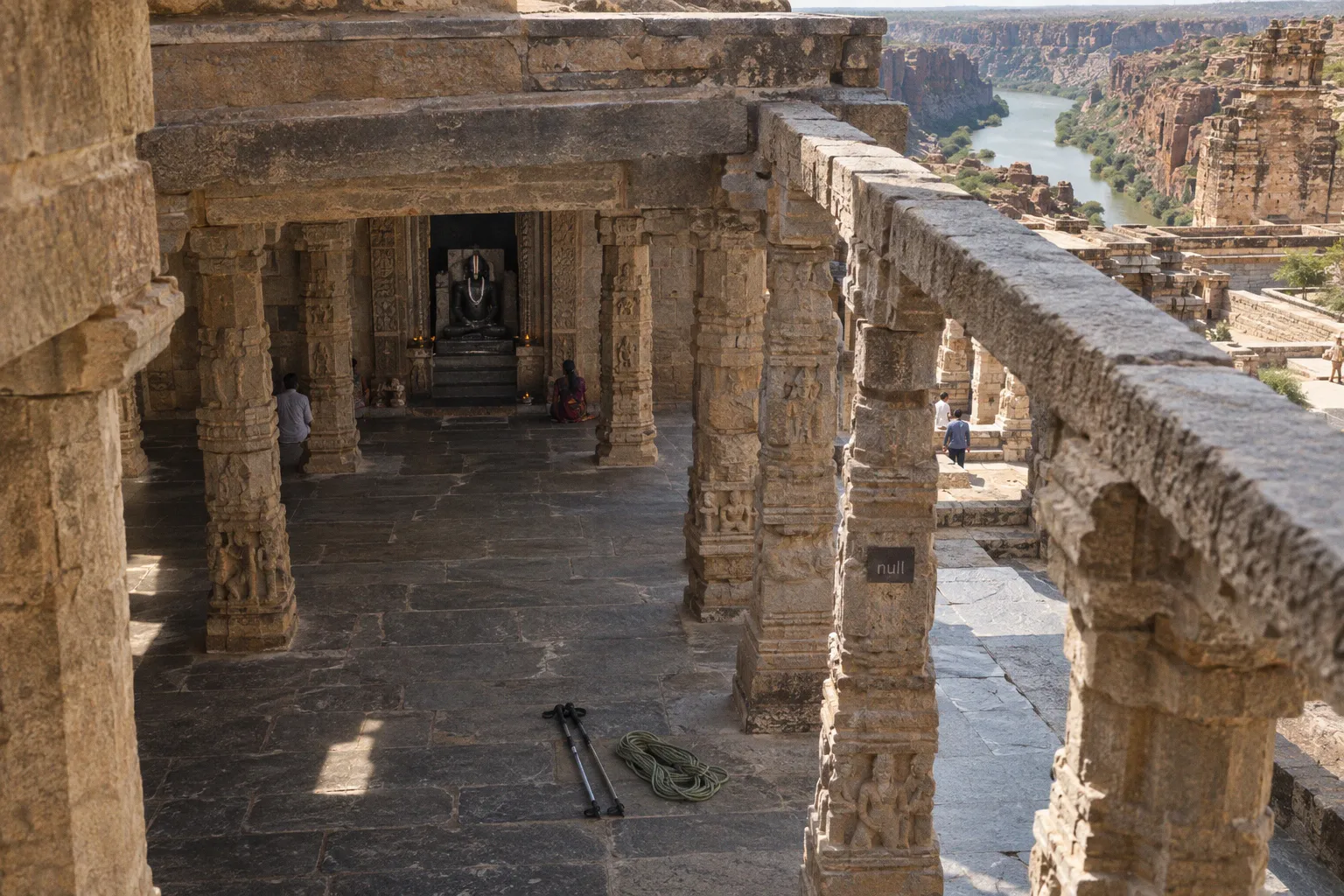
Belum Caves is one of those places where timing changes the entire experience. Arrive near the middle of the day, especially on a busy weekend, and you may find yourself descending into a humid underground passage behind several groups, listening to competing guide pitches before you have even reached the cave entrance. Arrive when the site opens, and the same network of chambers becomes easier to read: the lighting is clearer, the walk is less congested, and you have more space to pause at the formations without being pressed forward.
For travellers building a Gandikota–Belum Caves route, the practical question is not simply whether to take a guided tour. It is how to distinguish the official entrance arrangement from informal services, how to budget without mistaking a suggested tip for a compulsory fee, and how to move through a long subterranean system without underestimating its heat and scale. The best strategy is straightforward: reach Belum Caves close to 10:00 AM, enter through the official ticketing process, and treat any additional guide payment as a voluntary decision rather than an automatic part of admission.
The strategic advantage of arriving at opening time
Belum Caves operates from 10:00 AM to 5:00 PM throughout the year. That seven-hour window looks generous on a map, but it narrows once you account for the journey from Gandikota, the time required to walk through the public cave route, and the underground conditions that make a slow visit more comfortable than a rushed one.
The first visitors of the day have three practical advantages:
- The entrance area is generally calmer, so you can buy tickets and orient yourself before the main flow of visitors develops.
- The underground paths are less likely to be congested by school groups, family parties, or weekend tour clusters.
- You have more control over your pace, which matters when the route narrows, bends sharply, or descends towards deeper chambers.
This is particularly useful if Belum Caves forms part of a wider Rayalaseema road trip rather than a single-destination excursion. A late start at Gandikota can push the cave visit into the busiest part of the day, leaving you to negotiate both visitor traffic underground and the return journey afterwards. By setting Belum Caves as the first substantial stop, we create a route with more room around it: arrival at opening, a measured exploration, a break outside, and then onward travel towards the next destination.
The most useful phrase to keep in mind when planning is Belum Caves peak hours to avoid. The answer is not a precise, officially published crowd chart; it is a planning principle. Avoid arriving at the centre of the operating day when you can, and be especially cautious about weekends and public holidays, when the site may receive a more concentrated visitor flow. Weekday mornings are the cleaner choice for travellers who want to examine the cave system rather than simply pass through it.
At Belum, an early start is not about seeing more in less time; it is about giving the underground landscape enough quiet for its structure to become legible.
Why the first hour matters underground
Belum Caves extends for 3,229 metres in total, although the public walking route is much shorter, at approximately 1.5 kilometres. That distinction is easy to miss when planning from a tourist map. You are not walking the full surveyed length of the cave, but you are still entering a substantial geological system with descending passages, chambers, low sections, changing air movement, and a route that repeatedly turns away from the entrance.
The cave’s deepest point, Pataalaganga, lies around 120 to 150 feet below entrance level. The descent is not an extreme expedition, and the public areas are equipped with installed lighting and night-vision CCTV, but the depth changes how the visit feels. The air becomes more enclosed, the humidity is more noticeable, and stopping for photographs can create small bottlenecks when other groups are moving behind you.
A morning visit gives you greater freedom to pause at the principal points along the route. You can look across a chamber, identify how the passage is flanking the central walkway, and notice the difference between naturally shaped rock surfaces and later visitor infrastructure. In a crowded group, those details disappear under the practical pressure of keeping pace.
Entrance fees: what admission covers and what it does not
The official entrance fee is uncomplicated:
| Visitor category | Official entrance fee |
|---|---|
| Indian adult | ₹50 |
| Foreign visitor | ₹300 |
| Child | ₹35 |
These are the published admission figures used for planning a Belum Caves visit. They should not be confused with separate charges that may apply to parking, storage, photography equipment, or other site services, because those additional rates are not established by the available information here. In practical terms, budget the entrance ticket separately and do not assume that it automatically includes every service offered around the site.
The difference between the Indian and foreign visitor rates is substantial enough that international travellers should account for the correct category before arriving. Carrying a clear payment plan is useful, but the larger issue is conceptual: the ticket is the official gateway to the cave, not a bundled package that necessarily includes a private escort, special photography access, vehicle arrangements, or a customised underground itinerary.
This is where hidden costs of Belum Caves guides can begin to appear. A person near the entrance may offer to accompany you and present a price as if it were part of the standard process. That does not mean the official ticket is incomplete, nor does it establish that a guide is mandatory. The safest response is to separate the questions:
1. What is the official entrance fee for my visitor category?
2. Is the person offering assistance part of the formal site operation?
3. Is the additional payment a fixed official charge, a private arrangement, or a discretionary tip?
4. What exactly will the service add to the visit?
You do not need to turn the entrance into a negotiation. A calm request for the official ticket price and a clear explanation of any additional service is usually enough to restore the boundary between admission and informal assistance.
The difference between a guide fee and a tip
Official guide services inside the caves do not carry a fixed mandatory charge according to the available site information. Local guides may nevertheless expect a tip, commonly in the range of ₹80 to ₹100, if they accompany visitors and provide interpretation. That expectation is not the same as a compulsory fee written into the entrance ticket.
This distinction matters because visitors often accept the first price they hear while still standing outside the monument, where the spatial confusion of the cave has not even begun. If you choose to walk with a guide, agree on the nature of the arrangement before entering. If you prefer to explore independently, the cave has installed lighting along public pathways and night-vision CCTV, and a paid private guide is not required simply to enter or navigate the visitor route.
The right question is therefore not whether guides are useful in the abstract. It is whether this particular guide is offering information that you value, at a price you understand, for a route you already know is open to visitors without a mandatory private escort.
Debunking the mandatory-guide myth
The idea that visitors will inevitably get lost inside Belum Caves is one of the most effective ways to create unnecessary pressure at the entrance. It also misunderstands how the site is managed. The public pathways are lit, and CCTV has been installed through the cave system. These arrangements do not transform the site into a simple indoor attraction—the route still descends, turns, and passes through an environment with real underground scale—but they mean that independent exploration is possible.
A guide can add value in several circumstances. Someone familiar with the cave may point out formations that a hurried visitor would overlook, explain local names, or help a group move more efficiently through the accessible route. For travellers interested in geology, the guide’s interpretation may make the difference between seeing a series of dark walls and understanding how water, pressure, and time have shaped a subterranean corridor.
But usefulness is not the same as obligation.
If a guide approaches you before ticketing and says, in effect, that entrance or safety depends on hiring them, treat that as an informal claim rather than an established rule. Complete the official ticket process first. Then decide whether you want interpretation. This order is important because it puts the monument’s formal access arrangement before the informal sales pitch.
The cave is long enough that independent visitors should still behave with discipline. Stay on the public path, keep your group together, avoid entering restricted or unlit areas, and do not treat the presence of lights as permission to wander beyond the visitor route. Navigation is manageable when you respect the route; it becomes poor practice when visitors mistake a managed public corridor for an unrestricted exploration zone.
When paying for a guide makes sense
A guide may be worth the tip when:
- You want the names and local stories associated with individual chambers and formations.
- You are travelling with children or older relatives and prefer someone to regulate the pace.
- You are especially interested in the geological character of the cave and want explanations rather than a self-directed walk.
- You are short on time and want help identifying the principal sections without lingering at every turn.
- You are comfortable confirming the arrangement before the walk begins.
A guide is less essential when your priority is simply to experience the cave at your own pace, photograph the public spaces, and read the landscape through observation. The installed lighting makes the principal route accessible without forcing every visitor into a paid group.
This is also why the phrase Belum Caves guided tour traps and timing should be understood as two connected issues rather than separate search terms. The earlier you arrive, the less pressure you are likely to face from a crowded entrance and the easier it becomes to make a considered choice. Timing gives you negotiating space—not necessarily in the commercial sense, but in the basic sense of having a moment to understand what is being offered.
Managing humidity, depth, and cave navigation
The cave’s underground temperature may feel more pleasant than the exposed landscape around Gandikota, but cooler does not mean dry or effortless. Humidity becomes more apparent as you descend, and the enclosed atmosphere can make a steady walk feel heavier than its distance suggests. The public route is about 1.5 kilometres, yet distance alone does not describe the experience: stairs, bends, pauses, uneven visual conditions, and the need to let other groups pass all shape the rhythm.
Wear footwear suited to firm walking rather than loose sandals that shift on steps. Carry water for before and after the cave visit, and keep your belongings compact enough that they do not strike the walls or obstruct people in narrower passages. A small phone or camera is easier to manage than a large shoulder bag, especially when the route bends through confined sections.
The principal navigation mistake is to treat the cave as a sequence of isolated photo stops. Its character comes from the way the passages intersect and descend, with one chamber opening towards another and the visitor route repeatedly changing orientation. If you move too quickly from landmark to landmark, you may remember individual formations without understanding the spatial relationship between them.
A better approach is to use the route as a continuous section through the rock:
1. Begin by noting the direction of the main public path rather than immediately stopping for photographs.
2. At wider chambers, step aside before looking upwards or setting up a camera, allowing the moving line behind you to continue.
3. Pay attention to where the floor descends, where the ceiling lowers, and where the passage widens again; these changes help you remember the route.
4. Keep the deepest sections as part of a measured progression, not as a reason to rush ahead of your group.
5. On the return, notice how familiar spaces change when approached from the opposite direction.
Pataalaganga, located roughly 120 to 150 feet below the entrance level, gives the visit a clear sense of vertical scale. You are not merely walking into a shallow rock shelter; you are traversing a layered underground environment whose depth is part of its identity. That is why a generous schedule is more useful than an aggressive one. A hurried visitor may technically complete the route and still fail to register the cave’s structure.
Photography without creating a bottleneck
The installed lighting along public pathways allows visitors to see the route without relying solely on phone torches, but the light is functional rather than designed as a studio setup. Expect contrasts between illuminated surfaces and darker recesses. Phone cameras may struggle in those transitions, particularly when visitors are moving behind you and you have only a short time to compose an image.
The most considerate method is to photograph in wider sections, keep exposure adjustments brief, and avoid stopping at the centre of a passage. If a formation catches your attention in a narrow corridor, move to the nearest open point before studying it. This small change makes a considerable difference on busy days, when one stationary group can interrupt the movement of everyone behind it.
There is no verified standard government price chart available here for private photography equipment beyond ordinary cameras and smartphones. Do not assume that a person offering a special photography arrangement at the entrance is quoting an official site-wide tariff. Ask what the fee covers, and distinguish it from the regular admission ticket before handing over money.
Planning the 61-kilometre journey from Gandikota
Belum Caves lies approximately 61 kilometres from Gandikota Fort, making it a natural extension of a Gandikota canyon itinerary. The distance is close enough to connect the two attractions in one route, but it is not so short that you can treat the transfer as an incidental hop between viewpoints. The departure time from Gandikota determines whether Belum becomes a calm morning visit or a crowded midday stop.
If Belum is the priority, leave Gandikota early enough to approach the cave near its 10:00 AM opening. This arrangement works particularly well for travellers who have already spent the previous evening around the fort and canyon, because the early departure converts the overnight stop into a practical staging point rather than forcing you to retrace the day’s route later.
A sensible day structure looks like this:
- Early morning: Depart from the Gandikota area, allowing room for navigation and an unhurried arrival.
- Around 10:00 AM: Reach Belum Caves as the visitor facilities open and complete the official ticketing process.
- Late morning: Walk the public underground route at a measured pace, with time for photographs and pauses in wider chambers.
- After the cave visit: Take a break before continuing towards the next destination rather than combining the underground walk immediately with another demanding excursion.
- Afternoon: Choose between a return towards Gandikota, a wider Kadapa sightseeing route, or a continuation through the Rayalaseema circuit, depending on the rest of your itinerary.
The nearest major railhead is approximately 35 kilometres away at Tadipatri, which may be useful when building a broader arrival or departure plan. It does not, however, remove the need to think through the last road segment. Belum Caves, Gandikota, Mylavaram Dam, and the surrounding geological landmarks are distributed across a large landscape rather than arranged along a compact urban sightseeing corridor.
This spatial arrangement rewards travellers who group destinations by direction. A plan that zigzags between the canyon, the caves, the reservoir, and distant town stops can consume more of the day in transit than on foot. A plan that treats Gandikota and Belum as connected anchors has a clearer geographic logic, after which the next stop can be selected according to the direction of travel rather than added as an isolated attraction.
Belum as part of a wider geological route
Belum Caves and Gandikota tell different parts of the same broad travel story. At Gandikota, the landscape is read horizontally through the Pennar Gorge, fort walls, cliff edges, and exposed rock. At Belum, the direction changes: the route turns inward and downward, and the traveller reads the landscape through passages, chambers, erosion patterns, and the pressure of enclosed space.
That contrast is what makes the circuit more than a checklist of monuments. You move from a canyon shaped as an open dramatic corridor to a cave system where the corridor is hidden inside the ground. Mylavaram Dam and the Owk reservoir region add another register to the journey, shifting attention towards water management, open views, and the relationship between engineered structures and the dry terrain of Rayalaseema.
The practical consequence is that Belum should not be squeezed into the final exhausted hours of a long sightseeing day. Its underground conditions deserve a visitor who still has attention to spare. The cave is not difficult because it demands technical climbing; it is demanding because its scale and humidity encourage a slower form of looking.
A calm entrance strategy for independent travellers
The simplest way to avoid tourist pressure at Belum Caves is to remove uncertainty before you arrive. Know the official opening hours, know the admission price for your category, and know that a private guide is not a mandatory condition of entry. With those three points settled, an unofficial offer becomes a choice rather than a surprise.
At the entrance, keep the process orderly:
- Go first to the official ticketing point rather than agreeing immediately to services offered outside it.
- Confirm the admission amount for your visitor category.
- Ask whether any proposed guide payment is an official fixed charge or a discretionary tip.
- Decide whether you want interpretation, assistance with pacing, or simply access to the public route.
- Keep separate cash for the ticket and any guide tip you independently choose to give.
- Do not allow urgency at the entrance to dictate a service you did not plan to buy.
This is not a call to distrust every local guide. The cave has a depth and complexity that can reward explanation, and a knowledgeable guide may make the route more meaningful. The point is to preserve the difference between hospitality, interpretation, and pressure. A visitor who wants a guide should be able to choose one with clear expectations; a visitor who prefers to walk independently should not be made to feel that official access depends on an unverified extra payment.
Likewise, avoid making claims about services that are not confirmed. Ticket prices do not automatically establish parking charges, luggage storage rates, or special equipment fees. Belum Caves is best approached with a clear admission budget and a willingness to ask direct questions when a separate service is introduced.
The best time of day for Belum Caves
For most independent travellers, the best time of day for Belum Caves is the opening period, beginning at 10:00 AM, preferably on a weekday. This timing does not guarantee an empty site, and it should not be treated as a promise of perfect conditions. It simply gives you the strongest practical position: fewer accumulated groups, more freedom to navigate the public route, and more daylight hours remaining for the road journey afterwards.
If you cannot arrive at opening, aim to avoid the busiest middle portion of the day where possible, particularly during weekends and holiday periods. The later you enter, the more carefully you should protect time for the walk itself rather than allowing the entrance process, guide discussions, and photography stops to consume the available afternoon.
The final return through the cave can also be a useful moment for observation. Rock surfaces that looked dramatic from the first approach may appear more intelligible when seen from the opposite direction, while the route’s changes in width and elevation become easier to remember. That is one reason not to treat the visit as a race to the deepest point. Belum is a mapped system of passages, not a single viewpoint at the end of a corridor.
Plan your arrival for the clearest light outside the cave and the quietest practical conditions inside it; once you have made that decision, the rest of the visit becomes much easier to navigate.