Belum Caves to Gandikota road trip: essential travel checklist
The sixty-kilometre stretch between Belum Caves and Gandikota looks deceptively straightforward on a paper map.
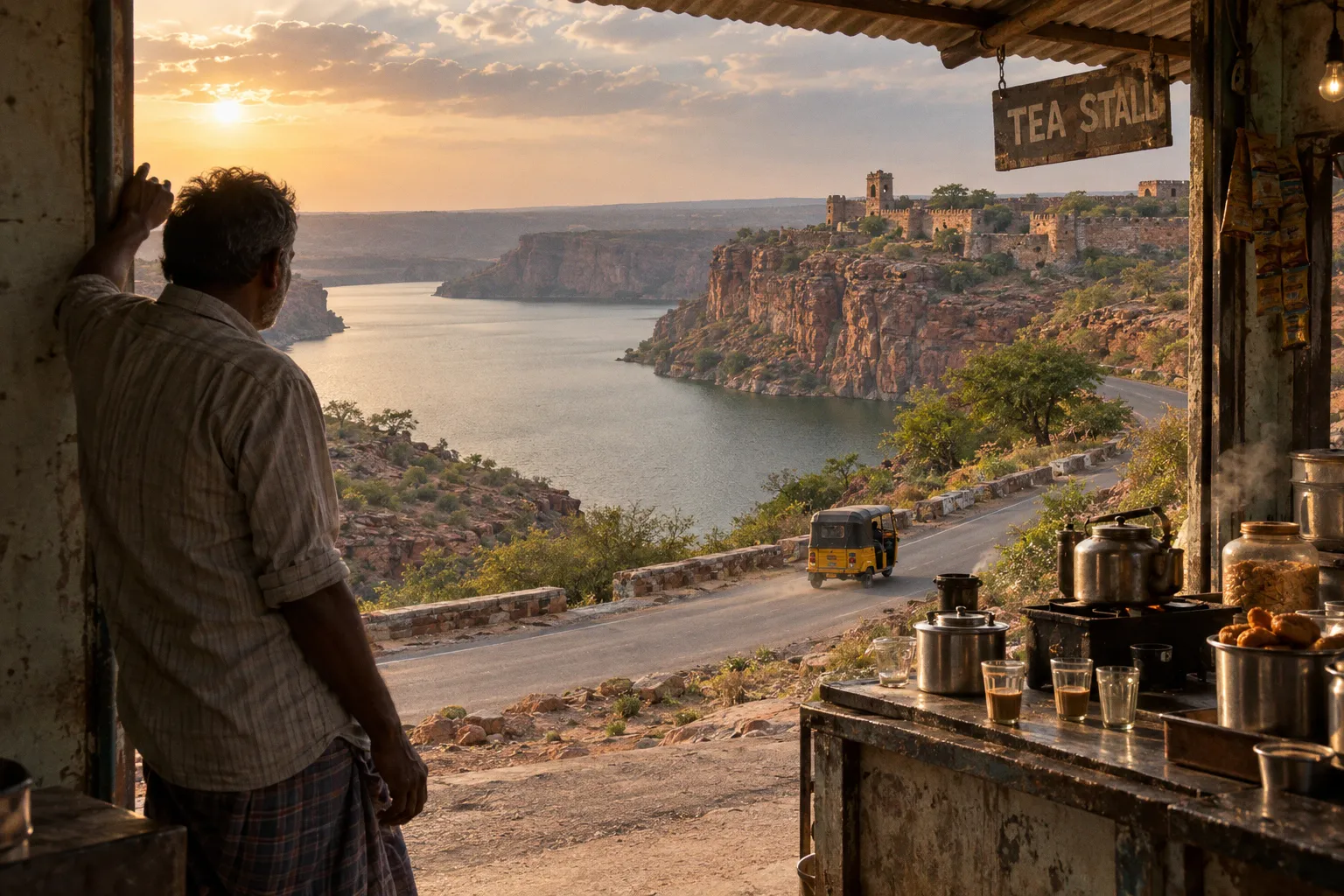
It is short enough to suggest an easy hour behind the wheel, yet remote enough for a missed fuel stop, a slow village crossing or a wrong turn to reshape the entire day.
The journey is a direct overland connection across the Rayalaseema plateau, with Belum Caves lying northwest of Gandikota. The two destinations are close in distance but very different in character: one takes you underground through limestone chambers, while the other opens onto a red-quartzite gorge cut by the Pennar River. The map makes them look easy to combine. The schedule requires more thought.
The practical question is not simply how to get from Belum to Gandikota. It is when to enter the caves, when to leave, how much driving time to allow, where the road is likely to slow down and what you should have in the vehicle before the reliable services of the larger towns fall behind you.
Navigating the 60km Route: Road Conditions and Travel Time
The first decision is whether you treat the drive as a quick transfer or as the backbone of a longer Rayalaseema day. The official distance is usually given as approximately 60 to 61 kilometres. A driver making no stops and encountering little traffic may cover it in about an hour. That is the optimistic version.
Most travellers should plan for closer to ninety minutes. The road is not a divided highway, and the nominal distance does not account for cattle crossings, tractors, agricultural vehicles, local traffic, market-town slowdowns or short pauses to confirm the route. A vehicle moving slowly in front of you can matter more here than an extra ten kilometres on the map.
Plan for ninety minutes rather than hoping for sixty.
The direct Belum–Gandikota corridor is generally manageable in a car, but it demands a different style of driving from an urban commute. Some stretches may feel open and fast, then narrow around settlements or become less comfortable when traffic is moving in both directions. Overtaking requires patience and clear visibility. A route that appears almost empty on a phone screen can still contain livestock, pedestrians, motorcycles and farm vehicles using the same road.
The most common navigational mistake is allowing a mapping app to choose an obscure “shortest route” through minor roads. A saving of a few kilometres is rarely worth introducing unmarked junctions, rougher surfaces or uncertainty about whether the road remains suitable for your vehicle. Keep the destination set correctly, check the route before departure and download an offline map rather than relying entirely on a live signal.
The final approach to Gandikota can also feel slower than expected. Once the broad road gives way to local access roads near the destination, navigation becomes less about speed and more about recognising the correct turn, following visible local directions and allowing for pedestrians or livestock. Do not schedule your arrival so tightly that a short delay leaves you reaching the canyon after the light has gone.
Treat the drive as the spine of the day, not the connective tissue between two attractions. Everything else in this itinerary works better once that decision is made.
The timing that actually works
The cave schedule determines the road schedule. Belum Caves opens at 10:00 AM, so a plan that begins with a complete cave visit before an early departure is not realistic. The useful sequence is to arrive before opening, enter at 10:00 AM and leave once you have returned to the surface.
For a straightforward day, reach the entrance around 9:45 AM. That leaves time for parking, tickets and a short pause before the visit begins. Allow roughly ninety minutes for the publicly accessible section, then leave enough time for water, photographs and reorganising your belongings before getting back into the vehicle.
A departure around noon places you in the Gandikota area during the early afternoon, assuming ordinary road conditions. That gives you time to visit the fort complex, walk towards the canyon viewpoints and stay for the later light without turning the entire day into a race.
The schedule is less dramatic than trying to force Belum into an imaginary early-morning slot, but it is workable. It also prevents a more serious mistake: arriving at the caves after midday and discovering that the visit has consumed the window you intended to reserve for Gandikota.
The canyon often becomes more expressive later in the day. Lower sunlight can bring out the layered geometry of the red-quartzite cliffs and add depth to the Pennar gorge. Reaching the viewpoint in the middle of the afternoon is still worthwhile, but the walls may look flatter and less defined than they do closer to sunset. That is not necessarily a problem with the landscape. It may simply be a timing problem.
Mastering the Belum Caves Experience: Timing and Access
Before road conditions become relevant, you have to negotiate the cave itself. Belum Caves operates on its own timetable, and the opening time is the first fixed point in the itinerary. The site is generally open from 10:00 AM to 5:00 PM, with last entry usually permitted around 4:30 PM. For a Belum-to-Gandikota road trip, the morning opening is the useful part of that window.
If you enter at 10:00 AM, you have enough time to explore the accessible sections without turning the visit into a race. If you arrive at noon, you still have time underground, but the remaining drive and the best canyon light begin competing with the cave. Arriving at three leaves very little flexibility, particularly if you want to reach Gandikota on the same day.
| Practical detail | Working plan |
|---|---|
| Opening hours | 10:00 AM–5:00 PM, with last entry usually around 4:30 PM |
| Total mapped cave length | Approximately 3.2 km |
| Publicly accessible section | Approximately 1.5 km |
| Deepest point, Patalaganga | About 120 feet underground |
| Time to allow for a normal visit | Roughly 90 minutes |
| Useful departure target | Around noon for a relaxed onward drive |
The publicly accessible stretch passes through chambers including Kotilingalu Chamber and Patalaganga. The descent is gradual but persistent, and the humidity becomes more noticeable as you move farther underground. This is not a technical cave expedition, but it is more physical than the entrance suggests. You will be walking, descending, climbing back and moving over surfaces that may feel uneven or slippery.
Wear footwear with reliable grip rather than treating the visit as a casual stroll. Carry water, keep your phone protected from moisture and allow your eyes a moment to adjust when moving between bright outdoor light and darker passages. A phone camera may fog as you descend, while low light makes it harder to notice poor footing until it is too late.
A practical morning sequence looks like this:
1. Arrive at Belum Caves before 10:00 AM, allowing time for parking and tickets.
2. Begin the visit at the official opening rather than planning around an earlier entry.
3. Allow about ninety minutes for the accessible route, with flexibility for longer stops in the larger chambers.
4. Return to the surface around 11:30 AM and take a proper break before driving.
5. Leave for Gandikota around noon, keeping the later afternoon available for the fort and canyon rim.
The main principle is simple: do not build the itinerary around a cave visit that starts before the caves open. Belum’s timetable is fixed; the road trip should be organised around it.
Logistical Realities of the Rayalaseema Circuit
The Belum-to-Gandikota corridor is easiest with a vehicle. Public transport is possible, but it is not as simple as stepping from one attraction to a bus that goes directly to the next. Connections may involve larger regional towns, waiting periods and schedules that do not line up neatly with the cave opening time or the desired canyon light.
If you are travelling by bus, treat the journey as a slower regional transfer rather than a short sightseeing hop. Build in tolerance for delays, keep the plan flexible and avoid making a fixed sunset arrival the central promise of the day. A missed connection can turn a manageable route into a full-day logistics exercise.
For most visitors, the realistic choices are:
- A self-drive rental car. This gives you control over departure times and stops, but check the rental company’s restrictions before booking. One-way drop-offs at a remote destination may not be available, and a vehicle collected in one city cannot automatically be left near Gandikota.
- A hired car with a local driver. This is often the least stressful option on a road where livestock, tractors, town traffic and changing surfaces matter more than the nominal distance. A driver who knows the area can also make better judgements about fuel and the final approach.
- A motorbike. This suits riders who are comfortable with heat, dust, exposed roads and a long day in the saddle. Fuel planning becomes more important, and the option is less forgiving if you are carrying camping equipment or travelling during the hottest part of the day.
- Public transport with local connections. This can work for travellers who prioritise cost and do not mind uncertainty. It is a poor match for a tightly timed itinerary built around a particular sunset or accommodation check-in.
The vehicle changes the character of the trip. A car with a driver allows you to leave the caves without immediately thinking about navigation or fatigue. A self-drive car gives you freedom to pause or alter the schedule. A motorbike makes the plateau feel more immediate, but it also exposes you to every hot stretch, crosswind and rough patch.
Seeing the route as a circuit
The Belum–Gandikota drive becomes more rewarding when it is treated as part of a wider Rayalaseema circuit rather than as empty space between two attractions. The landscape changes sharply over a relatively short distance: Belum is defined by limestone dissolution and an underground environment, while Gandikota shifts the focus to red rock, open plateau and a gorge cut through the terrain.
That contrast is one of the reasons the route deserves time. The destinations are not interchangeable viewpoints, and the road is not merely a technical link between them. Belum asks you to slow down underground, where distance and direction become difficult to read. Gandikota does the opposite, opening the landscape into a broad horizon and a dramatic drop towards the Pennar gorge.
If you are planning a larger circuit, avoid stacking too many major stops into the same day. A route that includes the caves, Gandikota, a reservoir or dam visit and a long onward transfer may look efficient on a map but leave little time at any of them. The region rewards fewer stops with better timing.
Securing Your Stay: Gandikota Accommodation Strategies
Gandikota’s accommodation options are limited, so the overnight decision should be made before the rest of the itinerary is fixed. The primary option near the fort and canyon is the APTDC-run Haritha Resort. Its main advantage is location: you are close enough to return to the canyon area for changing light without adding a separate long drive.
The rooms are functional rather than luxurious, and availability is limited. That combination is not a reason to dismiss the resort; it is a reason to book before building the trip around it. Staying nearby changes the rhythm of the visit. You can rest during the hottest part of the afternoon, return towards the fort later and avoid treating the canyon as one rushed stop between check-in and dinner.
The main alternative is to stay in Proddatur, roughly 35 kilometres away in the direction of Kadapa. Proddatur offers more commercial accommodation and a broader range of comfort and price points. It is a sensible fallback when Haritha is full or when you prefer to stay in a town with more services.
The trade-off is time. The drive from Proddatur to the canyon takes about forty-five minutes each way, making sunrise or sunset viewing dependent on an early start, reliable transport and a willingness to repeat the road after a long day.
| Accommodation strategy | Best for | Trade-off |
|---|---|---|
| Haritha Resort near Gandikota | Easy access to the fort and canyon, especially for sunrise or sunset | Limited inventory and functional rather than luxurious rooms |
| Hotels in Proddatur | More choice, town services and a wider range of comfort | About forty-five minutes by road to the canyon |
| Camping at Gandikota | Travellers carrying their own equipment and prioritising proximity to the landscape | Exposure to weather and less predictable facilities |
Camping offers a different kind of access, but it should not be treated as a guaranteed substitute for a room. Conditions are exposed, facilities may be limited and the experience depends heavily on what you bring. A lightweight day trip and an overnight camping setup are different logistical undertakings.
Whichever option you choose, do not assume that walk-in availability will solve the problem. The resort can fill on weekends and during holiday periods, while town hotels may become busy because of local events. Reserve ahead during the dry season and allow more lead time if your visit overlaps with Sankranti or another regional holiday.
If the Haritha Resort is full, Proddatur is a sensible fallback—but treat the extra forty-five minutes as part of the day’s rhythm, not as a minor detail.
Essential Provisions for Remote Andhra Pradesh Travel
This is where the checklist earns its name. The corridor between Belum and Gandikota is not impossibly remote, but it is remote enough for small omissions to become inconvenient quickly. The route rewards people who have dealt with water, fuel, cash and navigation before leaving the cave area.
Water and food
The cave descent, bright plateau and drive that follows all make hydration more important than it first appears. Carry enough water for the full day rather than relying on a refill point appearing precisely when you need one. Two litres per person is a sensible working allowance for a full day in this environment, particularly in hot weather or when the caves are combined with walking around the fort.
Food planning deserves similar attention. Roadside stalls and local eateries may be available, but there is no guarantee that a convenient or comfortable meal stop will appear at the moment hunger sets in. Carry something simple for the gap between the cave visit and the afternoon stop. A planned meal is better than waiting until everyone is tired, dehydrated and unwilling to continue.
If you are staying at Gandikota, check what food arrangements are available before arrival. Remote accommodation does not always operate like a city hotel with late-night room service and a choice of nearby restaurants.
Fuel
Fill the tank before committing to the more remote part of the journey. Fuel stations are less frequent outside the larger towns, and late-evening availability should not be taken for granted. Do not leave refuelling until the gauge is close to empty simply because the remaining distance looks short.
A full tank is not only about covering the planned kilometres. It gives you room to make an unplanned detour, wait in traffic, use the air conditioning or drive back to your accommodation after sunset without turning the final stretch into a calculation.
Cash
Digital payments are increasingly common, but small roadside businesses, parking attendants and local services may still expect cash. Keep rupees in smaller denominations for food, parking and minor expenses. Do not assume that a card terminal will be working at a remote ticket counter or that mobile data will be available at the exact moment a payment is due.
It is also worth separating some cash between bags or keeping an emergency amount in the vehicle. This is less about the expected cost of the day than about avoiding a needless search for an ATM when the route is already taking longer than planned.
Phone signal and offline maps
Coverage is generally more dependable on the main road than on smaller roads around the final approach to Gandikota. Gaps can occur, and the last thing you want is to be recalculating the route at an unmarked junction with a nearly empty battery.
Download offline maps before leaving the larger towns. Mark the accommodation, the cave entrance, the Gandikota fort area and any planned fuel or meal stop. Carry a charging cable and a power bank, especially if the phone is also being used for photographs and navigation.
Do not wait until you reach the canyon to discover that the accommodation pin is saved incorrectly. Check the route while you still have a reliable connection and keep the booking details available offline.
Clothing, footwear and sun protection
Belum Caves and Gandikota require different clothing decisions. Underground, the surfaces can be damp and the passages uneven. Outside, the plateau can be bright, hot and exposed. Comfortable walking shoes with grip are more useful than sandals designed only for a short town stroll.
Carry a hat, sunscreen and a light layer that protects against sun without making the cave visit uncomfortable. Sunglasses help outside but will need to be removed underground. If you are camping, add a torch, spare batteries, a groundsheet and enough water for the night rather than assuming that a basic daypack will cover the same needs.
What to keep accessible in the vehicle
Do not bury every useful item under luggage. Keep a small day bag within reach with:
- Drinking water and a simple snack
- Tickets, identification and accommodation details
- Cash in smaller denominations
- A phone, charging cable and power bank
- Sunglasses, sunscreen and a hat
- Walking shoes or sandals with dependable grip
- Basic medication and any personal prescriptions
- A small rubbish bag so the vehicle and roadside remain clean
The aim is not to overpack. It is to avoid unloading the entire vehicle every time somebody needs water, a phone charger or a layer for the evening.
Building a day that does not unravel
The strongest Belum Caves to Gandikota road trip logistics are not complicated. Arrive before the caves open, visit Belum at the beginning of the official window, allow ninety minutes for the direct drive rather than an idealised hour and protect the later afternoon for Gandikota.
The route is short, but the day is not. The cave visit involves walking and humidity; the drive requires patience; the canyon is best appreciated when you are not racing to check in or catch a connection. Accommodation should be reserved before arrival, fuel should be handled early and the essentials should be in the vehicle before the road becomes less convenient.
That is the practical shape of driving from Belum Caves to Gandikota: not a difficult transfer, but a journey that becomes noticeably better when its small uncertainties are dealt with in advance. The landscape is dramatic enough without adding avoidable logistical drama.