Jammalamadugu to Gandikota transport: avoiding local overcharges
The road from Jammalamadugu to Gandikota is only about 14–18 km. That distance does not guarantee a simple transfer. Gandikota’s last-mile transport is controlled by a small local market, fixed bus departures, and direct fare negotiation.
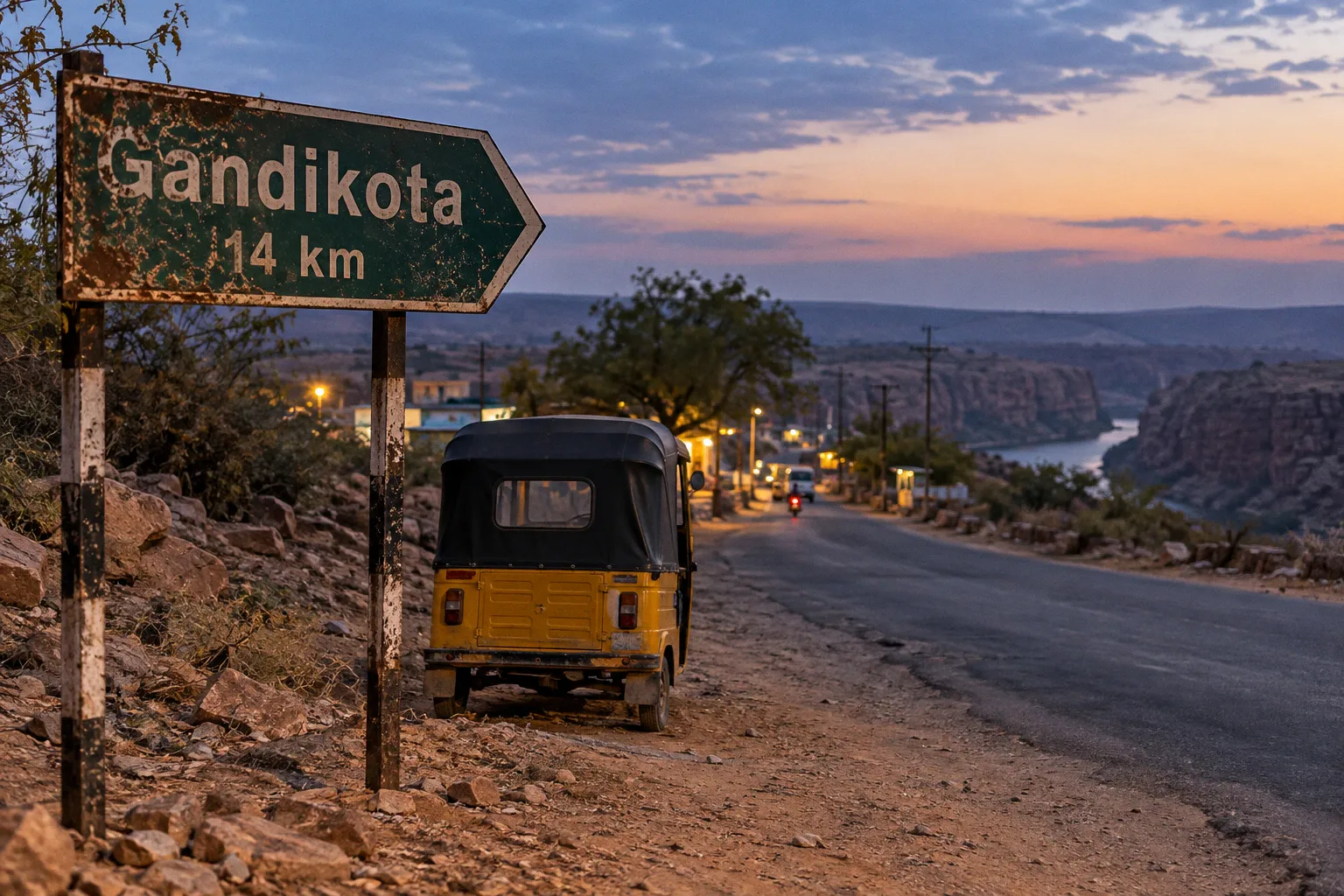
Visitors who arrive without a route plan are easy targets for inflated auto-rickshaw and taxi quotes.
The practical baseline is clear. A standard auto-rickshaw or taxi between Jammalamadugu and Gandikota generally falls around ₹250–₹350 under normal negotiated conditions. The APSRTC connection is cheaper, but it runs at designated times rather than at short intervals. Miss the bus and your bargaining position deteriorates immediately.
The correct approach is to treat Jammalamadugu as a transit junction, not as the final stage of a seamless public transport network. Confirm the departure window, establish the fare before entering a private vehicle, and keep a fallback plan for the last 15 km.
Jammalamadugu is the main transfer point
Jammalamadugu is the primary road connection for visitors approaching Gandikota from larger transport hubs such as Kadapa or Muddanuru. The local railhead is approximately 17 km from Gandikota, while the bus station is roughly 15 km away. From Jammalamadugu, the remaining road distance is approximately 14.4 km.
That is close enough for a short road transfer and far enough for drivers to exploit uncertainty. The common mistake is assuming that a short distance must have a universally fixed price. It does not. Local autos and taxis typically operate through direct negotiation. Do not assume that a meter will determine the fare.
The relevant transport points are:
- Jammalamadugu Old Bus Stand: the primary location for scheduled local bus access.
- Gandhi Statue Junction: another local departure point used for buses toward Gandikota.
- Jammalamadugu rail connection: useful for road transfers from nearby railheads, but not a direct arrival at the canyon.
- Gandikota settlement and fort area: the final destination zone, where onward transport can be less predictable than in Jammalamadugu.
The difference between these locations matters. A driver waiting near a bus stand may quote a tourist rate because the traveler has luggage, limited time, and no visible alternative. A traveler who already knows the road distance and has the bus schedule written down has more leverage.
The basic cost reference
Use the following figures as a negotiation baseline, not as a guaranteed tariff.
| Transport option | Practical reference | Main limitation |
|---|---|---|
| APSRTC local bus | Scheduled service | Departure times are fixed; exact ticket fare should be confirmed locally |
| Auto-rickshaw | Approximately ₹250–₹350 | Fare is negotiated directly; unbargained quotes may be higher |
| Private taxi | Approximately ₹250–₹350 for a standard one-way transfer in ordinary conditions | Vehicle type, waiting time, and return requirements can change the quote |
| Pre-arranged private vehicle | Variable | Convenient, but the total price must include all waiting and return terms |
A quote above this range is not automatically fraudulent. It may include waiting, a return journey, multiple passengers, unusual departure timing, or a vehicle larger than a standard auto. The problem is not that every higher quote is invalid. The problem is accepting one without identifying what it includes.
Ask three basic questions before departure:
1. Is the fare for one passenger or the entire vehicle?
2. Is the quoted amount one way or round trip?
3. Does the driver wait at Gandikota, or does the fare end at drop-off?
Do not enter the vehicle and negotiate after arrival. That reverses the control structure.
The distance is short. The pricing error is usually not. Fix the fare before the vehicle moves.
APSRTC is the predictable low-cost option
APSRTC operates direct local bus services from Jammalamadugu toward Gandikota at designated times:
- 06:30
- 09:30
- 13:45
- 17:30
- 21:30
These are scheduled departures, not continuous shuttle services. There is a three-hour gap between some services and a longer gap around the afternoon and evening periods. A traveler arriving ten minutes after a departure may face a substantial wait. A traveler arriving without checking the correct stand may miss the service entirely.
The departure locations associated with this route are the Old Bus Stand and Gandhi Statue Junction. Confirm the exact boarding point locally on the day of travel. Bus operations can be affected by operational changes, local conditions, or schedule revisions. Do not treat a printed travel itinerary from an old guide as a live timetable.
How to use the bus without losing the day
The bus works best when used as part of a timed transfer from a larger town or railhead. It works poorly when treated as an improvised backup after a long journey.
A functional sequence looks like this:
1. Reach Jammalamadugu with one scheduled departure in reserve.
If you are targeting the 13:45 bus, do not plan an arrival at 13:35. Road transfers from Kadapa, Muddanuru, or a railway station can run late.
2. Locate the correct stand before handling luggage.
Ask for the Gandikota service and verify whether the bus departs from the Old Bus Stand or Gandhi Statue Junction. Do not rely on a driver’s claim that the next bus is unavailable.
3. Confirm the route destination.
Local route names and stop descriptions can be inconsistent for visitors. Use Gandikota as the destination and verify that the vehicle is not terminating short of the fort area.
4. Carry smaller cash.
The exact current ticket price is not established here. Keep low-denomination rupee notes for the bus and for any onward transfer.
5. Record the return options before leaving Jammalamadugu.
The outbound schedule does not solve the return journey. If you arrive late in the day, the 17:30 and 21:30 departures are especially relevant, but their suitability depends on your accommodation and sightseeing plan.
The bus is not the right tool for every itinerary. It is useful when cost control matters and your arrival time aligns with the schedule. It is a poor choice if you have heavy expedition equipment, a fixed canyon tour start, or a late connection from another city.
Negotiating auto-rickshaw fares from Jammalamadugu
Hiring an auto-rickshaw is the most flexible way to cover the last mile to Gandikota. It is also the easiest way to pay a tourist surcharge. Local drivers frequently quote inflated rates to visitors who ask only for the destination and not the total terms.
The fare baseline from Jammalamadugu to Gandikota is approximately ₹250–₹350 under standard negotiation. That range should be treated as a starting reference for a normal one-way ride, not a regulated meter rate. The exact current government rate for local autos is not established, and you should not assume that an official meter is operating.
A controlled negotiation sequence
Use a short, direct exchange. Long explanations signal uncertainty.
1. State the destination clearly.
Say Gandikota. If you are going to a specific accommodation, name it only after confirming the price for the general destination.
2. Ask for the total vehicle fare.
Do not ask for the price per person unless you are deliberately sharing the vehicle. A driver may interpret a vague question in the most expensive way.
3. Name your counteroffer using the known baseline.
If the first quote is substantially above ₹350, state that the normal Jammalamadugu–Gandikota range is lower and ask whether the price includes waiting or a return.
4. Define one-way or return.
A return arrangement can be useful for sightseeing, but it must be written down or repeated clearly: outbound fare, waiting period, and return fare.
5. Confirm before loading luggage.
Once bags are in the vehicle, the negotiation becomes less balanced. The driver knows you are committed.
6. If the fare remains unreasonable, walk away.
There is no requirement to accept the first vehicle. Move to another driver or use the scheduled bus if the timing allows.
The strongest bargaining tool is not aggressive language. It is an alternative. A known APSRTC departure, another available auto, or a pre-arranged taxi prevents the driver from controlling the entire decision.
What an inflated quote may contain
A higher price can be legitimate when the driver is providing more than a simple transfer. Clarify whether the quote includes:
- A return trip to Jammalamadugu.
- Waiting during fort and canyon sightseeing.
- Transport between multiple viewpoints.
- A late-night or early-morning departure.
- A larger vehicle for several passengers or bulky camping gear.
- A detour to accommodation outside the main Gandikota area.
If none of these conditions apply, a high one-way quote is simply a high one-way quote. You are not required to justify refusing it.
Last-mile connectivity to the canyon requires a time plan
Gandikota is not a single transport stop with uniform access to every point of interest. The fort, canyon viewpoints, accommodation, and camping areas may not be served by the same vehicle arrangement. A driver who agrees to take you to Gandikota may be quoting only for a point-to-point drop-off.
This distinction matters for independent travelers carrying tents, water, cooking equipment, camera bags, or climbing-related gear. An auto that is adequate for two passengers with daypacks may be uncomfortable or impractical with expedition loads. Do not plan the transfer around passenger count alone. Calculate the luggage volume.
Match the transport to the itinerary
| Itinerary type | Most efficient arrangement | Main risk |
|---|---|---|
| Bus arrival with light luggage | APSRTC from Jammalamadugu | Missing the fixed departure and needing a private ride |
| Two travelers with daypacks | Negotiated auto-rickshaw | Accepting an inflated one-way quote |
| Group with camping equipment | Pre-arranged larger vehicle | Discovering that the return or waiting period was excluded |
| Same-day sightseeing | Vehicle with agreed waiting terms | Paying separately for every short transfer |
| Late arrival | Pre-arranged private transfer | Limited bargaining options after dark |
For a basic arrival at the fort area, a one-way auto is usually the simple solution if the negotiated price is reasonable. For a full sightseeing circuit, a vehicle with waiting time may be more efficient. The price must be agreed as a package. Otherwise, each stop becomes a new negotiation.
Use specific terms:
- Pickup point: Jammalamadugu Old Bus Stand, Gandhi Statue Junction, rail approach, or another named location.
- Drop-off point: Gandikota fort area, accommodation, campsite, or another exact destination.
- Direction: one way or return.
- Waiting: included or excluded.
- Time: departure time and expected return window.
- Luggage: number of passengers and approximate bags.
- Payment: total fare and payment point.
Avoid the phrase “take us around” without defining the route. It sounds efficient but leaves every operational detail unresolved.
Private vehicles: useful for groups, risky without terms
Hiring private vehicles for Gandikota sightseeing is practical when the group has camping equipment, when the timetable does not fit, or when a return connection is time-sensitive. It is not automatically better than a bus or auto. A private vehicle removes schedule dependence but introduces price ambiguity.
The common transport scam for Gandikota tourists is not necessarily a fake vehicle. It is an incomplete quote. The driver gives a low-looking number for the first leg and adds waiting, return, or sightseeing charges later. A second version is the opposite: a high quote is presented as a complete package, but the traveler never receives a clear list of what the package covers.
Before accepting a private vehicle, establish the following in one message or written note:
- Vehicle type and passenger capacity.
- One-way or round-trip status.
- Total price in rupees.
- Pickup location.
- Gandikota drop-off location.
- Waiting time included, if any.
- Additional charge for sightseeing stops.
- Additional charge for late departure or return.
- Whether fuel and toll-related costs are included.
- Payment timing.
Do not pay the full amount in advance to an unverified local contact solely because the driver says another vehicle is unavailable. A modest deposit may be part of an arranged service, but the terms must be clear and the operator identifiable. For a simple Jammalamadugu transfer, excessive prepayment creates unnecessary exposure.
The return journey is where many plans fail
Outbound transport is easier because every option points toward Gandikota. The return journey is constrained by your departure time and by the availability of a driver willing to leave the canyon area.
If you use an auto for arrival, ask whether the driver can return at a fixed time. Do not assume that a driver will remain available after dropping you. If the driver agrees to wait, define the waiting period and the total fare before sightseeing begins.
If you use the APSRTC bus, record the available return departures locally. The known outbound schedule from Jammalamadugu does not guarantee a mirror-image timetable from Gandikota. The exact local return schedule and current ticket fare should be confirmed at the bus stand or through local transport staff.
For a same-day trip, schedule backward from the final rail or road connection. Allow time for:
- Walking from the fort or accommodation to the pickup point.
- Loading camping or photographic equipment.
- Locating the driver.
- A delayed departure.
- The road transfer back to Jammalamadugu.
- A further connection to Kadapa, Muddanuru, or another town.
Do not book a tightly timed onward connection on the assumption that a 14 km road transfer will always take the same amount of time. The distance is stable. The vehicle availability is not.
A return vehicle is not secured until the pickup time, total fare, and waiting terms are agreed. A verbal promise without those details is only a possibility.
Transport errors that are easy to avoid
Most overcharging incidents are enabled by predictable mistakes. Remove the mistakes and the negotiation becomes routine.
1. Asking only for the destination
A visitor says Gandikota and waits for the driver to set every term. The driver supplies a price with no indication of whether it covers one passenger, the entire auto, a return trip, or sightseeing.
Correction: ask for the total vehicle fare and specify one way or return.
2. Treating the first quote as the market price
The first driver near a bus stand has a location advantage. That does not make the quote standard.
Correction: compare at least one alternative when time permits. Use the ₹250–₹350 reference for a normal one-way auto or taxi transfer.
3. Assuming the bus runs continuously
The APSRTC service operates at designated departure times: 06:30, 09:30, 13:45, 17:30, and 21:30. It is not a frequent urban route.
Correction: build the journey around a specific departure and arrive early enough to locate the correct stand.
4. Leaving the return plan until sunset
The outbound ride may be easy to arrange. The return vehicle may not be waiting.
Correction: secure the return terms before leaving Jammalamadugu or immediately after arrival in Gandikota.
5. Failing to distinguish a transfer from a sightseeing hire
A driver may quote for Jammalamadugu to Gandikota and then charge separately for fort viewpoints, accommodation transfers, or return travel.
Correction: list every stop and every waiting period before the vehicle departs.
6. Loading too much equipment into an unsuitable auto
Camping equipment changes the transport requirement. A vehicle that fits two people may not fit two people, a tent, sleeping systems, water, cooking fuel, and camera equipment safely.
Correction: describe the luggage before agreeing to the fare. If the load is substantial, request a larger private vehicle.
7. Carrying no small cash
Large notes complicate low-cost bus fares and minor transport payments. They also make it harder to settle an exact negotiated amount.
Correction: carry smaller denominations before leaving the main transit hub.
A practical arrival protocol
Use this sequence for the transfer from Jammalamadugu to Gandikota:
1. At the transit hub, identify the next APSRTC departure.
Record the time and the exact boarding location.
2. Compare the bus timing with your actual arrival.
If the next bus creates an unacceptable delay, move to private transport negotiation.
3. Ask two or more drivers for a total vehicle quote.
State the passenger count, luggage, destination, and one-way or return requirement.
4. Reject undefined package language.
Terms such as “full trip” or “Gandikota tour” have no operational value unless the stops and waiting time are listed.
5. Confirm the fare before loading bags.
Repeat the number and the direction.
6. Keep the driver’s contact details if a return is planned.
Confirm the pickup time and location in advance. Do not rely on finding the same vehicle later by chance.
7. Carry a transport reserve.
Keep enough cash for a private one-way transfer if the bus is missed or the planned vehicle cancels.
8. Reconfirm the final connection before sightseeing.
A canyon visit should not end with a last-minute search for a ride back to Jammalamadugu.
The objective is not to force every ride into the lowest possible number. The objective is to pay a defined price for a defined service and prevent the fare from changing after departure.
Final transport checklist
Before leaving for Gandikota, verify:
- Jammalamadugu is the planned transfer point.
- The road distance is approximately 14–18 km.
- The APSRTC departures are recorded: 06:30, 09:30, 13:45, 17:30, and 21:30.
- The correct boarding point has been confirmed locally.
- The normal negotiated auto or taxi baseline is approximately ₹250–₹350.
- The fare is defined as one way or return.
- Waiting time is either included or excluded in clear terms.
- The vehicle can carry the full luggage load.
- The return journey has a specific plan.
- Small cash is available.
- An alternative exists if the planned bus or driver is unavailable.
Jammalamadugu to Gandikota transport is manageable when treated as a logistics problem. Use the bus when its fixed schedule fits. Use an auto or taxi when flexibility has a defined price. Hire a private vehicle for groups and sightseeing only after the complete route and waiting terms are agreed.
The final rule is strict: no vehicle moves until the total fare, destination, and return conditions are clear.