Belum Caves road trip: avoiding common tourist pitfalls
The Gandikota to Belum Caves road trip looks straightforward on the map: roughly 60 to 70 kilometres, usually covered in about 1.5 to 2 hours through Jammalamadugu and Kolimigundla.
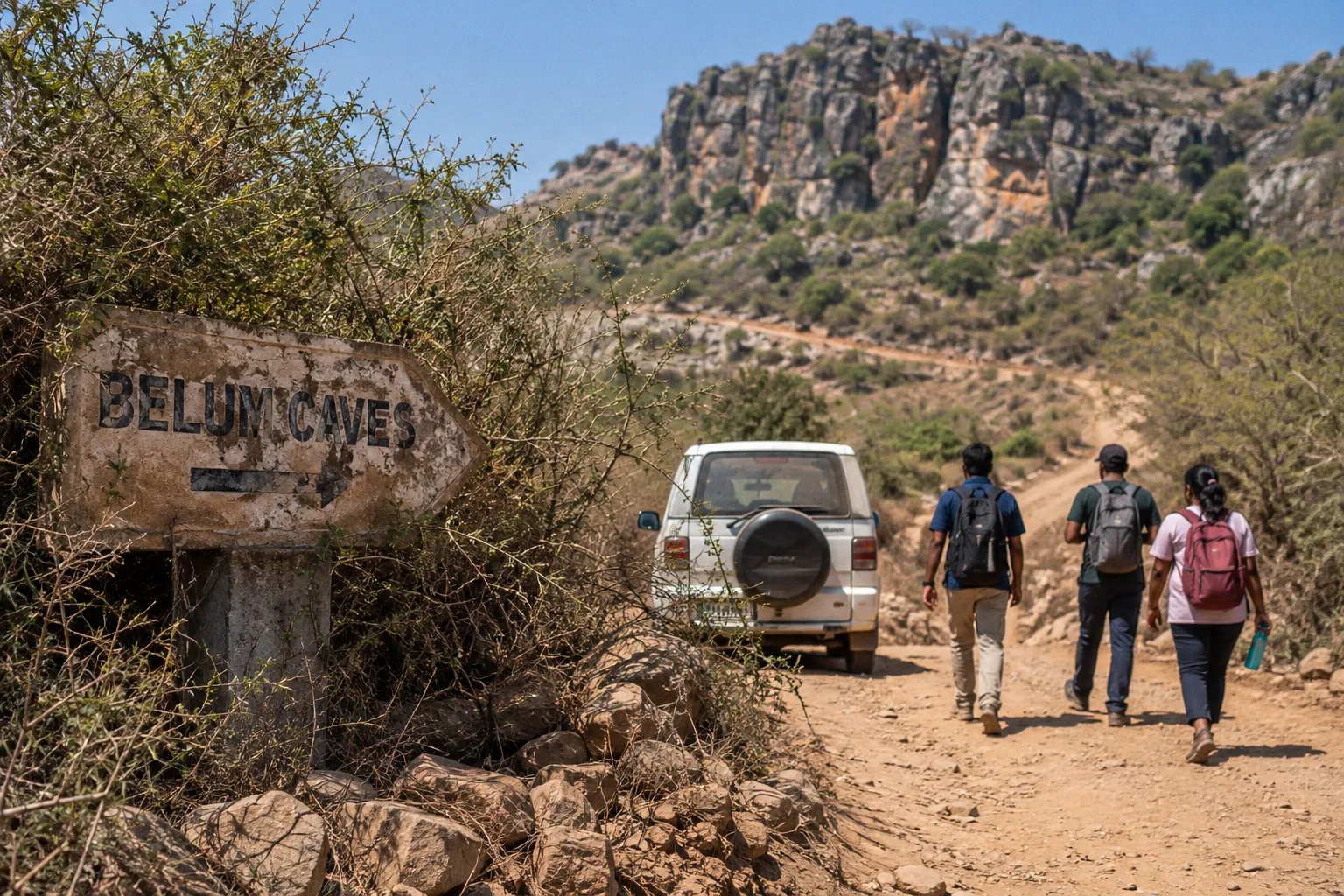
The distance is manageable, but the route becomes less forgiving when the day is poorly timed, the vehicle is arranged at the last minute, or the cave visit is treated as a quick stop between two better-known destinations.
The main navigational mistake is to think of Belum Caves as an attraction you can simply add whenever you reach the area. The caves operate from 10:00 AM to 5:00 PM, the underground passages become intensely humid as you descend, and the direct route offers very little in the way of proper food or accommodation. Good Gandikota to Belum Caves road trip logistics therefore begin before you leave the canyon: with a realistic departure time, enough water, a confirmed vehicle, and a clear understanding of how much physical effort the caves demand.
Mastering the 70-kilometre route
From Gandikota, the practical road connection to Belum Caves runs through Jammalamadugu and Kolimigundla. Depending on the exact route, road conditions, traffic, and the pace of the driver, the journey generally takes about 1.5 to 2 hours. That is the driving time alone; it does not include a breakfast stop, fuel, a delay at a junction, or the pause you may need after arriving before entering the caves.
The best route from Gandikota to Belum Caves is not necessarily the route that looks shortest on a navigation app. In this part of Rayalaseema, the useful question is whether the route remains comfortable and legible when you are driving in the stronger part of the day. A road that appears efficient on screen can become tiring when there are few shaded stopping points, limited food options, and little room for improvisation once you are away from the main towns.
Jammalamadugu is the key directional reference for the first part of the journey. From there, the road continues towards Kolimigundla and the cave complex. Rather than watching the map continuously, we can break the journey into simple spatial stages:
1. Leave Gandikota with fuel, drinking water, and food already arranged. Do not assume the cave entrance will provide a full meal later.
2. Use Jammalamadugu as the main route checkpoint. If you need fuel, a more substantial meal, or a last-minute supply, this is a better place to deal with it than the final stretch.
3. Continue towards Kolimigundla and Belum Caves without building in a late arrival. The cave site is open only between 10:00 AM and 5:00 PM.
4. Allow time to park, walk to the entrance, buy tickets, and adjust before descending. A nominal arrival at 4:15 PM is not the same as having a relaxed afternoon inside the cave.
5. Plan the return before you enter. Once you emerge tired, sweaty, and short on daylight, route decisions become less pleasant.
For travellers beginning at Gandikota, an early start usually produces a more usable day. It gives you room to reach Belum Caves near the beginning of the visitor window, when the drive is complete and the underground section can be explored without watching the clock from the first descent. If your itinerary reverses the order and you visit the caves first, the same principle applies: arrive early enough that a minor delay does not compress the entire visit into the final hour.
The route is short enough for a day trip, but not so short that you can leave the logistics until the last junction.
Why private transport makes the route easier
Private transport is the most practical arrangement for this circuit because the attractions are separated by rural roads and public connections may require transfers through Jammalamadugu or nearby towns. A pre-booked car or driver also gives you a fixed return plan, which matters when the cave visit takes longer than expected or when the heat makes you reluctant to continue immediately.
Do not treat a vehicle booking as a minor detail. A driver who knows only Gandikota may not have the same familiarity with the Belum Caves approach, and a vehicle arranged casually on the morning of departure may not be available for the full circuit. Confirm that the booking includes:
- the return journey to Gandikota or your next overnight stop;
- waiting time during the cave visit;
- the expected route through Jammalamadugu and Kolimigundla;
- fuel and toll arrangements, if applicable;
- a departure time that gets you to Belum Caves comfortably within operating hours.
The purpose is not to turn a rugged regional excursion into a rigid transport contract. It is to avoid reaching the cave entrance with no clear way back.
The underground climate is part of the itinerary
Belum Caves is not simply a cool underground attraction where the outside heat disappears. The cave environment has high humidity and limited air circulation, and the physical sensation changes as you move farther from the entrance. You may sweat heavily, feel breathless, and lose energy more quickly than the surface temperature suggests.
The explored cave system extends for approximately 3,229 metres, or about 3.2 kilometres, and the deepest point, Patalaganga, lies around 46 metres below the entrance level. You do not need to cover every passage to have a worthwhile visit, but you should understand that the route involves more than a short walk through a decorated chamber. It includes descending, traversing narrow or uneven sections, turning through branching passages, and climbing back towards the surface in conditions that may feel increasingly close and humid.
This is where many visitors misjudge the cave. The first section can feel manageable, particularly after arriving from an open road and a hot landscape. That initial comfort may encourage you to move quickly and descend farther without considering the return climb. A better rhythm is slower and deliberate: drink before entering, walk at a pace that allows steady breathing, and pause in wider chambers rather than waiting until you feel exhausted.
The cave’s depth and length are not merely statistics for a sightseeing description. They determine how you should organise the visit:
- Wear footwear with a secure grip rather than loose sandals.
- Choose lightweight clothing that remains tolerable when damp with sweat.
- Carry water in a container that is easy to handle while walking.
- Keep your phone protected from moisture and avoid relying on it as your only light source.
- Do not descend rapidly simply because another group is moving faster.
- Leave enough energy for the route back to the entrance.
The deepest section, Patalaganga, is particularly important in this respect. Reaching a low point underground can feel like the natural conclusion of the route, but it is only the midpoint of your physical effort. Every descent must eventually become an ascent, and the humid air can make that return feel more demanding than expected.
Humidity changes the pace of a guided tour
A Belum Caves guided tour timing is not just about securing a place within the 10:00 AM to 5:00 PM opening period. It also affects how much of the route you can explore comfortably. A midday visit may fit the broader itinerary, but the underground humidity can become oppressive after you have already spent the morning driving in the heat.
If your schedule allows, aim to enter closer to the beginning of the visitor window rather than treating 10:00 AM as the earliest possible moment and 5:00 PM as a flexible closing time. A late arrival leaves no useful margin for parking, ticketing, a slower group, or a deliberate visit to the deeper passages. The official visitor period should be treated as a firm boundary, not a suggestion.
You can also make the surface-to-underground transition easier by spending a few minutes in the shade before entering. Drink water before the descent, but do not overfill yourself immediately before walking through narrow or uneven passages. Once inside, take smaller, regular sips rather than waiting until thirst becomes intense.
Belum Caves rewards a measured pace; the deepest point is not impressive if you reach it already trying to recover your breath.
Understanding the entry fee without inventing a larger budget
Belum Caves entry fees are comparatively simple: Indian citizens are generally charged between ₹50 and ₹65, while foreign visitors are charged ₹300. The exact Indian ticket amount may vary within that stated range, so keep a small margin rather than arriving with the assumption that one precise figure will apply at the counter.
The ticket is only one part of the day’s cost. The hidden costs are less dramatic but more likely to disrupt the route: private transport, fuel, refreshments, and any additional stop you decide to make because the direct road offers limited dining. Visitors often focus on the ticket price because it is visible, while underestimating the cost of arranging a comfortable return from a relatively remote attraction.
A sensible budget for the visit separates expenses into three groups:
| Expense | What to expect | Why it affects the route |
|---|---|---|
| Cave entry | ₹50–₹65 for Indian citizens; ₹300 for foreign visitors | Keep a small allowance for variation in the local Indian ticket amount |
| Transport | Depends on the vehicle, route, and waiting arrangement | The driver may need to remain available during the full cave visit |
| Food and drinks | Limited choices near the entrance | Carry supplies rather than depending on a full meal at the site |
Parking and visitor traps are often discussed as though every rural attraction contains an elaborate network of charges. The more immediate problem at Belum Caves is usually not a complicated ticket structure but poor preparation: reaching the entrance without cash, assuming refreshments will be substantial, or arranging only a one-way ride because the map makes the destination look close.
Ask about the complete transport arrangement before leaving Gandikota. If you are using a driver, confirm whether waiting is included. If you are travelling independently, check your fuel level and keep enough money for the practical stops along the route. Exact local hiring rates for cave guides should not be assumed in advance, as arrangements may depend on availability and voluntary tipping rather than a single fixed public tariff.
Food is the weak point of the direct route
The road between Gandikota and Belum Caves is not lined with reliable restaurants, cafés, or full-service hotels. Near the cave entrance, visitors can generally find basic cold drinks and snack stalls, but these should be treated as supplementary provisions rather than a planned lunch stop.
This is one of the easiest pitfalls to avoid. Eat a proper meal before leaving Gandikota or stop in a larger town along the route, particularly if you are travelling with children, older family members, or anyone who finds long drives and humid underground spaces tiring. Carry food that travels well and does not depend on refrigeration, along with enough water for the drive and the cave visit.
The route requires more hydration than the distance suggests. You are dealing with a hot regional landscape outside, a long enclosed section inside, and a return drive after physical exertion. A single bottle purchased at the entrance may not be enough for the entire party, and snack stalls cannot substitute for planning.
A practical road-trip pack includes:
- drinking water for each traveller, with extra capacity for the return;
- simple food that can be eaten without a long stop;
- oral rehydration supplies if someone in the group is prone to heat exhaustion;
- a small towel or cloth for sweat;
- comfortable footwear with a firm sole;
- basic medication that travellers already use regularly;
- a bag for waste, since rural stops may not offer convenient disposal.
The aim is not to overpack for an expedition. It is to prevent hunger and dehydration from turning a manageable excursion into an uncomfortable one. The cave itself is the demanding part of the day; there is no reason to make the drive harder by depending on a food supply that the route does not consistently provide.
Where to solve problems before the cave entrance
Jammalamadugu is the most useful point for handling ordinary road-trip needs before the final approach. If you need fuel, a proper meal, or additional provisions, plan to deal with them before continuing towards Kolimigundla and the cave site. Once you are near Belum Caves, the range of practical choices narrows considerably.
This also changes how you should respond to small delays. If you realise that the vehicle needs fuel, do not postpone the stop because the cave is supposedly only a short distance away. If someone in the group is already hungry, do not assume there will be a restaurant at the entrance. A ten-minute correction in town is easier than an uncomfortable search after arriving at the attraction.
For travellers combining Belum Caves with Gandikota, the order of the day should reflect energy rather than only map distance. Gandikota’s canyon viewpoints and fort area involve outdoor walking and exposed surfaces, while Belum Caves adds humidity, steps, and enclosed passages. If both are placed into one day, allow enough time between them to drink, eat, and reset rather than treating the second site as an afterthought.
Building the visit around the 10 AM to 5 PM window
Belum Caves visitor hours are strictly 10:00 AM to 5:00 PM daily. That operating window should shape the route from the beginning, especially because the drive from Gandikota can already consume up to two hours in ordinary conditions.
The most comfortable structure is usually:
1. Early departure from Gandikota. Leave enough room for the drive, a short break, and an arrival before the busiest part of your planned visit.
2. Arrival with provisions ready. Avoid spending the first part of the visit searching for water or food.
3. Entry soon after opening when possible. This gives you the greatest margin for the longer passages and any slower movement inside.
4. A controlled exploration of the cave. Move steadily, pause when required, and do not allow the depth of the route to dictate an unnecessarily fast pace.
5. Surface recovery before the return drive. Drink, eat something substantial, and let the group cool down before getting back into the vehicle.
A late-morning or early-afternoon entry can work, but only if the rest of the route is already under control. The danger lies in allowing several small delays to accumulate: a late departure, an unplanned breakfast stop, difficulty finding fuel, a slow section of road, and then the assumption that the cave can still be explored fully after arrival.
The last entry conditions may depend on local management, crowd movement, and how the site handles visitors near closing, so the safest plan is not to arrive close to 5:00 PM. Treat the closing time as the point by which you should already be moving back towards the exit, not as the moment you hope to begin.
How much of the cave should you attempt?
The explored length of 3.2 kilometres can sound like a route that must be completed in its entirety. It is better understood as the scale of the system rather than a compulsory walking target for every visitor. Your physical condition, the humidity, the pace of the group, and the available time should decide how far you continue.
A guided visit can help with orientation because the cave contains intersecting passages and spaces that are not always intuitive when viewed from ground level. A local guide may also help you understand which chambers and formations are part of the standard visitor route. However, the presence of a guide does not remove the need to manage your own pace. If you feel overheated or breathless, stop and recover rather than allowing the group’s momentum to carry you farther underground.
The most useful question is not whether you have seen every accessible section. It is whether you can return to the entrance comfortably and still have enough energy for the journey back to Gandikota or your next destination.
Common mistakes that make the road trip harder
The same errors appear repeatedly on this route because they arise from a mismatch between the map and the actual experience. The distance seems modest, the cave appears to be a single sightseeing stop, and the visitor window looks generous until the drive, ticketing, and physical effort are placed together.
Leaving without a confirmed return vehicle
A one-way plan is fragile. Public transport may involve transfers through Jammalamadugu or nearby towns, and the final stretch is not a route where you want to negotiate your return after emerging tired from the cave. Arrange the round trip in advance, or make sure your own vehicle is ready and fuelled.
Arriving during the strongest heat
The underground environment does not automatically provide relief from the day’s heat. You will still begin and end the visit on the surface, and the humid air below can become uncomfortable even when the cave feels cooler in places. An early arrival reduces the amount of exposed driving and walking before the descent.
Carrying too little water
The drive may be only 60 to 70 kilometres, but the day includes physical exertion and limited air circulation. Pack for the full outing, not merely for the car journey.
Depending on the entrance stalls for lunch
Basic drinks and snacks are available near the site, but the direct route does not offer the kind of dining infrastructure that supports an unplanned full meal. Eat beforehand and carry food for later.
Treating 5:00 PM as a flexible closing time
A cave visit is not a good place to test the final minutes of an attraction’s operating schedule. Enter early enough to explore at a steady pace and leave with a margin.
Driving back immediately after the descent
The return drive begins after you have walked through a hot, humid underground environment, possibly climbed through the deepest sections, and spent several hours on the road. Give everyone time to recover. This is particularly important for older travellers and children.
A workable itinerary from Gandikota
For most independent travellers, the most reliable Gandikota to Belum Caves road trip logistics follow a simple pattern: prepare in Gandikota, use Jammalamadugu as the practical service point, reach Belum Caves early, and reserve enough time for the return rather than filling every gap with another attraction.
If you are leaving Gandikota in the morning, depart with breakfast completed or packed. Use the road through Jammalamadugu and Kolimigundla, allowing roughly 1.5 to 2 hours for the drive rather than relying on the shortest theoretical navigation estimate. At Belum Caves, pay the applicable entry fee, secure your belongings, drink water, and begin the visit without rushing.
Inside, use visual landmarks and the movement of other visitors to maintain orientation, but do not assume that a broad passage means the physical demands have ended. The cave flanks, chambers, stair sections, and lower passages create a changing rhythm, and humidity may build as you continue. Keep Patalaganga in view as a deep point on the route, not as a challenge that must be reached regardless of how the group is feeling.
After returning to the surface, take a proper break before driving. Rehydrate, eat, and check the return route while everyone is still alert. If the cave visit has taken longer than expected, resist the temptation to add a distant sightseeing detour simply because it appeared on the original plan. A road trip through Rayalaseema works better when the itinerary leaves space for the terrain to set the pace.
The right way to think about the circuit
Belum Caves and Gandikota belong to the same broad regional journey, but they offer very different spatial experiences. Gandikota opens outward across the Pennar Gorge, with long sightlines, exposed rock, fort walls, and a landscape that can be read from above. Belum Caves turns the journey inward, directing you through descending corridors, enclosed chambers, and a subterranean route whose scale is not obvious from the entrance.
That contrast is precisely why the circuit is worth doing, but it is also why the day needs structure. The two sites do not demand the same clothing, hydration strategy, pace, or mental preparation. The canyon asks you to manage sun and distance across open ground; the caves ask you to manage humidity, breath, footing, and the return from below.
The safest plan is therefore not the one with the most stops. It is the one that gives each landscape enough time to be understood on its own terms.
The Gandikota to Belum Caves road trip is entirely manageable when the essentials are settled before departure: a pre-booked return vehicle, a start early enough to respect the 10:00 AM to 5:00 PM opening window, adequate water and food, and a realistic approach to the 46-metre descent towards Patalaganga. The route may cover only 60 to 70 kilometres, but the day crosses several different kinds of terrain, from open road to enclosed passage, and each one changes how you should travel.
For the best light and the most comfortable rhythm, begin early, reach the caves with time in hand, and leave the deeper sections before fatigue starts making decisions for you. That small adjustment turns a rushed attraction stop into a coherent journey through the region—from the red quartzite gorge above ground to the long, humid corridors beneath it.