Gandikota canyon camping: permits and local regulations
Gandikota is easy to visit for a few hours and much harder to understand as an overnight destination. The fort and the Pennar Gorge are open to daytime visitors on a fixed schedule: the site’s stated visiting hours run from 8:00 AM to 6:00 PM.
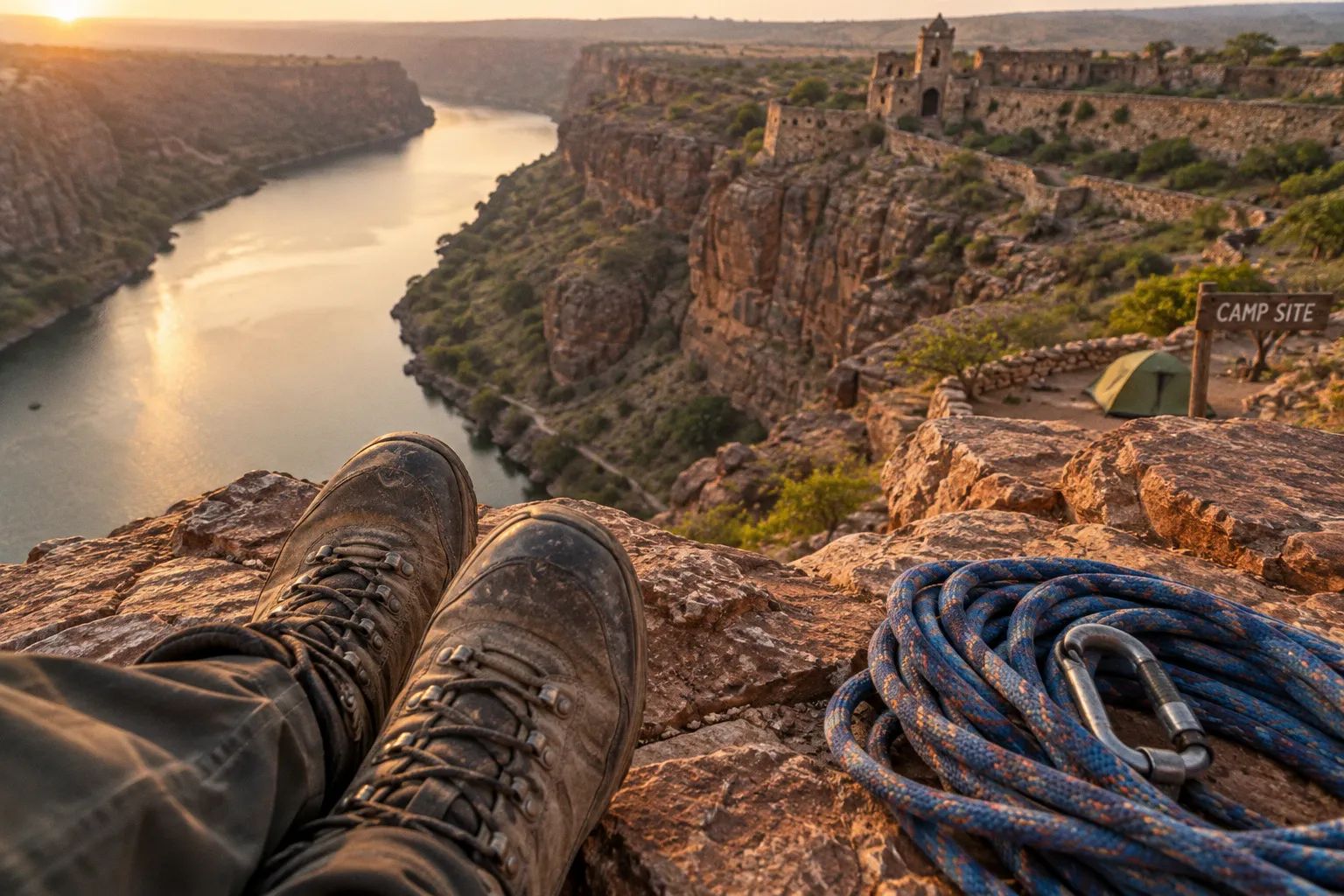
The overnight bottleneck
That makes the daytime visit relatively straightforward. You arrive, see the fort and canyon viewpoints, and leave within the published window.
Camping changes the question. A tent on the canyon rim is not simply an extension of a day visit, and the publicly available information does not set out a clear, standard permit procedure for an individual traveller who wants to pitch a personal tent. Nor does it identify a definitive list of locations where independent camping is authorised.
That distinction matters. The absence of a visible permit counter does not automatically mean that independent camping is allowed, and the lack of a published prohibition does not turn every open patch of ground into a legal campsite. At Gandikota, the most reliable overnight arrangement is a booked private camp operating from its own site. Independent camping remains poorly documented: before treating it as an option, a traveller would need current confirmation from the relevant local authority or landholder for the exact location and date.
The practical answer is therefore less satisfying than a simple permit rule. There is a functioning commercial camping market, but no clearly documented public pathway for anyone who wants to arrive with a tent and camp independently beside the gorge.
At Gandikota, the important distinction is not between a tent and a hotel. It is between an organised campsite with a named operator and an overnight plan whose permission has never been clearly established.
Private campsites versus independent tent pitching
Most visitors who stay overnight around Gandikota use a private campsite. These sites generally operate as paid accommodation rather than as open public camping grounds. The operator controls the plot, accepts the booking, provides the sleeping arrangement, and sets the conditions for arrival, meals, fires, vehicles and departure.
This is a materially different arrangement from carrying a tent to the canyon rim. A commercial camp gives the traveller a clear counterparty: there is a business name, a booking record and someone responsible for explaining where guests may sleep. It does not remove every risk, and it does not mean that every claim made by an operator is automatically accurate. It does, however, make the overnight plan legible.
Independent tent pitching is less clear. Publicly available material does not establish a standard application form, named permit office or universally recognised permit category for personal camping on the gorge edge. It also does not provide a confirmed map of legal independent camping spots near the Pennar Gorge. Local land ownership and the status of particular plots may vary, and permission for one piece of land would not necessarily apply to another.
That is why a traveller should not treat a conversation with one local person as a general permit for the entire canyon. If independent camping is being considered, the relevant questions are specific:
- Who controls the exact plot where the tent will stand?
- Is overnight use permitted there, rather than merely daytime access?
- Does the permission cover fires, vehicles, toilets and additional members of the group?
- Is there a local restriction connected with the fort, temple grounds, agricultural land or another protected or managed area?
- What happens if the person who gave informal approval is not present later that evening?
None of these questions can be answered safely by assuming that an empty plateau is public land. A scenic location may sit beside the fort, a village, a farm or a private campsite without being available for unsupervised overnight use.
| Question | Booked private campsite | Independent tent pitching |
|---|---|---|
| Who controls the site? | The named campsite operator | Not always clear from the landscape |
| How is the stay arranged? | Reservation, payment and operator instructions | Requires prior confirmation for the exact plot |
| Is there a published individual-camping procedure? | Usually not needed for the guest because the operator handles the stay | Not clearly documented in the available information |
| What does the guest receive? | A defined sleeping arrangement and stated facilities | Whatever has been independently arranged |
| Where does responsibility sit? | Shared between guest and commercial operator, subject to the booking terms | Largely rests with the traveller unless a valid local arrangement exists |
| Main uncertainty | Whether the operator’s registration and promises are current | Whether overnight use is permitted at that location at all |
The table is not a legal classification. It is a planning distinction. A registered or established camp may be the more practical choice, but travellers should still ask what the operator is authorised to provide and whether the booking is for a site inside a managed compound or merely for transport to an informal camping area.
There is no sound basis for presenting verbal local consent as the official route for independent camping. It may be possible for a landholder or local authority to approve use of a particular plot, but the procedure, authority and conditions should be confirmed locally rather than inferred from custom. If that confirmation cannot be obtained, the responsible choice is to use an established accommodation provider or stay outside the canyon area.
Fort access and the 6:00 PM cutoff
The fort’s published visiting hours are the clearest part of Gandikota’s overnight planning problem. Day visitors should work on the basis that the fort and its visitor areas are open during the stated daytime window and that access after 6:00 PM may not be available.
What the available information does not establish is a detailed enforcement pattern. It does not confirm a fixed security rotation, a guaranteed gate-locking procedure, or a universal rule that every person remaining within the wider fort or canyon area after closing is legally trespassing. Those conclusions go beyond the known visiting hours.
The sensible interpretation is narrower: do not rely on continued access to the fort after the published closing time unless an authorised accommodation provider has explicitly explained how its guests enter, leave and remain on the premises. A campsite booking should not be treated as a substitute for permission to wander through closed visitor areas. Ask the operator where the campsite sits in relation to the fort boundary and whether the route to the accommodation remains usable after the daytime site closes.
This is especially important when a booking is advertised as “Gandikota camping” but the actual sleeping area is outside the fort. The name may describe the destination rather than the legal status of the land. A camp near the gorge is not automatically located inside the fort perimeter, and a tent with a view of the canyon is not automatically authorised for overnight use.
Before travelling, confirm four practical details with the operator:
1. The exact location of the campsite, preferably through a map pin rather than a general destination name.
2. Whether the site lies inside or outside the fort’s managed visitor area.
3. The latest arrival time for guests who have not yet checked in.
4. How guests access the site after the fort’s daytime visiting hours end.
Day visitors should also avoid building a schedule that depends on a last-minute exit. Roads, traffic, heat and delays at the viewpoint can all turn a comfortable departure into a rushed one. If the intention is to stay overnight, arrange the campsite in advance and arrive while the site is operating normally, rather than treating the evening as an opportunity to find an unofficial place to pitch.
A 6:00 PM closing time is a confirmed planning constraint. It is not, by itself, a complete description of how every boundary around Gandikota is enforced.
Commercial camping packages and operator licensing
Commercial camping packages around Gandikota commonly combine accommodation with meals and access to basic campsite facilities. Depending on the operator, the package may include a pre-pitched tent, mattress or bedding, drinking water, toilets, dinner, breakfast, a campfire area or transport to nearby activities. Other packages may add guided walks, kayaking or group activities.
The contents are not standardised. “Camping” can mean a simple tent on a prepared platform, an air-conditioned tent or cottage, or a group booking with an entire compound reserved for one party. The label tells you less than the booking terms.
Ask for the following in writing:
- The exact sleeping arrangement and whether the tent is shared.
- The number of guests included in the quoted rate.
- Whether bedding, meals, water and toilets are included.
- Whether the fire, if advertised, is controlled by the operator.
- The check-in and check-out times.
- Whether activities such as kayaking or guided walks are included or charged separately.
- The cancellation terms if weather, access or local restrictions affect the stay.
- The name of the business responsible for the booking.
The regulatory point is equally important. Commercial operators offering paid accommodation or adventure activities may be subject to registration and licensing requirements associated with the Andhra Pradesh Tourism Development Corporation, commonly referred to as APTDC. APTDC registration is a reason to ask better questions, not a guarantee that every facility, safety measure or marketing claim is in place.
The available information does not establish that every registered camp automatically carries guest liability insurance, maintains a fire-safety protocol approved by the local fire authority, or files guest manifests with the tourism department. Those protections should not be assumed from registration alone. If they matter to your trip, ask the operator directly and request the relevant terms or documentation.
The same caution applies to the phrase “licensed camp”. It may refer to a business registration, an accommodation approval, an activity-specific licence or a general description used in advertising. Ask what is registered, under which business name and for which service. A camp that offers accommodation and a camp that takes guests kayaking may not be operating under identical requirements.
A useful pre-booking message is simple: ask the operator to confirm the site address, registration status, services covered by the booking and the person responsible for guests after dark. The aim is not to turn a weekend trip into a regulatory investigation. It is to make sure the booking corresponds to a real, identifiable site rather than an informal promise attached to a popular destination name.
What the package does not solve
A paid booking does not automatically give a guest unrestricted access to the canyon rim, the fort or nearby private land. It does not cancel the site’s visiting hours, and it does not make unsafe behaviour acceptable. The operator may control the campsite but not the public viewpoint, road, temple grounds or adjacent agricultural plots.
Likewise, a package is not a substitute for personal preparation. Camps may have water and food but limited medical supplies. They may provide lighting inside the compound while the road and cliff paths remain dark. Mobile coverage may vary by location and network. If the operator advertises an activity, clarify whether it is guided, what equipment is supplied and what weather conditions cause cancellation.
Reading the package price
The cost of a Gandikota stay depends on the accommodation standard, the number of people sharing, the meal plan and the activities added to the booking. It is better to compare inclusions than to compare a single headline price.
A low-cost tent may include only the sleeping structure and a mattress. A more expensive option may include air conditioning, a private bathroom, meals and a dedicated sitting area. A group package may look expensive per booking but become reasonable when split between several people. None of these formats is automatically better; they serve different kinds of trips.
For a useful comparison, separate the price into five parts:
1. Sleeping arrangement. Check whether the tent is private, shared or allocated on arrival.
2. Facilities. Ask about toilets, showers, electricity, charging points and drinking water.
3. Food. Confirm which meals are included and whether vegetarian or other dietary requirements can be accommodated.
4. Activities. Treat kayaking, guided walks and equipment rental as separate line items unless the booking explicitly includes them.
5. Transport. A camp may be close to Gandikota on the map but still require an auto-rickshaw, jeep or other transfer from the nearest town or bus connection.
The most common mistake is to book a camp for the view and discover that the practical conditions do not match the group. Families may need reliable toilets and a stable sleeping platform. Photographers may need access before sunrise but find that the campsite’s gate or transport schedule does not support it. Stargazers may prefer a basic camp with a dark open area over a more comfortable site that runs bright lights and generators through the night.
Ask about generator hours before choosing a camp for astronomy. A site can be surrounded by a dark landscape and still have poor night-sky conditions if floodlights, vehicle headlights or generators remain active near the tents. The best observation area is usually a stable, open place away from the cliff edge and direct camp lighting. It does not need to be the most dramatic viewpoint.
The cliff edge is not a campsite
The Gandikota gorge is the reason people come, but the rim is also where the consequences of a small mistake become severe. Sections of the edge are unfenced or only lightly marked. Rock, dust, uneven ground and darkness make the area unsuitable for casual movement after sunset, particularly after rain or when people are carrying food, cameras or camping equipment.
There is no verified universal Gandikota rule requiring every visitor to remain a precise number of metres from the edge. Exact distances sometimes circulate as if they were official regulations, but they should not be presented as site-wide law without confirmation from the responsible authority. A sensible distance can still be useful as a personal precaution: remain well back from any unfenced drop, increase that margin in darkness or poor weather, and choose a viewing position where a stumble will not become a fall.
The same principle applies to fires. Do not place a campfire near the rim, dry grass, tents or loose combustible material. If a campsite offers a fire, it should be located and managed by the operator in a designated area. Independent campers should not interpret the absence of a sign as permission to build one. Wind can carry sparks across dry ground, and a fire near a cliff is difficult to control or extinguish safely.
A good night-time setup is deliberately unromantic:
- Keep tents, cooking equipment and bags away from the edge.
- Use a headlamp rather than a phone torch when walking.
- Mark the route between the tent, toilet and common area before dark.
- Do not walk the rim while drinking or while carrying hot food.
- Keep children within arm’s reach near viewpoints.
- Avoid standing on projecting rocks or loose shelves for photographs.
- Store glass and sharp objects inside the camp compound.
- Follow the operator’s instructions if weather, wind or visibility changes.
These are precautions, not invented local regulations. Their purpose is to reduce exposure in a place where the terrain is more consequential than the comfort of the photograph.
Environmental care is similarly basic but non-negotiable. Carry out synthetic waste, food packaging and batteries. Do not burn plastic or leave disposable plates around the viewpoint. Keep food away from the edge and do not throw leftovers into the gorge. A commercial campsite may collect waste within its own compound, but visitors remain responsible for anything they carry to public viewpoints.
Water deserves attention too. Bring enough for the journey and confirm what the campsite supplies. Water that is technically available may not be treated, chilled or suitable for every traveller. Toilets may be shared and located away from the tent area, which is another reason to inspect the route before dark rather than discovering it at midnight.
Planning an overnight stay without overclaiming permission
A reliable Gandikota plan starts by separating what is known from what still needs confirmation.
Known site information includes the daytime visiting window and the existence of commercial camping options around the destination. Less clear are the procedures for independent tent pitching, the exact status of particular plots outside organised camps and the way access is handled at every site after the fort closes. Those uncertainties are not a reason to avoid Gandikota; they are a reason not to improvise the legal part of the trip.
For a private camp booking, confirm:
- The operator’s full business name and current contact details.
- Whether the operator can provide its current APTDC registration or other applicable licensing information.
- The exact campsite location and whether it is inside or outside the fort’s visitor area.
- The check-in process and the latest arrival time.
- What the booking includes and what costs extra.
- The location of toilets, water points and common areas.
- The operator’s policy on campfires, generators and night movement.
- The procedure for weather-related cancellation or an unsafe activity.
- The route to the nearest main road and how emergency transport would be arranged.
For independent camping, the threshold should be higher. Do not rely on a generic statement that camping is “allowed in Gandikota”. Obtain confirmation for the specific plot, the specific night and the specific group. If the person granting permission cannot identify their authority over the land, or if the arrangement depends on finding someone after arrival, the plan is not sufficiently settled.
This is also where the distinction between a local welcome and formal permission matters. A friendly conversation can make a traveller feel accepted, but it may not settle land ownership, site management or responsibility if something goes wrong. Treat informal approval as information that needs verification, not as a universal permit.
Final position
Gandikota is not difficult because the destination has an elaborate public permit system. It is difficult because the overnight rules for independent camping are not clearly documented, while the landscape encourages people to assume that an open view is an available campsite.
For most visitors, a private campsite is the cleaner option: it gives the stay a named operator, a defined sleeping area and a booking trail. Even then, check what the operator is actually registered or licensed to provide. APTDC registration should prompt verification, not assumptions about insurance, fire approvals or government oversight.
The fort’s daytime hours should shape the itinerary, but they should not be inflated into claims about a universal enforcement schedule or automatic trespass. Arrive early enough to deal with the operator, understand the site boundary and leave public visitor areas before closing unless you have clear, authorised instructions for remaining on the premises.
Independent camping may be possible in some locations, but the public procedure for obtaining permission and the list of designated spots are not clear enough to present it as a standard, legal camping route. Without location-specific confirmation, it is an unresolved plan rather than a permit.
The safest way to experience the canyon after dark is therefore straightforward: book an identifiable campsite, confirm the exact site and overnight access arrangements, treat every distance from the unfenced rim as a personal safety margin rather than an official universal rule, and leave no trace beyond the memory of the view.