Monsoon camping gear for Gandikota canyon stays
The Pennar Gorge does not get Kerala-style monsoons. Gandikota sits in a rain-shadow belt averaging 567 mm of annual rainfall — roughly half what the Western Ghats receive — but what falls between…
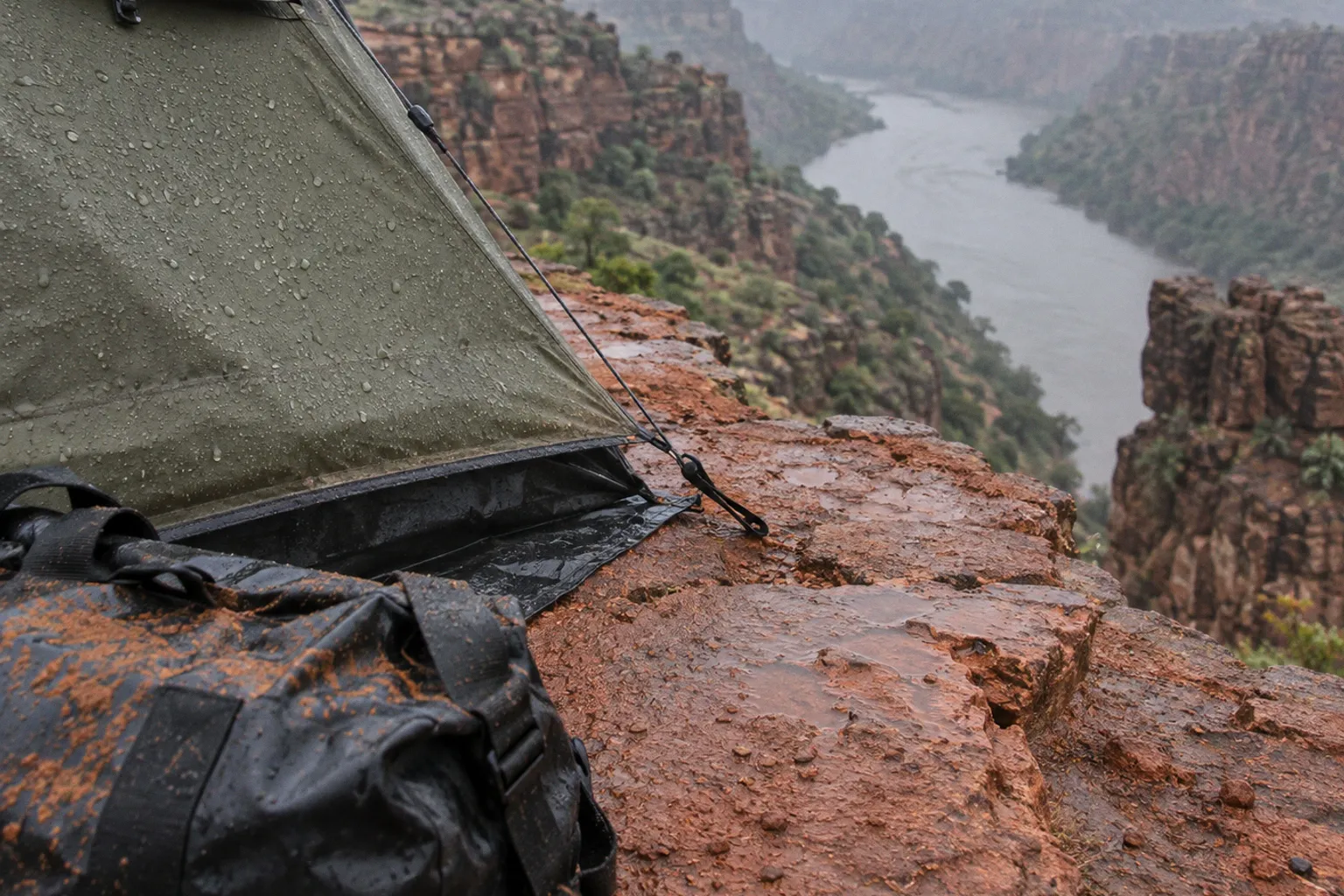
The Pennar Gorge does not get Kerala-style monsoons. Gandikota sits in a rain-shadow belt averaging 567 mm of annual rainfall — roughly half what the Western Ghats receive — but what falls between June and September arrives in sudden, hard bursts that turn the canyon's red quartzite into a frictionless sheet within minutes. A tent pitched without adequate anchor weight on the canyon rim has a short lifespan once the first convective cell rolls in from the west.
That is the operating environment for any canyon camping gear list built for the Indian monsoon season in this region. The gear requirements below are calibrated for it: intermittent storms, sustained 20–30 km/h gusts along exposed ridges with higher spikes in channelized terrain, slick rock underfoot, and 25 km of unpaved road between your camp and the nearest hospital in Jammalamadugu.
Reading the Rain-Shadow Climate Before You Pack
Gandikota lies at 320 meters above sea level in Kadapa district, a zone shielded from the full force of both monsoon branches by the Eastern Ghats. Annual rainfall totals around 567 mm, with average temperatures holding near 28°C year-round. The monsoon window runs June/July through September, but rainfall is delivered in scattered thunderstorms rather than multi-day deluges — typically 30–90 minute convective bursts in late afternoon or overnight, separated by dry, humid intervals.
For the camper, three operational implications follow:
- Storm cells build fast against the western canyon wall and unload before drifting east. Lead time from first radar signature to first drops is often under 30 minutes, not the 90 minutes of a frontal system.
- Air in the gorge stays humid even between storms. Dew formation on tents, tarps, and sleeping bag shells is constant after sundown. A "dry" night in July still means wet gear by dawn.
- Wind in the gorge channels predictably. Air rising against the western wall during a cell's approach produces ridge-top gusts that hit the canyon rim perpendicular to the cliff face — directly into the broadside of any shelter you set up.
Pack for humidity first, rain second, wind third. That hierarchy determines every gear selection in the sections that follow.
Tents and Anchors for a Canyon Rim That Does Not Forgive
A monsoon-season tent in Gandikota needs to solve two problems at once: shed sudden rain without pooling, and stay anchored on rocky ground where conventional stakes are useless.
Hydrostatic head is the headline spec. For canyon-rim camping in a rain-shadow zone with intermittent but intense bursts, the floor and rainfly should both carry a minimum 3,000 mm rating. The 1,500 mm tents sold for fair-weather trekking wet through within the first sustained downpour. Seams must be factory-taped; field-applied seam sealer breaks down within days under heat and humidity cycles.
Tent geometry matters more than brand name. A low-profile geodesic or semi-geodesic design sits closer to the ground, presents less surface area to ridge gusts, and redistributes wind load across multiple poles. Tall cabin-style tents, popular for family car camping, act as sails the moment the wind shifts 90 degrees on the canyon rim.
| Parameter | Minimum Spec | Reason |
|---|---|---|
| Fly hydrostatic head | 3,000 mm | Intermittent intense bursts exceed 1,500 mm ratings within minutes |
| Floor hydrostatic head | 5,000 mm (bathtub floor) | Ground saturation during prolonged rain, kneeling pressure |
| Pole count | 3+ crossing points | Distributes gust load across structure |
| Guy line count | 8+ attachment points | Redundant anchoring on rock |
| Packed weight | Under 3.5 kg per person | Carry distance from road head to rim sites |
Anchoring is where most campers fail in this terrain. The red granite does not accept standard tent stakes. You are working with friction points, cracks, and loose boulders. Carry a dedicated anchor kit:
- Four 8–10 kg fillable sandbag anchors — empty on the drive in, filled with local sand or pebbles at camp
- Two 15 m lengths of 6 mm reflective static rope for guylines tied to boulder clusters
- A 3×3 m or 4×4 m silnylon or PE tarp rigged as a secondary rain shield above the tent fly
- Heavy-duty tent stakes for the limited patches of soil found in scrubby flat zones near the rim
A tent on the Gandikota rim without sandbag anchors is not camping equipment — it is a kite with a sleeping bag attached.
Pitch with the broadest tent wall facing away from the prevailing wind direction. In the Pennar Gorge that means orienting the shelter's narrowest profile toward the west, where convective cells approach. Set guy lines at 45 degrees rather than the usual 60, because lower angles resist uplift better on exposed rock.
Footwear and Traction on Wet Red Quartzite
The rock that makes Gandikota visually distinct is the same rock that makes it dangerous when wet. Red granite here carries high silica content and a polished surface texture from wind erosion. Dry, it grips adequately. Wet, the friction coefficient drops below that of wet glazed tile — there is no useful traction with standard hiking boot lugs.
You need footwear built for approach and scrambling in wet conditions, not trail hiking:
- Vibram Megagrip or comparable high-friction compound outsoles. Standard Vibram rubber loses too much grip on wet smooth rock.
- Lug depth of 4–5 mm with multi-directional patterning. Shallow lugs skate; deep lugs brake.
- Stiff midsole for edging on boulders. Cushioned trail runners fold and slip.
- Drainage ports or mesh uppers. Standing in water during river crossings is routine at the gorge floor.
A dedicated approach shoe (La Sportiva TX series, Scarpa Drago, Five Ten Camp Four) outperforms a backpacking boot on this terrain. Save the boots for winter camping when dry rock and cooler temperatures make traction a non-issue.
Add gaiters to keep scree and grit out of your footwear during the scramble down to the Pennar River. Knee-high gaiters also reduce snake contact, since the canyon hosts Russell's viper and saw-scaled viper populations during warm monsoon nights.
Sock strategy matters more than most campers realize. A wet cotton sock against skin causes blisters within 30 minutes of walking. Use Merino wool or synthetic blends; carry two pairs so one dries while the other is worn. A dry pair at the bottom of the sleeping bag each morning is non-negotiable.
Moisture-Proofing Electronics and Camp Essentials
The gorge's humidity alone — independent of any rain that hits your tent — will corrode electronics, fog optics, and degrade paper maps within 48 hours. Rain is a secondary threat; ambient moisture is the constant.
Build a tiered dry-bag system rather than relying on a single waterproof pouch:
| Tier | Capacity | Contents |
|---|---|---|
| Primary dry bag | 20–30 L | Headlamp, power bank, charging cables, phone, satellite communicator |
| Secondary dry bag | 10–15 L | Camera body, spare batteries, lens cloth, memory cards |
| Ziplock backup | 2–4 L each | Documents, ID, cash, permits — stored inside the primary bag |
| Hard case | Pelican-style | GPS device, any screen you need to read while wet |
Camp lighting deserves separate consideration. A canyon-rim camp after sundown is pitch black — no ambient light from villages reaches most sites, and monsoon cloud cover eliminates starlight. Carry a primary headlamp rated at 300+ lumens with an IPX7 waterproof rating (submersible to 1 m for 30 minutes), plus a backup at 150 lumens stored inside the dry bag. Standard IPX4 splash-resistant lights fail within hours of sustained monsoon humidity.
Power banks lose capacity fast in cool humid air and faster when wet. Store them inside an insulated dry bag near your body overnight. A 10,000 mAh bank at room temperature delivers roughly 70% of rated capacity at 15°C ambient; colder and the battery management system throttles output.
For sleeping bag and clothing moisture management, store bags in a compression dry sack rather than the standard stuff sack. Between trips, hang bags in dry airflow for at least 24 hours before storage. Damp down loft loses roughly 30% of its insulation value — the difference between a 0°C bag and a +5°C bag in real-world performance.
Emergency Preparedness for a 25-Kilometer Run to Care
The nearest government hospital and fuel station sit in Jammalamadugu, 25 km from the canyon rim. Kadapa, with fuller medical facilities, is 77–80 km out. Bangalore is 280–300 km distant, a 6–7 hour drive in dry conditions. None of those distances shrink when the dirt access road turns to mud.
Calculate your real evacuation timeline before you need it: 25 km of unpaved road from canyon rim to Jammalamadugu translates to 45–90 minutes by vehicle in dry weather. During a monsoon storm, the same road can become impassable for 12–24 hours. A medical event at 8 PM on a wet July evening will not reach a hospital before morning.
Communication redundancy is the only hedge against that gap:
- Primary: a personal locator beacon or satellite messenger (Garmin inReach, ZOLEO, or equivalent) carried on your person, not in the pack. Two-way text confirmation to a contact outside the region.
- Secondary: a fully charged smartphone with offline topo maps. Cell coverage at the canyon rim is unreliable — BSNL and Jio have intermittent signal, Airtel is generally absent. Treat the phone as a backup, not the primary.
- Whistle and signal mirror for line-of-sight rescue within the gorge.
A first-aid kit must be self-sufficient for at least 12 hours of field care. Beyond standard blister and trauma supplies, include:
- Oral rehydration salts (4–6 packets per person)
- Broad-spectrum antibiotic (consult a travel medicine clinic before departure)
- Snake bite bandage with pressure immobilization technique documentation
- Water purification: chlorine dioxide tablets plus a 0.1 micron filter, not just one method
- Irrigation syringe for wound cleaning
Water sourcing at the canyon is unreliable in the way most campers assume it is reliable — the Pennar River runs during monsoon but carries high sediment load after storms. Filter, then treat. Do not drink unfiltered river water even if it looks clean; cattle activity upstream of most campsites introduces E. coli consistently.
Fuel logistics: if you arrived on a tank that needed refueling before reaching Gandikota, refuel in Jammalamadugu. The canyon approach has no fuel station. Running out 15 km from the nearest pump in monsoon mud is a multi-hour recovery.
Final Gear and Protocol Checklist
Use this as your pre-departure verification — any unchecked item is a trip delay or a safety compromise:
1. Tent hydrostatic head rated 3,000 mm+ on fly, 5,000 mm+ on floor
2. Four sandbag anchors filled and positioned before sunset
3. Approach shoes with high-friction rubber, resoled or replaced within the last 500 km of use
4. Vibram or comparable lugs inspected for wear — replace if lugs are smooth
5. Primary headlamp 300+ lumens, IPX7, with backup stored in dry bag
6. Power bank kept inside an insulated dry bag, never loose in the pack
7. Satellite communicator charged and registered before departure
8. Two-way confirmation of evacuation contacts outside the region
9. First-aid kit includes oral rehydration salts and snake bite bandage
10. Water filter and chemical treatment both packed, not just one
11. Fuel topped off in Jammalamadugu, not assumed for the return
12. Dry bags checked for pinholes — fill with air and submerge briefly before each trip
13. Sleeping bag dried for 24 hours before packing
14. Trip itinerary filed with someone outside Andhra Pradesh, not just a contact at home
The canyon rim does not negotiate. If a piece of gear is marginal at home, it fails here — usually between midnight and dawn, when replacement is impossible.