Gandikota cliff camping: finding the perfect edge site
A Gandikota cliff camping site is not selected by view alone. The best-looking point may have loose red granite, an exposed drop-off, no lighting after sunset, and no practical access to water or staff.
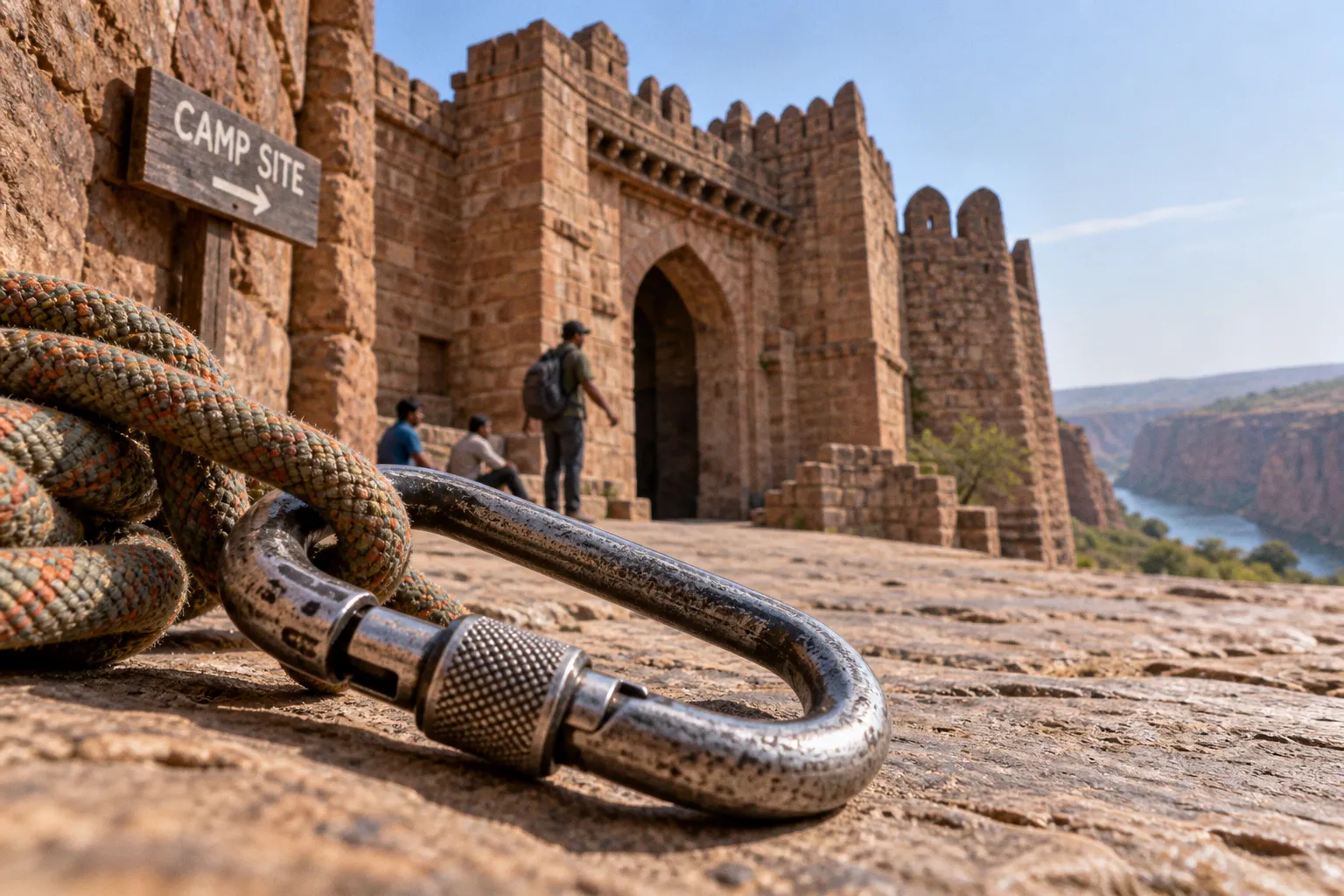
At the canyon rim, a site that is 20 metres closer to the edge can be less usable than one several hundred metres inland.
The workable approach is simple: choose an approved camping area first, then compare its distance from the gorge, accommodation type, facilities, terrain, and activity schedule. Gandikota is not a location for unrestricted cliff-edge pitching. Organized camps operate in gated private areas, with options ranging from basic dome tents to air-conditioned glamping units. These are the sensible starting points for an overnight stay near the Pennar River cliff.
Gandikota sits along the Pennar River in the Erramala hill range, approximately 15 km from Jammalamadugu. Road distances are roughly 280 km from Bangalore, 370 km from Chennai, and 380 km from Hyderabad. That makes the camp selection part of the trip plan, not a minor detail to solve after arrival.
Navigating Gandikota’s gated camping ecosystem
Camping around the gorge is not one uniform product. The term Gandikota wilderness camping locations covers several different arrangements:
- Tent-only rental with basic sleeping equipment.
- Standard overnight packages with bedding, campfire, dinner, and breakfast.
- Activity packages that add rappelling, climbing, ziplining, or kayaking.
- AC tents or rooms inside organized campgrounds.
- Informal or self-pitched arrangements whose permission and operating conditions may not be clear.
The last category requires caution. Exact regulations for pitching personal tents outside gated private campsites are not established in the available information. Do not assume that an empty patch near the rim is available for camping. Absence of a fence is not proof of permission. Absence of a warning sign is not proof of stability.
A controlled campsite gives you several operational advantages:
1. Defined access. You know where vehicles stop, where tents are located, and where the main facilities are positioned.
2. Known sleeping equipment. Basic packages generally include bedding and blankets. The actual condition should still be confirmed before payment.
3. Food logistics. Dinner and breakfast are commonly included in standard packages, reducing the need to carry a full cooking system.
4. Staff presence. This matters after dark, when the gorge edge and uneven rock become difficult to read.
5. Activity coordination. Rappelling, rock climbing, ziplining, kayaking, and sunrise viewing can be scheduled without moving between unrelated operators.
The main compromise is distance. Some AC rooms and tents are approximately 300 to 500 metres from the main facilities. That is not a trivial walk when carrying luggage, moving in darkness, or returning after an evening meal. Ask where the accommodation sits relative to toilets, dining, parking, and the gorge viewpoint. Do not accept “near the canyon” as a useful measurement.
The correct cliff campsite is not the one closest to the drop. It is the one that gives you controlled access to the view without turning every night movement into a fall hazard.
What to confirm before booking
Use direct questions. Avoid relying on package names because operators use the same labels for different levels of service.
- Is the campsite inside a gated private area?
- Is the quoted price per person, per tent, or per room?
- Does the package include bedding and blankets?
- Are dinner and breakfast included?
- Is the tent air-conditioned or naturally ventilated?
- How far is the tent from the main facilities in metres?
- Is a vehicle allowed near the tent, or is luggage carried from the parking area?
- Are activities included or charged separately?
- Is the gorge access open after sunset?
- What lighting is available between the tent area and toilets?
- Is the campsite exposed to uneven rock or an unprotected edge?
- What happens if the activity is cancelled because of weather or operating conditions?
These questions are not excessive. They identify whether you are purchasing a basic overnight camp, a managed glamping stay, or a bed inside a tent-shaped room with an adventure package attached.
Comparing tent tiers: basic domes versus AC glamping
Price differences at Gandikota usually reflect logistics, not just fabric quality. A tent with bedding and a blanket is a different product from an AC unit located near the facilities. Treat each tier according to its actual function.
| Accommodation type | Typical arrangement | Approximate cost | Operational strengths | Main limitations |
|---|---|---|---|---|
| Tent-only rental | Basic dome tent, usually for two or three sharing | Around ₹500 per person | Lowest entry cost; suitable if you already have a simple overnight plan | Meals, activities, and additional equipment may not be included |
| Standard camping package | Dome tent with bedding, blanket, campfire, dinner, and breakfast | About ₹1,400–₹1,599 per person | Efficient for a one-night stay; fewer food and equipment decisions | Basic comfort; exact facilities vary by operator |
| Full activity package | Camping combined with meals and activities such as rappelling | Around ₹2,500 per person | Consolidates the overnight stay and adventure schedule | Higher cost; the activity timetable controls the day |
| AC tent or room | Climate-controlled accommodation within an organized campsite | Varies by operator | Better heat management and a more controlled sleeping environment | Usually positioned 300–500 metres from main facilities; not the same as being on the cliff edge |
The ₹500 figure should be treated as a starting point for tent-only rental, not as the cost of a complete camping trip. Once food, bedding, transport inside the property, and activities are added, the total changes quickly.
Standard packages in the ₹1,400 to ₹2,500 range are more practical for most visitors arriving from Bangalore, Chennai, or Hyderabad. The travel distance already consumes most of the useful daylight. A package that includes dinner and breakfast removes a separate resupply problem and keeps the group inside the organized campsite.
Basic dome tents
Basic domes are suitable when the objective is a functional overnight stay rather than hotel-level comfort. They can work well for visitors who:
- Arrive during the cooler October–February period.
- Carry a headlamp and a personal water supply.
- Do not require air-conditioning.
- Are comfortable with shared occupancy.
- Plan to spend daylight hours outside the tent.
- Need a low-cost base for canyon exploration.
The failure point is usually not the tent itself. It is the assumption that a low package price includes everything. Confirm sleeping arrangements, blanket availability, toilet access, meals, and the distance to the dining area.
AC glamping units
AC tents or rooms are useful during warmer periods and for visitors who need a more controlled sleeping environment. They are not automatically the best choice for canyon viewing. Organized AC accommodation may sit 300 to 500 metres from the main facilities, and the unit may be separated from the rim by the campsite layout.
This creates a simple trade-off:
- Better thermal control.
- Higher cost.
- Longer movement between accommodation and facilities.
- Potentially less direct access to the rim.
- Greater dependence on the campsite’s internal transport or lighting.
If your priority is stargazing, ask whether the AC unit sits under strong exterior lighting. If your priority is sunrise, ask how long it takes to walk to the viewpoint before dawn. Air-conditioning solves heat. It does not solve route planning.
Safety protocols for edge-side stays and terrain hazards
The canyon rim is a working hazard zone. Red granite and rock surfaces can appear stable while carrying loose fragments, broken edges, and uneven steps. A clear daytime path may become a poor route after sunset.
The safe camping zones around Gandikota gorge are the managed areas with defined boundaries and controlled access. Do not move your tent toward the edge to improve the view. Do not sleep on an unverified cliff platform. Do not use a narrow ledge as a photography position.
Edge management
Maintain a conservative distance from steep drops. The correct distance depends on the ground, slope, visibility, and group movement. There is no useful universal number that makes every cliff edge safe.
Follow these rules:
1. Stay behind established boundaries or marked access areas. If the campsite or local staff directs visitors away from a section, treat that direction as final.
2. Do not approach the rim after sunset unless access is clearly authorized and illuminated. A phone flashlight does not provide sufficient depth perception on broken rock.
3. Keep children and distracted adults away from the edge. Photography, group movement, and low visibility create predictable failures.
4. Do not step backward while taking photographs. The camera frame is not a terrain assessment.
5. Avoid isolated areas after dark. The problem is not only the drop. It is also the lack of immediate assistance if a fall, ankle injury, or equipment problem occurs.
6. Treat loose red granite as unstable. Test footing before transferring weight, especially on sloped surfaces.
7. Keep tent entrances facing away from exposed edges. A poorly oriented entrance encourages night movement toward the rim and reduces control over loose equipment.
The phrase “best spots for canyon edge tents” needs to be interpreted carefully. The best spot is not necessarily the closest permissible point to the gorge. It is a level, approved location with a stable approach, usable lighting, access to facilities, and a clear route to a viewpoint.
Personal equipment for a managed campsite
A complete equipment list does not need to be large. It needs to cover the conditions the package does not cover.
- Headlamp with a usable output of at least 200 lumens.
- Spare batteries or a charged backup light.
- Closed-toe footwear with a firm outsole.
- Lightweight long trousers and a long-sleeved layer.
- One litre of drinking water per person for the active part of the day.
- Personal medication and a compact first-aid kit.
- Power bank and charging cable.
- Small dry bag for phone, wallet, and documents.
- Eye protection or sunglasses for exposed daytime terrain.
- A thin insulating layer for cooler nights between October and February.
- Insect protection if the campsite has open dining or riverside access.
The 200-lumen headlamp recommendation is for route visibility around camp, not for illuminating a cliff. No headlamp makes an exposed edge safe. Keep a spare light because a failed phone battery turns an easy return into a navigation problem.
Heat management
March to June is the extreme heat period. The middle of the day, especially from 12 PM to 3 PM, is a poor window for strenuous canyon activity. Plan movement around the heat rather than trying to force a full outdoor schedule.
A practical sequence is:
- Arrive and settle before the hottest period when possible.
- Keep the midday block for shade, food, rest, and equipment checks.
- Schedule canyon-rim viewing near sunset.
- Return to the organized campsite before visibility deteriorates.
- Use the cooler morning window for sunrise viewing, walking, or activity sessions.
AC accommodation reduces sleeping discomfort, but it does not protect you during a midday hike, climb, or exposed viewpoint stop. Carry water and limit unnecessary movement on open rock.
Timing the canyon rim for views and stargazing
October to February is generally the most suitable period for camping and gorge exploration because conditions are cooler. That does not remove the need for a thermal layer or a light source. Nights can be uncomfortable when clothing is selected only for daytime heat.
Sunset and sunrise are the two most useful viewing periods. They also create the most predictable crowd movement, so route control matters.
Sunset planning
Reach the approved viewing area before the light falls. Do not wait until the last available minute and then attempt to return across uneven ground in darkness. Check the route in daylight. Note the location of steps, rock breaks, tent lines, dining areas, and any restricted sections.
A reliable sunset routine is:
1. Confirm the return path before leaving the campsite.
2. Carry a headlamp, even if the walk begins in full daylight.
3. Leave the viewpoint before the group becomes difficult to manage.
4. Keep away from unprotected drop-offs during photography.
5. Return to the gated campsite rather than continuing into isolated areas.
The gorge can remain visually clear after sunset while the ground becomes unreadable. These are different conditions. A good view does not mean a safe route.
Sunrise planning
Sunrise viewing is easier when the campsite location is known in advance. Ask whether the viewpoint is inside the property, adjacent to it, or requires a separate transfer. A room or AC tent 300 to 500 metres from the main facilities may still be farther from the actual viewing point.
Prepare clothing and footwear the previous evening. Keep the headlamp accessible. Do not walk barefoot or in loose sandals across red granite. If the route is unlit or not authorized before dawn, wait for adequate light or follow staff instructions.
Stargazing without false expectations
Gandikota is promoted for canyon views and outdoor nights, but a campsite is not automatically a dark-sky observatory. Glamping units, dining areas, vehicle headlights, campfires, and security lighting can reduce night-sky visibility.
For better stargazing:
- Move only to an approved open area.
- Stay clear of the rim and uneven rock.
- Avoid shining white light into the group’s field of view.
- Use a red-light mode if your headlamp has one.
- Keep phones dimmed and face-down when not in use.
- Check whether the campsite’s campfire or exterior lights remain active late.
- Use a groundsheet or seating area rather than standing near a drop-off.
A basic campsite may provide a better sky view than a brightly lit AC unit, but this depends on placement and lighting policy. Ask the operator instead of assuming that the more expensive accommodation has the best astronomy conditions.
Darkness improves the stars and reduces your margin for error. Keep the astronomy area and the cliff edge completely separate.
Integrating adventure activities into the overnight stay
Gandikota camping packages may include cliff rappelling, rock climbing, ziplining, kayaking on the Pennar River, and sunrise viewing. These activities should be treated as separate operational events, not as automatic features of the tent booking.
A full activity package may cost around ₹2,500 per person and can include rappelling and meals. Confirm the exact inclusions. Package labels do not tell you the duration, start time, equipment provided, age restrictions, weather policy, or transfer requirements.
Activity selection by campsite logistics
Rappelling and rock climbing require the most attention to operator control. Ask where the activity starts, how the group reaches the launch point, and whether helmets, harnesses, ropes, and supervision are supplied. Do not approach technical sections independently after the organized session.
Ziplining is sensitive to queue time and operating windows. If it is a primary reason for booking, schedule it early enough that a delay does not remove the rest of the day’s plan.
Kayaking on the Pennar River is a separate terrain problem from camping on the gorge rim. River access may involve transport, stairs, or a longer approach. Confirm whether kayaking operates on the date of your stay and whether the package includes the transfer and safety equipment.
Sunrise viewing is low-complexity but time-critical. It is often easier to complete than a technical activity and gives you a reliable reason to maintain an early start.
Do not stack every activity into one compressed schedule. Heat, travel fatigue, and delays at the campsite can make a full package physically inefficient. A better plan gives each major activity a defined block and leaves time for food, hydration, and recovery.
A workable one-night schedule
Arrival and setup
- Reach the campsite during daylight.
- Confirm the tent, bedding, lighting, toilets, and meal location.
- Store valuables and inspect the route between the tent and facilities.
- Ask staff about restricted cliff sections and the sunset access point.
Late afternoon
- Complete any technical activity while visibility is good.
- Carry water and wear closed footwear.
- Avoid adding a long rim walk immediately after rappelling or climbing.
Sunset period
- Move to the approved viewing area before the final light.
- Keep the group together.
- Use no risky photo positions.
- Return before the route becomes difficult to read.
Dinner and night
- Keep the headlamp accessible.
- Do not wander into isolated areas.
- Use only approved areas for stargazing.
- Secure footwear, phones, and small equipment inside the tent.
Morning
- Prepare for sunrise with a light, footwear, and water.
- Check the route before leaving.
- Return for breakfast and pack without rushing.
- Inspect the tent area for personal equipment before departure.
This sequence protects the main objective: an overnight stay that remains functional from arrival to departure. The canyon is not improved by adding unnecessary movement in darkness.
Choosing a campsite in Gandikota: the final selection
The right Gandikota cliff camping site depends on the group’s actual requirements. A low-cost dome works for a simple overnight base. A standard package is more efficient when meals and bedding are needed. AC glamping is useful when heat control matters more than immediate access to the rim. An activity package is suitable when the trip is built around organized adventure sessions rather than independent exploration.
Use this final selection order:
1. Permission and boundaries. Choose a gated, organized campsite or a clearly authorized arrangement.
2. Terrain. Reject any site requiring movement across unstable or exposed rock to reach basic facilities.
3. Distance. Record the distance from the tent to toilets, dining, parking, and the viewpoint.
4. Season. Prefer October to February for cooler camping conditions. Treat March to June as a heat-management problem.
5. Package contents. Separate tent rental from food, bedding, campfire, activities, and transport.
6. Night access. Confirm lighting, staff presence, and whether the gorge-side route closes after sunset.
7. Activity schedule. Book only the activities that fit the available daylight and recovery time.
8. Emergency margin. Carry a headlamp, water, closed footwear, medication, and a charged phone.
Gandikota rewards disciplined planning. It does not reward improvisation at the edge. Select the campsite for stable access, controlled logistics, and a clear night route. Take the view from the authorized side of the boundary. Leave the exposed rock and unverified cliff pitches out of the plan.