Gandikota canyon stays: tent camping versus luxury glamping
Gandikota canyon camping versus glamping sites is not a choice between two versions of the same room. It is a choice between two operating systems.
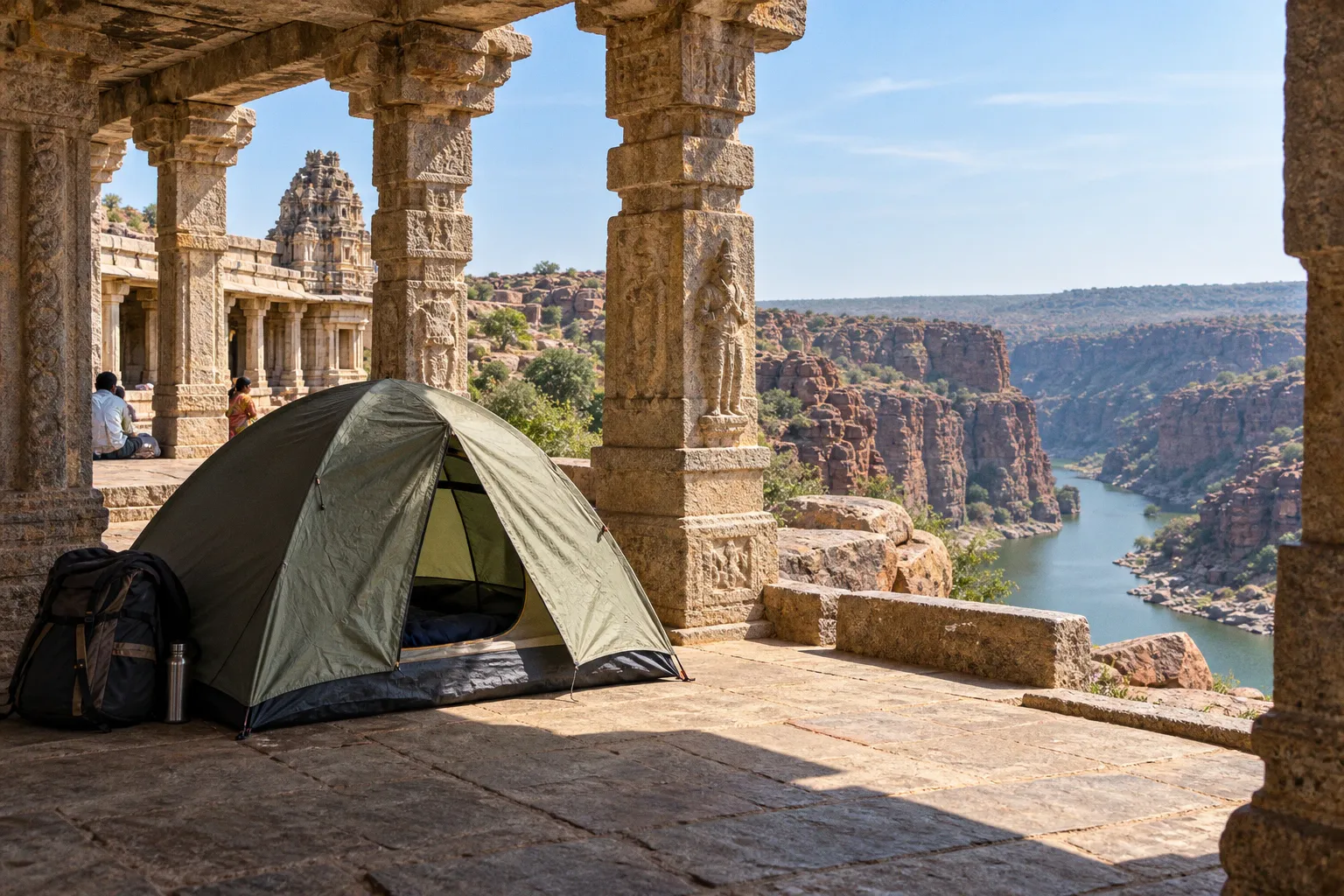
Basic dome camping gives you a foam mattress or sleeping bag, a 2–3 person tent, shared washrooms, and a direct overnight position near the Pennar gorge landscape. Luxury glamping and AC room stays move you farther back from the immediate cliff edge and add fixed beds, electrical charging, air conditioning, fans, and attached washrooms. The difference is not decorative. It affects sleep, heat management, hygiene, luggage, power access, and how much equipment you need to carry.
For most visitors, the correct decision depends on three variables: tolerance for basic facilities, heat exposure, and whether the overnight stay is the main objective or only a base for sightseeing around Gandikota Fort and the gorge.
Basic tent camping maximizes terrain access. Glamping maximizes operational control. Choose the failure mode you can tolerate.
The raw option: cliff-side dome tent camping
Standard Gandikota tent camping is a low-infrastructure overnight stay. The accommodation is usually a small dome tent intended for two or three people. Inside, the setup commonly includes a basic foam mattress or sleeping bags. Facilities are shared. Washrooms may be outdoor public blocks or container units rather than private bathrooms attached to each tent.
This is the closest match to a field camp without carrying and pitching your own shelter. You arrive at an established camping ground, use the supplied sleeping arrangement, eat according to the package schedule, and sleep in a fabric shelter. The setup is functional. It is not a hotel room with canvas walls.
The main advantage is position. Basic camping grounds are typically arranged close to the canyon-side recreational area, giving you faster access to the open gorge landscape and the evening camp environment. That does not mean every tent is pitched on the precipice. It also does not mean the tent has an unobstructed view from the mattress. Site layout changes, and safe camping grounds need usable flat terrain rather than theatrical placement at the edge.
What the basic package usually includes
Weekend packages for standard dome tent camping generally fall in the range of ₹900 to ₹1,500 per person or per night. The exact basis of the charge varies by operator. Some packages are priced per person. Others may be presented as a night package with occupancy assumptions.
Meals are often part of the package, commonly breakfast and dinner. A campfire may also be included. Confirm the meal timing before arrival. A campfire is not a substitute for a late food service, and remote campgrounds do not always operate like restaurants.
Typical components include:
- A 2–3 person dome tent.
- Foam mattresses or sleeping bags.
- Shared outdoor, public, or container washrooms.
- Basic meal service, often breakfast and dinner.
- Campfire arrangements, subject to site rules and weather.
- A fixed camping plot on established ground.
The equipment list is short because the operator supplies the shelter and bedding. Your personal packing list is not short if you want to sleep properly. Bring a headlamp, not only a phone flashlight. Use a model with at least 200 lumens for walking between tents and washrooms. A lower-output light can work inside the tent but is weak for uneven ground and unlit paths.
Carry earplugs if you are sensitive to group noise. Carry a sleeping liner if you do not want direct contact with shared bedding. Carry a light insulating layer even when daytime temperatures are high. Canyon camps lose heat after sunset, and the tent fabric does not provide the thermal stability of a masonry room.
The washroom problem is not a minor detail
The greatest practical difference between basic camping and glamping is often the washroom, not the mattress.
A shared facility means you leave the tent, walk across the camp area, and use a common block. At night, that requires footwear, a light, and some tolerance for queues or variable cleanliness. The issue becomes more significant for families, older travelers, and anyone planning a short overnight stay with no interest in managing camp routines.
Do not assume that a dome tent has an attached private washroom. Standard budget camping in Gandikota generally relies on shared facilities. Private attached washrooms are associated with upgraded AC tents and rooms, not automatically with every tent package.
This distinction should be confirmed before payment:
- Is the washroom inside the unit or in a shared block?
- Is the facility a permanent bathroom, public block, or container unit?
- Is hot water available, or is that not part of the service?
- Are washrooms located within the camping ground or outside it?
- Does the package include bedding, or are sleeping bags charged separately?
An operator may use the word “camping” for several different products. The structure of the package matters more than the label.
The upgraded option: AC glamping tents and resort rooms
Luxury glamping in Gandikota is built around climate control and fixed infrastructure. These units are generally set up farther back from the immediate cliff edge on flatter terrain. They are heavier, more complex structures and require more stable access to power and services than a lightweight dome tent.
The typical upgrade includes an actual bed, air conditioning, fans, electrical charging points, and an attached washroom. Depending on the operator, the accommodation may be described as an AC luxury tent, glamping tent, or AC room. These categories are not necessarily identical in construction, but they serve the same purpose: reduce the number of field compromises.
The rate is usually around ₹2,000 to ₹3,000 per night per unit or room. This is a different pricing model from the basic package, which is often quoted per person. Do not compare the numbers without converting them to total occupancy cost.
For two people, a ₹2,000 unit can be competitive with two basic camping fees at the upper end of the budget range. For one person, the premium is more obvious. For three occupants, the basic tent may remain cheaper, but the comfort gap does not shrink.
What you are paying for
The glamping premium buys control over the parts of outdoor travel that most often damage sleep:
- Air conditioning during hot conditions.
- A fixed bed rather than a foam mattress on the ground.
- Electrical power for phones, cameras, and lighting.
- A fan or additional air circulation.
- An attached washroom.
- More protection from dust, insects, and camp movement.
- A position on stable ground away from the immediate cliff edge.
It does not automatically buy a private cliff-edge view, silence, or a fully serviced hotel experience. Glamping sites can still have neighboring units, shared dining areas, vehicle movement, and weather exposure around the entrance. The accommodation is more controlled. The surrounding terrain remains a canyon environment.
AC is also a power dependency. If electricity is interrupted, the unit loses one of its main advantages. Ask whether backup power is available and which services it supports. A charging point is useful. It is not evidence of uninterrupted air conditioning.
Gandikota overnight stay options comparison
The table below separates the two common accommodation classes without treating them as interchangeable products.
| Parameter | Basic dome tent camping | AC glamping tent or AC room |
|---|---|---|
| Typical rate | ₹900–₹1,500 per person or per night | ₹2,000–₹3,000 per unit or room per night |
| Usual capacity | 2–3 people per dome tent | Varies by unit or room; confirm occupancy |
| Sleeping surface | Foam mattress or sleeping bag | Actual bed |
| Climate control | None | Air conditioning, often with a fan |
| Washroom | Shared outdoor, public, or container facilities | Attached private washroom |
| Power access | May be limited or unavailable at the tent | Electrical charging points generally provided |
| Position | Camping ground near the gorge-side recreation area | Set farther back on stable terrain |
| Meals | Often included in standard packages | Depends on the operator and booking |
| Campfire | Often included in basic packages | May be available through the property |
| Field exposure | High | Moderate |
| Best fit | Budget travelers and deliberate outdoor stays | Visitors prioritizing sleep, hygiene, and climate control |
The table gives the operating difference. It does not establish a universal standard for every operator. Gandikota accommodation is not one centrally managed inventory. Basic camps, glamping operators, and the Andhra Pradesh Tourism Development Corporation’s APTDC Haritha Hotel provide different service levels.
Cost: compare the full night, not the headline rate
The budget decision becomes clear only after you calculate the total cost for the group.
Suppose two people book basic camping at ₹900–₹1,500 each. The accommodation component becomes ₹1,800–₹3,000 for the night before considering transport and optional services. A single AC unit at ₹2,000–₹3,000 may therefore sit inside the same broad group budget, depending on the actual rate and occupancy.
That does not make the options equal. The basic package may include breakfast, dinner, and a campfire. The glamping rate may be quoted for the unit only. Conversely, the glamping package may include services not bundled with the basic tent. Read the inclusions line by line.
Use this sequence before you compare:
1. Convert every rate to a total price for your group.
2. Identify whether the rate is per person, per tent, per room, or per night.
3. Remove assumptions about meals. Confirm breakfast and dinner separately.
4. Confirm whether bedding is supplied in the basic tent.
5. Confirm whether the private washroom is attached to the booked unit.
6. Check whether taxes, transport, activities, or campfire charges are separate.
7. Ask for the cancellation and weather policy before sending payment.
The most common pricing mistake is comparing ₹1,200 per person with ₹2,500 per room as if they describe the same occupancy. They do not.
A third option: APTDC Haritha Hotel
The APTDC Haritha Hotel provides another accommodation category at the canyon site. It offers AC rooms, 8-bed dormitories, and approved camping facilities. Its reported AC room tariff is around ₹1,500–₹2,000 per night, with weekday and weekend variation.
This option sits between the two field extremes in practical terms. It is not the raw tent experience, but it may provide a more conventional room structure without paying the full rate of an upgraded private glamping unit. The dormitory changes the calculation again for solo travelers or larger groups.
The Haritha Hotel is relevant when your priority is reliable room infrastructure rather than tent identity. It may also be a better operational choice if you plan to spend most of the day away from the campsite and only need a secure base for sleep, washing, and charging equipment.
Availability and current tariffs require direct confirmation. Accommodation inventory changes. Do not treat an older rate as a guaranteed live price.
The cheapest night is not always the lowest-cost decision. Poor sleep, missing meals, and weak power access create expenses after arrival.
Logistics: access, luggage, power, and sleep
Gandikota is not a remote expedition in the technical sense, but the final accommodation logistics still matter. The nearest major rail and bus transit access around Jammalamadugu is approximately 14–18 km from the Gandikota campsite area. That distance needs to be covered by road transport before your stay begins.
This is where the two accommodation types diverge.
A basic tent camp may require more movement between the vehicle drop point, tent area, meal area, and shared washrooms. Keep your luggage compact. A large hard-shell suitcase is a poor field item even when a vehicle reaches the camp. Use a duffel or backpack that can be carried over uneven ground.
For glamping or an AC room, luggage is less restrictive. You still need to move it from the vehicle to the unit, but the accommodation is designed around fixed furniture and private facilities. The setup reduces the need to keep every item organized inside a small floor-level tent.
Pack by accommodation type
For basic dome camping:
- Headlamp with spare batteries.
- Sleeping liner or personal sheet.
- Closed footwear for night movement.
- Lightweight warm layer.
- Personal water bottle.
- Power bank, because charging may be limited.
- Minimal toiletries in a waterproof pouch.
- Earplugs if you sleep lightly.
- Small dry bag for phone and camera equipment.
For AC glamping or an AC room:
- Charging cables and a compact power adapter.
- Lightweight sleepwear suited to air conditioning.
- Closed footwear for outdoor movement.
- Headlamp for areas beyond the unit.
- Personal medication and basic first-aid supplies.
- A small daypack for the gorge and fort.
The glamping list is shorter because the room handles more of the infrastructure. It should not be zero. The property’s power and bathroom do not remove the need for field-safe clothing and lighting after dark.
Sleep conditions
Basic tents respond directly to the weather. They heat up quickly when exposed to sun and provide limited insulation after sunset. Ventilation depends on tent design and how the entrance is managed. A foam mattress separates your body from the ground but does not provide the support of a real bed.
Glamping units and AC rooms provide a more stable sleep environment. This matters if you are combining the overnight stay with a long drive, an early sightseeing schedule, or photography at dawn. The practical advantage is not luxury branding. It is recovery.
If you arrive already tired from transit, the value of the attached washroom and fixed bed increases. If you arrive specifically to spend the night in a basic outdoor camp, the same features may have less value.
Gorge access versus controlled comfort
The phrase “cliff-side camping” creates a misleading expectation. Basic tents can be close to the canyon-side activity area, but tents should not be assumed to stand directly on the precipice. Safe accommodation requires a stable surface, controlled access, and enough separation from the edge for people, equipment, and weather movement.
Upgraded glamping structures are positioned farther back from the immediate cliff edge. That reduces direct exposure and permits heavier construction, power connections, and attached washrooms. The trade-off is simple: you surrender some immediate terrain contact for better infrastructure.
This is not a question of which option has the better view. View quality depends on the exact plot, surrounding units, vegetation, weather, and access restrictions. A tent near the gorge can have poor sightlines. A unit set back from the edge can still provide practical access to the main viewing areas.
Treat the canyon edge as a hazard zone, not as an accommodation feature. Loose rock, uneven ground, darkness, wind, and crowd movement all increase risk after sunset. Do not walk near exposed edges while carrying an open flame, operating a drone, or using a phone as your only light. Keep children away from unfenced drops. Do not rely on a campsite advertisement to define the safe boundary.
Stargazing in Gandikota
The basic camp is the stronger choice if your objective is to spend more time outdoors after dark. You are already located in an outdoor environment, and the transition from tent to open ground is short. The lack of built-in comfort is part of the astronomy workflow: less time in a room, more time outside.
Glamping is still compatible with stargazing. It is better suited to travelers who want a controlled sleep base and a separate outdoor viewing session. The AC unit does not remove the need to carry a red light, protect camera equipment from dust, or check weather conditions. It only improves the recovery interval between observing sessions.
Use a red-light mode when possible. Preserve night vision. Keep the light pointed at the ground while moving. Do not assume that a campfire improves astronomy. Firelight destroys dark adaptation for everyone near it and can make faint stars harder to see.
For a practical comparison:
- Choose basic camping when outdoor exposure is the objective.
- Choose glamping when astronomy is one activity within a broader trip.
- Choose an AC room when sleep and hygiene take priority over tent identity.
- Choose a dormitory when low cost matters more than privacy.
- Use the campsite’s actual layout, not the marketing label, to judge proximity to the gorge.
Who should choose which stay?
There is no universal winner in the canyon tent camping vs luxury glamping Gandikota decision. The correct option depends on your tolerance for infrastructure failure and your reason for staying overnight.
Choose basic tent camping if:
- You want the lowest-cost established camping format.
- You are comfortable with shared washrooms.
- You want to spend substantial time outdoors after dark.
- You can sleep on a foam mattress or sleeping bag.
- You are traveling with a partner or small group that fits a 2–3 person tent.
- Breakfast, dinner, and a campfire included in the package are useful.
- You accept limited or uncertain charging access.
- You are treating the overnight stay as a field experience rather than a hotel substitute.
Choose AC glamping if:
- You need a fixed bed and attached washroom.
- Heat is likely to damage your sleep.
- You need electrical charging for phones, cameras, or other equipment.
- You are traveling with older people or guests who do not want shared facilities.
- You want the camping setting without sleeping on a ground-level mattress.
- You are willing to pay ₹2,000–₹3,000 per unit or room.
- You accept that the structure will usually sit farther back from the immediate cliff edge.
Choose the APTDC Haritha Hotel if:
- You want a conventional AC room at the canyon site.
- You are comparing a room against a private glamping unit rather than a dome tent.
- An 8-bed dormitory is useful for a larger or budget-conscious group.
- You want access to approved accommodation and camping facilities within the tourism infrastructure.
- You prefer a room base for sightseeing instead of a dedicated tent stay.
Booking questions that prevent the wrong arrival
Do not book from a single photograph. Ask for the exact unit category and the current inclusions.
Send the operator a short written confirmation covering these points:
1. Is the quoted price per person, per tent, per room, or per night?
2. How many people can sleep in the booked unit?
3. Does the basic tent include a mattress, sleeping bag, or both?
4. Is the washroom shared or attached?
5. Is the glamping unit genuinely air-conditioned, and is the AC operational during the full booked period?
6. Are electrical outlets inside the unit?
7. Are breakfast and dinner included?
8. Is the campfire included, and is it subject to weather or site restrictions?
9. How far is the unit from the parking or vehicle drop point?
10. Is the booked structure near the gorge-side activity area or farther back on the property?
11. What happens if heavy rain or sudden weather disrupts the camping setup?
12. Is the quoted rate current for the intended weekday or weekend?
Weather is a particular concern for basic tents. Exact real-time availability of private cliffside tent spots can change during monsoon conditions and sudden weather fluctuations. Do not treat a booking confirmation as proof that a specific edge-facing plot will remain available under unsafe conditions. Site managers may relocate or restrict access for operational reasons.
Final decision
For a direct wilderness camping or glamping in Gandikota decision, use this rule:
- Basic dome tent camping is the better value when you want outdoor exposure, accept shared infrastructure, and can manage with limited comfort.
- AC glamping is the better tool when you want the canyon setting but require controlled sleep, charging, and a private washroom.
- APTDC Haritha Hotel rooms or dormitories are the practical middle route when you need established accommodation without committing to a tent product.
The basic camp is not an inferior glamping unit. It is a different category. The glamping unit is not a cliff-edge tent with a higher price. It is a more stable accommodation structure positioned away from the immediate precipice.
Before departure, confirm the rate basis, washroom type, meal inclusions, power access, occupancy, and weather policy. Carry a proper light. Keep away from unfenced edges after dark. If the site layout differs from the booking description, trust the terrain and the safety boundary, not the photograph.
That is the entire Gandikota accommodation comfort levels comparison in operational terms: sleep on a supplied mattress near the outdoor camp, or pay for climate control and private infrastructure farther back from the gorge. Decide before arrival.