Adventure gear rentals in Gandikota: spotting faulty equipment
A cheap harness can become an expensive mistake the moment your feet leave the canyon floor. In Gandikota, the problem is not only the rental price.
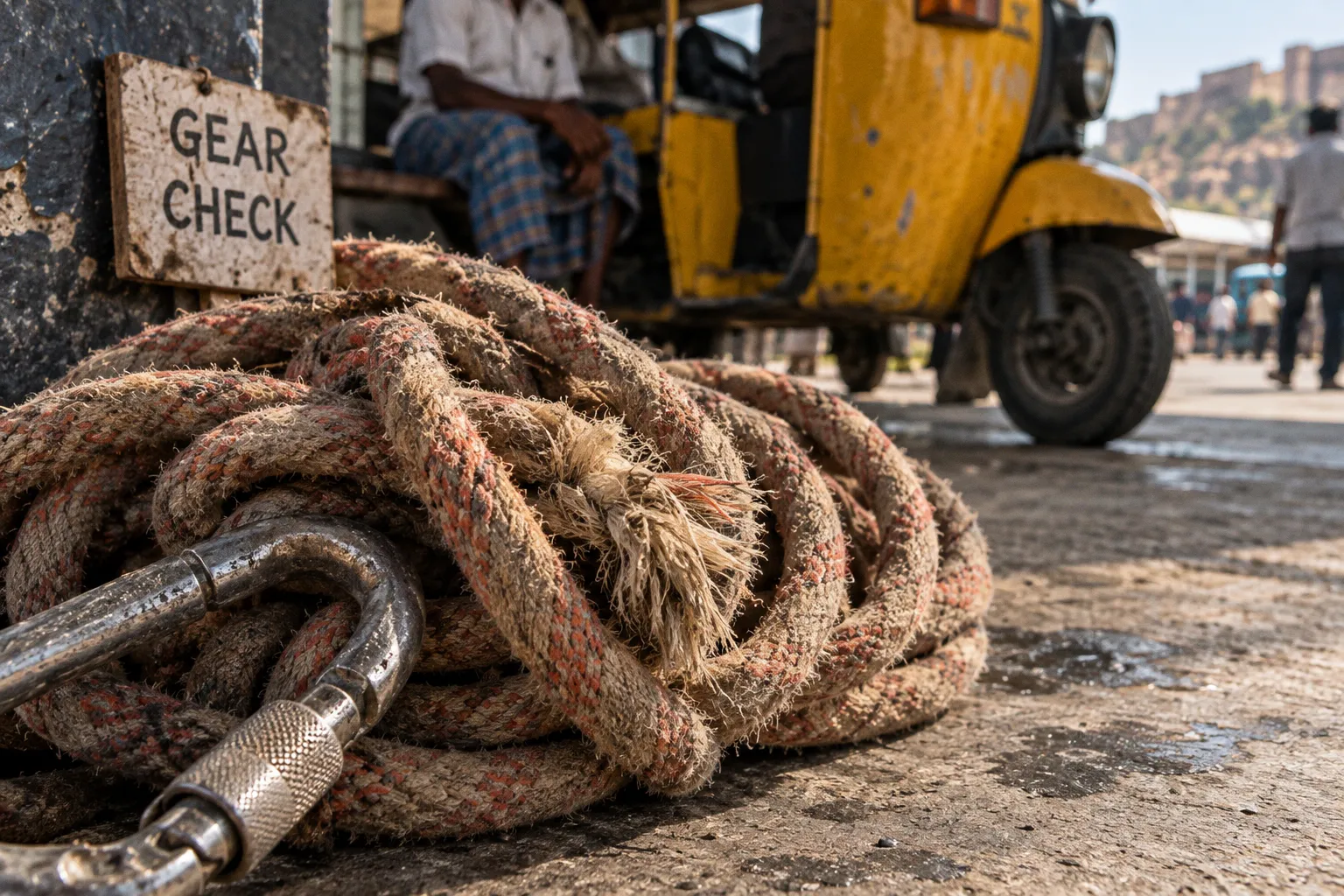
Adventure Gear Rentals in Gandikota: How to Spot Faulty Equipment
It is whether the operator can show compliant equipment, whether the gear has been maintained, and whether the person handing you a helmet knows how to manage a fall, a capsize, or a sudden change in river conditions.
The Andhra Pradesh Adventure Tourism Rules issued through GO Ms. No. 15 on June 26, 2025, classify unregistered adventure operations and the use of uncertified or substandard equipment as legal malpractice. That gives you a clear baseline. Do not treat a frayed harness, a leaking kayak, or a vague price quote as part of the adventure. Stop. Inspect. Ask for proof. Walk away if the operator cannot answer.
In Gandikota, you are not renting a thrill. You are renting the margin between a controlled activity and an uncontrolled incident.
The first move: separate a rough setup from an unsafe one
Gandikota is a rugged destination. Dust gets into buckles. Red quartzite scrapes fabric. River water leaves residue on kayaks and personal flotation devices. A campsite may look basic without being dangerous, and a piece of gear may look worn without being unfit for use.
Your job is not to demand showroom condition. Your job is to identify damage that can change how the equipment behaves under load, impact, or water pressure.
That distinction matters because operators often work with equipment that shows normal field wear. Dirt alone does not prove that a harness is unsafe. A faded color does not automatically mean that a life jacket has failed. But missing labels, damaged stitching, cracked hardware, broken adjustment points, or unexplained repairs should move the rental into the no-go category.
Before you pay or clip in, establish four facts:
- What exact activity does the rental cover: kayaking, rappelling, rock climbing, canyon trekking, or camping?
- Which pieces of equipment are included in the quoted price?
- Who is responsible for fitting and checking the gear?
- What happens if the equipment is defective or the activity is cancelled?
If the answer changes at the counter, the price is not clear enough to accept.
Rappelling and climbing gear: inspect the load-bearing parts
Rappelling gear has no room for casual inspection. The system normally depends on several components working together: harness, helmet, rope, connectors, anchor setup, and descent device. You do not need to be a professional rope technician to identify obvious warning signs. You do need to look at the parts that carry your body weight.
Harnesses
Hold the harness in both hands and inspect the webbing from end to end. Run your fingers over the material. Look for:
- Cuts, deep abrasions, melted sections, or stiffened webbing.
- Loose or heavily pulled stitching around tie-in points and leg loops.
- Bent, cracked, or sharply deformed buckles.
- Adjustment points that slip instead of locking.
- Unclear or missing manufacturer information.
- Repairs that the operator cannot explain.
Dust is expected in Gandikota. A harness that is dusty but structurally sound is not the same as one with torn load-bearing webbing. Do not let an operator rush you through the fitting process. Put it on, tighten the waist belt and leg loops, and move through the range of motion you will use on the route. Squat. Step up. Lean back slightly while the guide holds the system. The harness should stay positioned without pinching, twisting, or sliding down.
A loose harness is not a comfort issue. Poor fit can affect your balance, make it harder to control your descent, and create dangerous pressure during a fall or prolonged hang.
Helmets
Check the shell for cracks, deep dents, and damage around the rim. Inspect the chin strap and adjustment mechanism. Fasten it and shake your head. The helmet should stay in place without choking you or leaving a large gap above your forehead.
Do not accept a helmet with a broken strap because the guide says you will only be on the wall for a short time. A short route still includes loose rock, contact with the canyon wall, and mistakes by other participants above you.
Carabiners and connectors
Inspect the gate. It should open and close smoothly, then return fully to its locked position. Look for sharp burrs, deformation, heavy corrosion, or a gate that sticks halfway. If the connector has a locking sleeve, test the locking action. Do not use a connector that only looks closed while the locking mechanism remains unreliable.
Never assume that every metal connector is suitable for every part of a rope system. Ask the guide which components are intended for the activity and watch how they are connected. A pile of climbing hardware on the ground is not proof of a properly built system.
Ropes and descent devices
A rope used for rappelling should not present obvious cuts, exposed core, severe flattening, melted sections, or unusual stiffness. Run your eyes along the accessible length. If the guide refuses to let you see the rope before the activity, treat that as a serious warning.
Look at the descent device as well. Deep grooves, sharp edges, cracks, or uncontrolled wear can affect rope handling. The guide should explain how you will hold the brake strand, how you will communicate, and what to do if you need to stop.
You should receive a practical briefing before you move toward the edge. It should cover body position, braking hand, commands, clipping or attachment points, and the procedure for starting and stopping. A fast instruction shouted after you are already leaning over the drop is not a proper safety briefing.
Anchors: the part you cannot casually ignore
The anchor is the point where the entire system meets the rock or fixed structure. You may not be able to independently certify the anchor, but you can still observe the setup and ask direct questions.
Ask the guide:
- Where is the main anchor?
- Is there a backup?
- Who installed or checked the system?
- What is the communication command for stop?
- What happens if the rope path rubs against the rock?
A competent guide should answer clearly and demonstrate the system without irritation. You are not being difficult. You are attached to it.
Do not step into a rappelling system while the rope runs across a sharp edge without visible protection or explanation. Do not accept a setup where the guide cannot identify your attachment point. Do not let anyone tell you to ignore a strange sound, sudden rope drag, or shifting anchor arrangement.
Kayaking on the Pennar: inspect flotation, hull, and fit
Guided kayaking sessions at the Gandikota gorge are commonly listed at around 45 minutes. That is enough time for a poor life jacket, a loose foot brace, or a damaged paddle to become a persistent problem. Water activities punish small oversights because you cannot simply put the equipment down and walk away once you are offshore.
Life jackets
Put the life jacket on before entering the kayak. Tighten every available strap. The jacket should remain in position when you pull upward at the shoulders and move your arms. It should not ride up over your face or leave the chest loose.
Inspect the flotation panels, outer fabric, buckles, and stitching. Reject a jacket with:
- Torn fabric around the straps.
- Broken buckles or missing adjustment points.
- Flattened or severely lumpy flotation material.
- Strong chemical or mold odors combined with damaged fabric.
- A fit so large that it can slide over your head.
A life jacket that has absorbed water or lost its shape may still look usable while providing poor support. Ask the operator whether the jacket is intended for your size and whether you can change it if the fit is wrong.
Kayak hulls and drainage
Check the hull for cracks, splits, deep gouges, and openings around fittings. Scratches are normal on boats used around rocky banks. A crack that opens when you press near it is not normal wear.
Look inside the cockpit or seating area. Remove loose stones, sharp debris, and standing water before launch. Check the seat, back support, foot rests, and any adjustable straps. Your legs should have stable contact without being trapped. You need enough control to steer and brace, but you must also be able to exit quickly if the kayak capsizes.
Ask the guide what the capsize procedure is. The answer should be practical: how to release yourself, where to hold the paddle, where to move, and how the group will regroup. If nobody explains the procedure, do not assume the river will provide a gentle lesson.
Paddles and group control
Inspect the paddle shaft for cracks and excessive flex. Check the blades for splits or loose connections. A damaged paddle may not break immediately, but it can fail when you need it for steering or stability.
Before launch, establish how the group will stay together and how the guide will signal. The Pennar is not a swimming pool. Water level, current, wind, rocks, and access points affect how a session should run. You do not need a dramatic weather event to turn a relaxed paddle into a difficult return.
The guide should control the route and pace. If participants are scattered without a clear regrouping point, or if the operator pushes you onto the water without a briefing, pause the launch.
Camping equipment can also reveal how the operator works
Camping is lower-risk than rappelling or kayaking, but poor rental practices often show up first in the campsite. Torn tents, wet bedding, missing lights, and surprise charges are not just comfort complaints. They tell you whether the operator tracks equipment, discloses conditions, and respects the booking agreement.
Basic dome tent camping in Gandikota typically ranges from ₹900 to ₹1,500 per person per night with meals included. Bare-tent allocations can start around ₹500 per person, often excluding food, activities, and local transfers. AC Swiss tents or AC rooms may be listed around ₹1,899 to ₹2,199 per person.
Those figures are useful as orientation, not as a guarantee for every date or operator. A low quote may exclude meals, transfers, bedding, activity fees, or taxes. A higher quote may include a better accommodation category. The only safe comparison is item by item.
Ask to see the tent before settling in if possible. Check the floor, seams, zippers, poles, bedding, and groundsheet. Look for:
- A wet or visibly stained sleeping surface.
- Broken poles or improvised pole repairs.
- Zippers that cannot close.
- Missing guy lines in exposed locations.
- Bedding that smells strongly of damp or mildew.
- Unclear access to toilets, lighting, or drinking water.
Do not confuse a basic campsite with a deceptive one. A simple tent can be perfectly reasonable when the operator describes it accurately. The problem begins when the booking promises one category and delivers another, then adds charges after arrival.
Pricing red flags: make the quote itemized before you hand over money
Gandikota adventure gear rental scams do not always begin with obviously damaged equipment. Some begin with a clean booking message and an incomplete price.
The operator may quote a base amount, then add separate charges for the harness, helmet, guide, launch, transport, food, or campsite access. Separate fees are not automatically fraudulent. Hidden fees are the problem.
Request an itemized receipt showing:
| Booking detail | What you should be able to identify |
|---|---|
| Activity | Kayaking, rappelling, climbing, trekking, or camping |
| Duration | For example, a guided kayaking session listed as 45 minutes |
| Equipment | Harness, helmet, rope system, life jacket, paddle, kayak, or tent |
| Food and transfers | Included, excluded, or available at an additional stated price |
| Participant price | Per person or per group |
| Cancellation terms | What happens if weather, water conditions, or operator issues stop the activity |
| Receipt | The amount paid, operator identity, and date of service |
Andhra Pradesh tourism regulations specifically identify failure to issue proper receipts and charging more than notified prices as fraudulent and non-compliant practices. That does not mean every price difference is illegal. It means you should insist on documentation instead of accepting a verbal total that changes at the counter.
Count the people included in the quote. Ask whether equipment is shared or individually assigned. Ask whether a guide is included. Confirm whether the activity price includes the safety briefing and fitting. If the operator refuses to put the total in writing, keep your money in your pocket.
The fastest way to expose a bad rental deal is to force the price into writing before the gear comes out.
Verifying registration and guide credentials
The Andhra Pradesh Tourism Development Corporation guidelines require adventure guides to undergo risk assessment and first-aid training. The same safety framework places responsibility on operators to use appropriate equipment and manage adventure activities properly.
Ask the operator to show valid APTDC registration or the relevant registration details for the business conducting the activity. Do not settle for a generic claim that the company is approved. Match the name on the registration information with the name on your booking and receipt where possible.
You are looking for consistency:
1. The business name should remain the same across the booking, receipt, registration information, and guide’s explanation.
2. The activity being sold should match the operation described by the guide.
3. The guide should be able to explain the route, major hazards, emergency response, and equipment.
4. The operator should identify who controls the activity on the day.
5. The pricing should remain consistent from booking to payment.
A registration claim does not remove your responsibility to inspect the gear. Certification and equipment condition are separate questions. A compliant operator can still hand you a badly maintained item by mistake; a polished-looking setup does not prove that the business has met every requirement.
Pay attention to how the guide handles reasonable questions. A good response is direct and specific. A bad response relies on pressure: everyone else is already waiting, the gear is fine, there is no time, or you will lose your booking if you hesitate. That is not risk management. That is sales pressure.
Age restrictions are not optional
The APTDC safety guidelines explicitly prohibit children under 18 from participating in high-risk adventure activities. That restriction applies to activities such as high-consequence rappelling, climbing, or other operations classified under the relevant rules. Do not rely on an operator who says a child can participate because the route is short or the parent is nearby.
If a minor is part of your group, state the age before booking. Ask which activities are permitted under the operator’s rules and the applicable tourism requirements. Do not wait until the group reaches the launch point.
The same principle applies to physical capability. A participant who cannot comfortably wear the harness, follow commands, swim when the activity requires it, or control a paddle may need a different activity. A guide should not treat every participant as interchangeable.
The briefing is a real equipment check
The quality of the briefing tells you how seriously the operator treats the rest of the system. Listen for clear instructions, not a rushed speech designed to get the group moving.
For rappelling, you should understand:
- How to sit into the harness.
- Which hand controls the brake strand.
- How to keep your feet placed on the wall.
- How to stop or ask for assistance.
- Which commands mean lower, stop, or continue.
- What to do if loose rock moves above or below you.
For kayaking, you should understand:
- How to enter and exit the boat.
- How to hold and use the paddle.
- How to respond if the kayak tips.
- Where to regroup.
- What signals the guide uses.
- What hazards or restricted areas you must avoid.
For canyon trekking, ask about loose rock, exposed edges, water crossings, footwear, heat, and the expected return route. A canyon route can change in difficulty when the ground is wet, visibility drops, or the group spreads out.
If the guide cannot explain the activity in language you understand, stop before departure. Do not nod along and hope to copy the person ahead.
A practical decision sequence at the rental counter
Use this sequence when renting climbing equipment in Gandikota or booking a water and canyon activity:
1. Name the activity and total price. Get the duration, inclusions, exclusions, and cancellation terms in writing.
2. Check the operator identity. Compare the booking name, receipt, and registration information.
3. Inspect the gear before fitting. Look at harness webbing, helmet shell, connectors, rope, life jacket, kayak, paddle, or tent.
4. Fit the equipment yourself under the guide’s supervision. Move, tighten, and test adjustment points.
5. Ask for the hazard briefing. Require activity-specific instructions, not general reassurance.
6. Confirm the age and participation rules. Do this before payment, especially for anyone under 18.
7. Keep the receipt. It records what you paid for and gives you a clear basis for challenging hidden charges.
8. Make the go/no-go call. A scenic canyon does not justify accepting a damaged system.
The sequence is simple because the decision should be simple. If the gear is damaged, the price is hidden, the operator cannot show registration, or the briefing is missing, do not proceed.
Go or no-go: make the decision before the edge
Go when the equipment fits, the load-bearing parts look sound, the guide explains the system, the price is documented, and the operator can provide credible registration and training information. Stay with the activity only if the guide maintains control of the group and responds clearly to questions.
Call it a no-go when:
- A harness has damaged webbing or unreliable buckles.
- A helmet has a cracked shell or broken strap.
- A connector does not lock correctly.
- A rope shows severe damage or the operator refuses inspection.
- A life jacket does not fit or has damaged flotation.
- A kayak has a structural crack or unsafe seating.
- The operator adds unexplained charges.
- You cannot obtain a proper receipt.
- The guide skips the safety briefing.
- The operator ignores the under-18 restriction.
- Staff pressure you to accept equipment or conditions you have already challenged.
You do not owe a rental operator your money, your trust, or your body weight. Gandikota rewards preparation and punishes lazy assumptions. Check the gear. Check the guide. Check the price. Then decide.
The canyon will still be there for a safer booking.