Footwear for Gandikota canyon: balancing grip and comfort
The red quartzite slabs at Gandikota are not difficult because they are uniformly steep or technical. They are difficult because the surface keeps changing underfoot.
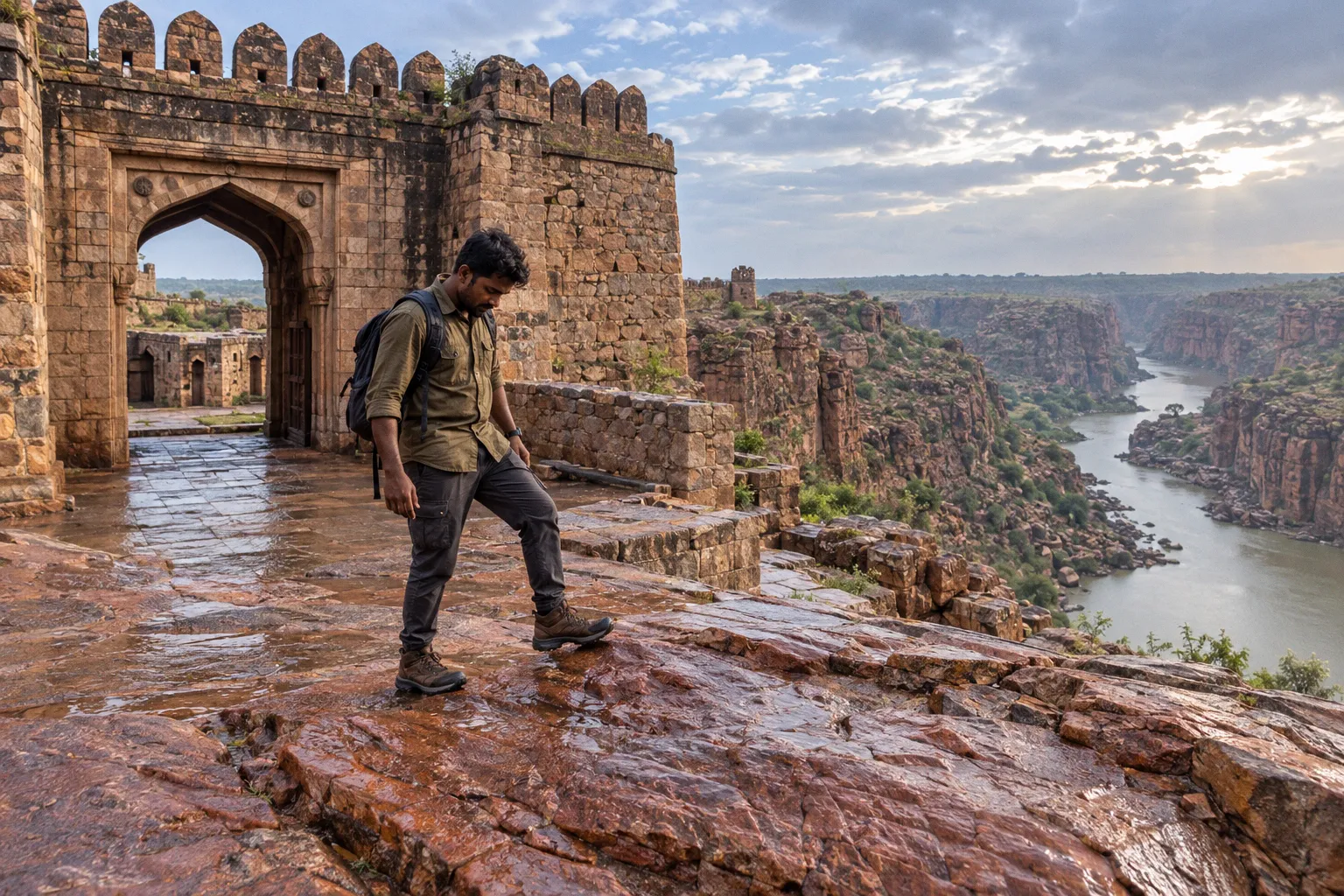
A dusty rock plate asks for grip; loose scree asks for lugs that can clear themselves; a broken boulder field asks for lateral stability; and the heat makes every unnecessary layer feel heavier by the hour.
That is why gandikota canyon footwear for rocky terrain should not be chosen by appearance or by the label “hiking shoe” alone. A comfortable sneaker may be fine around the fort and on compact ground, yet feel vague and unreliable as soon as the trail moves onto angled quartzite. The right shoe is a compromise: enough rubber contact and structure for unstable ground, but not so much bulk that the foot overheats before the walk is over.
Anatomy of the Gorge: Why Standard Sneakers Fail on Quartzite
Gandikota’s canyon is carved through old quartzite and sandstone formations. The descent from the fort area toward the Pennar River does not behave like a forest path, where soil absorbs part of each step, or like clean alpine rock, where the sole can engage a relatively predictable surface. Here, dust, fractured stone and irregular edges often occupy the same foothold.
Several surfaces matter when choosing footwear.
- Red quartzite slabs. These are dense, angled sections of rock that may carry a thin layer of fine red grit. The stone itself can offer useful friction, but the dust between the outsole and the rock changes the contact completely. A hard, flat sole may begin to slide before its tread has a chance to settle.
- Layered sandstone bands. Broken layers create uneven rises and ledges rather than a smooth walking surface. The edge of a layer may crumble slightly under pressure, so a shoe needs a stable forefoot and enough protection to keep repeated impacts from becoming painful.
- Loose scree. Small stones shift under the foot instead of accepting it cleanly. This is where lug shape and spacing become more important than a fashionable upper or a soft, road-running feel.
- Boulder fields near the river approach. Larger rocks introduce a different problem. The foot may land on a tilted or rolling surface, and the ankle has to manage movement from the side as well as from front to back.
This combination explains why generic sneakers often feel wrong in the canyon. Their rubber is usually optimized for pavement, and their outsole is designed to roll smoothly rather than hold a loose edge. The cushioning may be pleasant on a flat approach, but a soft, flexible platform can become imprecise on broken ground. When the surface is dusty quartzite, the shoe may glide before the tread can engage.
A road-to-trail hybrid can be a better option, but the category is broad. Some models have a genuinely useful trail outsole; others simply add a few shallow grooves to a road-running shoe. The distinction becomes obvious on a descent. A trail shoe should let the foot settle without constant searching for a stable position. If the sole folds easily across the middle or feels slick when pressed against clean stone, it is not a strong candidate for the canyon.
What the upper and midsole need to do
The outsole receives most of the attention, but the rest of the shoe determines whether that grip is usable.
A shoe with a very soft midsole can feel comfortable during the first part of a walk and unstable later, particularly when the foot is repeatedly landing on sloped rocks. A firmer, more controlled platform helps keep the foot aligned over the sole. It does not need to feel like a mountaineering boot; it simply should not collapse sideways every time the ground changes.
The upper also needs to hold the foot without creating pressure points. Laces that can be tightened around the midfoot, a secure heel cup and a toe box that allows the toes to spread are more useful than excessive padding. Too much internal volume lets the foot move inside the shoe, while an overly narrow toe box creates pressure when descending.
For a first visit, think in terms of controlled contact rather than maximum cushioning. The best hiking shoes for Gandikota are the ones that allow you to place the foot accurately and keep it there, even when the ground is dusty and uneven.
The Physics of Traction: Selecting Rubber Compounds for Sandstone
Traction on rock depends on the interaction between the rubber, the tread shape and the surface under the shoe. Dust is the disruptive element. Fine grit can behave almost like a lubricant on a smooth slab, especially when the outsole is hard enough to bridge over the particles rather than deform around them.
Softer trail compounds generally have an advantage on dusty rock because they can conform more closely to small irregularities in the surface. That does not mean the softest rubber is automatically the best choice. Very soft rubber can wear quickly on abrasive stone, and a tread designed for clean climbing surfaces may not clear loose material effectively. Gandikota footwear has to work across more than one surface.
Look for a compound that offers a deliberate balance:
- Enough softness to conform to rough rock. The rubber should not feel like a rigid plastic layer under the forefoot.
- A defined contact pattern. Some broad, relatively flat zones can help on slabs, while edged lugs are more useful when the ground becomes loose.
- A stable heel area. On a descent, the rear of the outsole should make predictable contact instead of feeling rounded and vague.
- A compound suited to abrasive ground. Sticky rubber is useful, but a climbing-style sole that sacrifices durability and loose-ground performance is not necessarily a sensible canyon choice.
A sharp heel edge can help with braking on a descent, but it does not turn a steep or dusty slope into a secure staircase. Braking should come from the whole foot placement, the tread and a controlled body position. Relying on one aggressive heel feature encourages the kind of hard planting that makes a slide more likely if the surface gives way.
The same caution applies to claims about rubber. A manufacturer may describe a compound as “sticky,” but the label tells you little about how the outsole behaves when dust fills the tread. What matters is whether the shoe maintains contact on rock while still releasing grit. A sole built only for clean slabs may feel excellent on a dry boulder and disappointing a few steps later on loose ground.
Sticky rubber helps on dusty quartzite, but traction is a system: compound, tread, foot placement and surface all have to cooperate.
Why casual soles lose confidence
Lifestyle sneakers often use rubber intended for sidewalks, indoor floors or light everyday wear. Their patterns may be shallow, closely packed or dominated by smooth flex zones. Those features make the shoe quiet and comfortable on pavement, but they leave little to bite into loose material.
A smooth outsole is not always dangerous on every section of the approach. The problem is the sudden change from firm ground to a sloping slab or a patch of scree. A sole that has worked perfectly around the fort can become the weakest part of the setup once the route turns uneven.
Ankle Stability and Protection Against Sharp Boulder Fields
Grip does not eliminate the need for stability. On a boulder field, the foot can be pushed sideways even when the outsole is holding the rock. A low-cut trail runner allows the ankle to move freely, which can be an advantage for an experienced walker who has strong foot control and prefers a lighter shoe. It also leaves more of the stability task to the muscles and ligaments around the ankle.
A mid-cut hiking boot adds structure around that area and can make an uneven descent feel less tiring. It does not lock the ankle in place, nor should it. Excessive stiffness can make it harder to adapt when a rock shifts. The useful support is controlled resistance to unwanted movement, combined with a sole that does not twist too easily.
The anatomical point matters here: inversion is the inward rolling of the sole of the foot, while eversion is the outward movement. A shoe collar may help limit the range of unwanted ankle movement in either direction, but the collar alone cannot prevent an injury. Fit, outsole stability, foot placement and pace remain more important than shaft height by itself.
A practical way to think about the options:
- Mid-cut hiking boots suit first-time visitors, walkers carrying a daypack and anyone who feels uncertain on loose or tilted ground. They offer more ankle coverage, better debris protection and a stable platform, though they can feel warm.
- Low-cut trail runners suit experienced trekkers who are comfortable placing each step and who prioritize ventilation and low weight. They are a reasonable choice in dry conditions when the route is familiar.
- Approach shoes can be excellent on clean slabs because their climbing-influenced rubber and precise fit encourage careful foot placement. Their flatter areas and relatively modest lugs are less convincing when the trail turns into loose scree.
- Heavy mountaineering boots are usually unnecessary for a standard canyon visit. Their stiffness and insulation can become liabilities unless the itinerary involves genuinely demanding off-trail travel or a substantial load.
Toe protection is useful, not a magic shield
The front of the foot takes repeated contact on broken rock. A reinforced toe box or a modest rubber rand is therefore a sensible feature, especially for walkers who are still learning to descend on uneven terrain. It protects against knocks and gives the upper more durability when the shoe meets a sharp edge.
It is better to treat toe protection as advisable rather than mandatory. A well-fitting trail runner with a structured toe box can be perfectly serviceable, while a poorly fitting boot with a thick rand can still cause trouble. The important questions are whether the toes have room to spread, whether they stay away from the front of the shoe on a descent and whether the upper can tolerate regular contact with rock.
Balancing Breathability and Durability in Arid Canyon Heat
Heat changes the footwear decision. A boot that feels reassuring in the morning may become restrictive once the ground reflects sun and the walk continues over exposed rock. In Gandikota, breathability is not a luxury reserved for comfort-focused hikers. It affects how quickly the foot swells, how much moisture builds up inside the shoe and how securely the heel remains held.
Mesh uppers usually ventilate better than waterproof constructions. They also dry more quickly after sweat or an accidental splash. That makes them the more practical option for many dry-season walks, provided the mesh is protected in high-wear areas and the shoe has enough structure for the terrain.
Waterproof membranes have a narrower but legitimate use. They can be helpful when the itinerary includes wet ground, persistent seepage or a crossing where keeping the feet dry is more important than maximum ventilation. They are less attractive when the main challenge is heat. Once moisture enters a waterproof shoe from sweat or from over-topping the collar, it tends to leave slowly.
A useful seasonal distinction is not a calendar promise but a ground assessment:
- Choose more ventilation when the forecast is hot, the route is dry and the walk includes long exposed approaches.
- Consider water resistance when recent weather has left the rock and scree damp, or when the itinerary includes water near the river.
- Avoid selecting a membrane simply because it sounds more protective. In a hot, dry canyon, the extra barrier may create more discomfort than useful protection.
Durability matters as well. Lightweight mesh can be comfortable but vulnerable to abrasion from sandstone edges. Look for overlays around the toe and along the sides, while avoiding a shoe so heavily reinforced that it loses flexibility and dries slowly. The ideal upper protects the high-wear zones and leaves the rest of the foot able to release heat.
Socks are part of this calculation. A thin, well-fitting hiking sock is generally better than a thick cotton sock that holds moisture and bunches inside the shoe. The goal is not maximum padding; it is a smooth interface with no folds around the heel, arch or toes.
Lug Patterns and Tread Depth for Loose Scree and Steep Descents
Tread geometry is one of the least appreciated parts of a canyon shoe. On loose scree, the lugs need to enter the surface, hold long enough for the foot to settle and then release the material instead of carrying a packed layer into the next step.
There is no single ideal lug depth for every section of Gandikota. Deeper lugs can improve purchase in loose ground, but they may feel unstable or disconnected on hard slabs. Very shallow patterns offer better contact on firm surfaces and usually roll more comfortably, but they have less ability to clear loose material.
The most versatile pattern tends to have:
- Moderately deep lugs with clear edges. They should be substantial enough for scree without turning the shoe into a stiff mud boot.
- A multidirectional layout. Forward-facing edges help with climbing, rear-facing edges assist with braking, and lateral features matter when stepping across a slope.
- Open spacing. Gaps allow grit to leave the outsole instead of forming a smooth layer beneath it.
- A recognizable heel braking zone. It should support controlled downhill steps without encouraging the wearer to slam the heel into every landing.
- Some flatter rubber for slabs. A shoe made entirely of widely spaced aggressive lugs may be less comfortable and less predictable on hard rock.
The common failure is not always a lack of depth. A closely packed pattern can collect fine grit, while a soft outsole with weak edges can deform until the tread loses definition. Inspect the shoe from below and ask how it will behave on both surfaces: can the lugs reach through loose material, and can the broader rubber still contact a slab?
When buying a new pair, flex it by hand and twist it gently. A little flexibility is useful, but the shoe should not fold dramatically through the middle or twist like a casual trainer. Then examine the heel. If it is already rounded and smooth before the first trip, it will offer less control on the descent.
Footwear Comparison for Gandikota Terrain
| Feature | Mid-cut hiking boot | Low-cut trail runner | Approach shoe |
|---|---|---|---|
| Slab performance | Strong when fitted with a capable sticky or all-terrain rubber | Strong if the outsole has real rock grip | Often excellent on clean, firm rock |
| Loose scree | Usually good, especially with open multidirectional lugs | Varies widely by model and lug design | Often weaker where the outsole is flatter |
| Ankle coverage | Highest of the three | Minimal | Minimal |
| Heat management | Moderate; depends on upper and lining | Usually best | Moderate |
| Toe protection | Commonly good | Ranges from light to substantial | Usually good |
| Weight and fatigue | Heavier, but more supportive | Light and efficient for experienced users | Between the two in many models |
| Best use | First visits, uncertain footing, heavier packs | Skilled walkers in dry conditions | Scrambling on firm rock with limited loose ground |
The comparison is only useful if the specific outsole matches the terrain. A lightweight trail runner with a serious lug pattern can outperform a poorly designed hiking boot, while a supportive boot with a worn sole is still a poor choice. Brand reputation and the word “technical” on the box cannot replace looking at the rubber, the tread and the fit.
For many visitors, a mid-cut hiking boot remains the most forgiving option. It gives the ankle and upper foot more structure and usually offers better protection from debris. A low-cut trail runner is a credible alternative when the wearer already knows how to move over uneven rock and values ventilation. An approach shoe makes sense when slab scrambling is the focus, not when the route includes a long stretch of loose scree.
Making the Final Choice Before the Descent
The shoe should be tested before the trip, but not merely on a flat pavement. Walk in it on a slope, on rough ground and on a surface where the foot has to brake. The test does not need to reproduce Gandikota exactly. It needs to reveal whether the heel lifts, whether the toes strike the front during a descent and whether the sole feels stable when the foot lands at an angle.
Pay attention to these details:
1. The heel should stay seated. A small amount of movement may be normal, but repeated lifting creates friction and reduces control. Adjust the lacing before deciding that the shoe is too large.
2. The toes need descending room. They should not be compressed against the front, yet the foot should not slide forward inside the shoe.
3. The midfoot should feel held, not squeezed. The laces must secure the foot without producing numbness or pressure across the top.
4. The outsole should show useful edges. Avoid a pattern that is already rounded, shallow or polished in the heel and forefoot.
5. The upper should protect without trapping heat. Reinforcement at the toe and along the side is valuable; a fully sealed construction may not be.
6. The shoe must be broken in. New footwear should be used on shorter walks first so that hot spots appear before the canyon, not during it.
7. Socks should be part of the fitting process. Try the shoes with the same socks you intend to wear outdoors.
8. Carry a simple repair option. Spare laces and a small amount of tape take little space and can make a damaged shoe manageable until the walk is over.
9. Clear grit from the shoe when it builds up. A stone under the foot can create a pressure point, alter your stride and lead to a blister; it does not need a particular distance or time to become a problem.
10. Match the shoe to the day. A heavily lined waterproof boot may be sensible in wet conditions and unnecessarily hot in a dry, exposed canyon.
Do not interpret “support” as permission to move faster. A stable shoe expands the margin for error; it does not remove loose rocks, dust or fatigue from the route. Shorter steps, deliberate foot placement and a slower pace on uncertain ground will do more for safety than an aggressive outsole used carelessly.
The descent into the gorge is not the place to discover that a new shoe rubs, twists or loses grip. Test the fit and the outsole on comparable ground before the rim.
The best canyon walking shoes are not necessarily the heaviest, stiffest or most aggressively marketed. They are the pair that keeps the foot secure on dusty quartzite, remains predictable on loose stone and vents enough heat to stay comfortable through the day. For a first visit, that usually means a supportive trail shoe or mid-cut hiking boot with a genuine all-terrain outsole, a secure heel, moderate toe protection and no unnecessary waterproof insulation. Experienced trekkers may reasonably go lighter, but only when their footwear and their movement skills are equally well matched to the rock.