Kadapa to Gandikota transit: public bus versus private cab
The road from Kadapa to Gandikota is approximately 77 km. The distance is manageable. The transport problem is not.
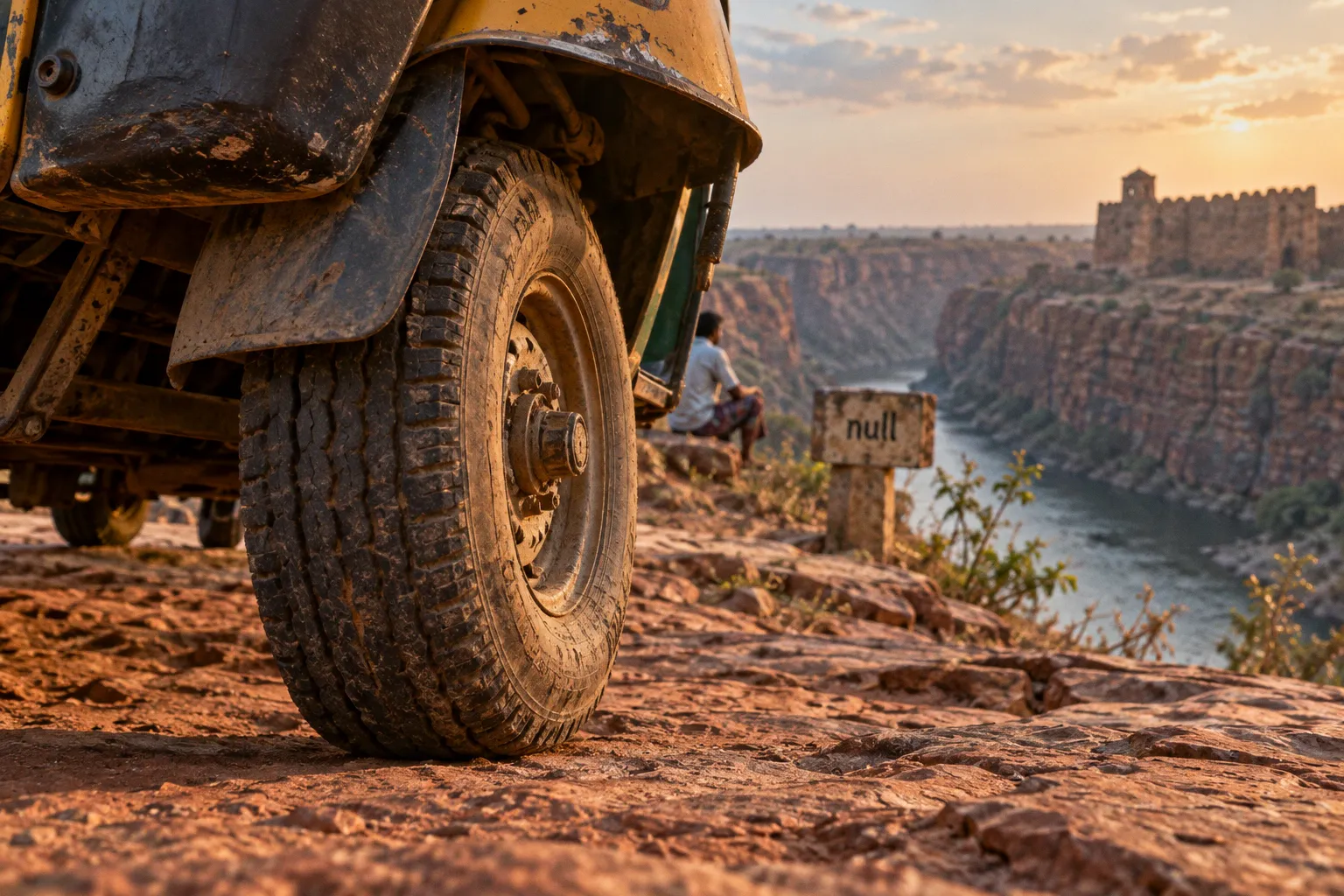
Public transport normally requires a change at Jammalamadugu, followed by a separate 15–18 km last-mile journey to Gandikota Fort. A private cab removes that transfer and runs door to door in roughly 1.5 to 2 hours. The cost difference is substantial, but so is the difference in failure points.
For travelers researching Gandikota public transport options from Kadapa, the decision comes down to three variables: departure flexibility, luggage, and tolerance for an uncertain final connection. The bus route is cheaper. The cab route is simpler. Neither should be treated as a seamless, high-frequency connection.
The 77 km route: distance is not the full calculation
Kadapa is the practical transport base for many visitors approaching Gandikota. It has the broadest rail connectivity in the area and sits closer to Kadapa Airport than the larger regional alternatives. Gandikota itself does not have a major passenger railway station or commercial airport. The final approach is by road.
The headline distance—77 km—creates a misleading impression. On a map, Kadapa to Gandikota looks like a straightforward intercity trip. In operational terms, the route divides into two different legs:
1. Kadapa to Jammalamadugu, generally handled by APSRTC bus or private vehicle.
2. Jammalamadugu to Gandikota Fort, approximately 15–18 km, usually completed by auto-rickshaw or local taxi.
The second leg is where a low-cost public journey becomes less predictable. A bus may get you close to the destination, but it does not remove the need to arrange the final road connection. Local vehicles may be available, but their supply, timing, and pricing are not fixed to the same standard as a scheduled intercity service.
The road distance also matters when carrying camping equipment. A traveler with one small daypack can manage a transfer. A traveler carrying a tent, sleeping system, cooking kit, water, and camera equipment has a different problem. Every transfer adds loading, unloading, and the possibility of leaving equipment behind.
The cheapest route to Gandikota is not automatically the lowest-risk route. The Jammalamadugu transfer is the deciding variable.
Kadapa to Gandikota travel is therefore best planned as a route with a connection, not as a single bus ride. This distinction affects departure timing, luggage strategy, and the amount of daylight available for reaching the fort or campsite.
Public transit workflow: APSRTC bus plus Jammalamadugu transfer
Direct public buses from Kadapa to Gandikota are scarce. The standard public-transport workflow is to take an APSRTC bus from Kadapa to Jammalamadugu, then arrange an auto-rickshaw or local taxi for the remaining 15–18 km.
This is the main public transit pattern:
1. Reach the Kadapa bus stand with enough time to identify the current service to Jammalamadugu.
2. Confirm the destination with the conductor before boarding. Do not assume that every service follows the same stopping pattern.
3. Exit at Jammalamadugu and keep your luggage with you during the transfer.
4. Negotiate or confirm the local vehicle fare before departure.
5. Complete the final 15–18 km to Gandikota Fort.
6. Reassess the return connection before committing to a late departure from the fort area.
The exact daily departure schedule for the Kadapa–Jammalamadugu leg should be confirmed locally. A fixed, dependable timetable cannot be assumed from general route information. This matters more on the return journey, when missing the available connection can leave you dependent on a local taxi.
The final transfer typically costs around ₹250–₹350 for an auto-rickshaw or local taxi covering the 15–18 km stretch. Treat that figure as a working range, not a guaranteed tariff. Fare conditions can vary with time of day, vehicle type, passenger count, luggage, and the driver’s willingness to accept the route.
Where public transport works well
The bus-and-local-vehicle combination is suitable when:
- Your priority is keeping transport costs low.
- You are traveling with a compact bag rather than expedition equipment.
- Your schedule has room for waiting and transfer delays.
- You are comfortable asking for directions and arranging the last-mile ride locally.
- You are arriving early enough to avoid depending on the final available vehicle.
It is also a reasonable choice for travelers already moving through Jammalamadugu. In that case, the transfer is part of the existing route rather than an additional complication.
Where public transport becomes inefficient
The route becomes less attractive when:
- You have a fixed check-in or tour start time.
- You are carrying a tent, cooler, tripod, or multiple bags.
- You need to reach Gandikota with reliable daylight remaining.
- You are traveling with children, older passengers, or anyone uncomfortable with roadside transfers.
- You plan to return to Kadapa on the same day and cannot absorb a missed connection.
The problem is not the 77 km distance. The problem is that the journey is made of two separate transport decisions. A bus can complete the first leg successfully while the second leg remains unresolved.
Private cab logistics: the cost of removing the transfer
A private cab from Kadapa provides direct, door-to-door movement to Gandikota. One-way fares generally start at approximately ₹1,716 to ₹1,881, depending on whether the vehicle is a hatchback, sedan, or SUV.
The cab price is higher than the public option, but it buys operational simplicity:
- One vehicle for the full route.
- No change at Jammalamadugu.
- No separate negotiation for the final 15–18 km.
- Better control over departure time.
- Easier loading for camping and photography equipment.
- A practical option for groups dividing the fare.
Travel time by private cab is approximately 1.5 to 2 hours, depending on the starting point, traffic, stops, and road conditions. The driver should be given Gandikota Fort as the destination, not merely Gandikota village, if the objective is to reach the fort area directly.
Hatchback, sedan, or SUV
Vehicle class should be selected according to equipment, not status.
| Vehicle type | Practical use | Main limitation |
|---|---|---|
| Hatchback | One or two travelers with compact luggage | Limited cargo space for camping equipment |
| Sedan | Two to four travelers with standard bags | Roof or boot capacity may become restrictive with bulky gear |
| SUV | Groups, heavy luggage, camping equipment, or extra cabin space | Higher starting fare |
A hatchback is adequate for a light travel load. It becomes a poor choice when passengers carry tents, sleeping bags, water containers, backpacks, and camera cases. A sedan offers a better compromise for ordinary sightseeing luggage. An SUV is justified when the cargo volume is substantial or when several passengers are sharing the vehicle.
Do not assume that an online starting fare includes every possible service condition. Confirm whether the quoted amount is:
- One way or round trip.
- Inclusive of tolls.
- Inclusive of parking or waiting charges.
- Based on a specific vehicle class.
- Valid for pickup from the railway station, bus stand, hotel, or airport.
- Applicable to a direct drop at Gandikota Fort.
Unorganized local taxis outside transport hubs may quote different prices. There is no guaranteed fixed fare for every private vehicle operating from Kadapa Railway Station or the surrounding area. A booked cab with a clear written fare is easier to audit than an improvised agreement after arrival.
When a cab becomes financially reasonable
The private option becomes more defensible when the fare is divided among passengers. A one-way starting fare of ₹1,716–₹1,881 is expensive for one traveler but considerably more manageable for a group of three or four. The calculation should include the Jammalamadugu last-mile fare that public travelers would pay separately.
The cab also has value when the alternative is losing several hours to waiting, missing a campsite check-in window, or arranging emergency transport after a late arrival. Cost is only one part of the route. The other part is the number of independent connections you must successfully complete.
Bus versus private cab: the operational comparison
The following comparison describes the route in practical terms rather than marketing terms.
| Parameter | Public bus via Jammalamadugu | Private cab from Kadapa |
|---|---|---|
| Route structure | Kadapa to Jammalamadugu, then separate local vehicle | Direct Kadapa to Gandikota |
| Road distance | Approximately 77 km overall | Approximately 77 km overall |
| Transfer requirement | Yes. Final leg is about 15–18 km | No scheduled transfer |
| Known local fare | Approximately ₹250–₹350 for the Jammalamadugu–Gandikota leg | One-way starting around ₹1,716–₹1,881 |
| Travel time control | Low. Depends on bus departure and local connection | Higher. Departure can be arranged in advance |
| Luggage handling | Multiple loading and unloading points | One vehicle throughout |
| Schedule certainty | Exact daily bus frequency requires local confirmation | Usually better when booked before departure |
| Best use case | Budget travel with flexible timing | Time-sensitive travel, groups, or heavy equipment |
| Main failure point | Missing or delaying the Jammalamadugu connection | Fare conditions, vehicle class, or booking reliability |
The bus route wins on base cost. The cab wins on continuity. If you are traveling without a private car and carrying only a daypack, public transport remains viable. If your Gandikota plan includes camping, sunrise photography, or a fixed tour departure, the cab reduces the number of variables that can disrupt the day.
Railway access: choosing the correct gateway
Rail travelers have several access points, but they are not equivalent.
Jammalamadugu is approximately 18 km from Gandikota and is the most relevant rail-side gateway for the final approach. From there, you still need an auto-rickshaw or local taxi to reach Gandikota Fort.
Yerraguntla Junction is approximately 47 km away. It can be useful depending on your train routing, but the remaining road transfer is substantially longer than from Jammalamadugu.
Kadapa Railway Station is approximately 77 km from Gandikota. It offers broader nationwide train connectivity and is often the more practical arrival point for travelers whose train does not serve the closer stations. From Kadapa, you can either follow the public bus connection through Jammalamadugu or arrange a direct private cab.
This produces three different rail strategies:
- Train to Jammalamadugu: shortest final road leg, but local vehicle availability becomes the critical factor.
- Train to Yerraguntla Junction: intermediate road distance and possible routing advantages.
- Train to Kadapa: stronger overall rail connectivity, followed by a 77 km road journey.
The nearest station is not always the best station. A station with fewer useful train services can create a longer wait and a more difficult last-mile connection. Select the gateway based on the full trip chain, not the final distance alone.
Airport access: Kadapa versus Tirupati
Kadapa Airport is the nearest airport to Gandikota, at approximately 75–90 km by road. Flight connectivity is limited compared with larger regional alternatives.
Tirupati Airport is approximately 219–225 km from Gandikota. It may offer broader flight options, but the additional road distance changes the logistics completely. A traveler choosing Tirupati for flight availability should budget for a substantially longer overland transfer and should not treat it as a near-Gandikota airport.
For most visitors, the airport decision is therefore a trade-off:
- Kadapa Airport: shorter road transfer, limited flight connectivity.
- Tirupati Airport: longer road transfer, potentially more routing flexibility.
A private cab is the practical airport solution because airport arrivals rarely align neatly with the bus-and-transfer sequence through Jammalamadugu. Public transport may still be possible, but it requires more independent connections and more schedule research than the Kadapa road journey alone.
Planning the last mile to Gandikota Fort
The final 15–18 km from Jammalamadugu should be treated as a separate logistics task. Do not arrive at Jammalamadugu with no plan and assume that a vehicle will immediately be available at the desired price.
Use a basic preparation sequence:
1. Confirm the exact destination. Gandikota village, Gandikota Fort, and a campsite or accommodation property may not be treated as identical drop points by every driver.
2. Separate transport money. Keep smaller denominations available for the local fare.
3. State the passenger and luggage count before agreeing. A vehicle accepting two passengers may not accept four large packs at the same rate.
4. Clarify one-way or return service. A driver offering a return arrangement should specify the waiting condition and pickup time.
5. Plan the return before entering the fort area. The outbound journey is easier when the vehicle is already arranged.
6. Avoid relying on an unverified late connection. If the day’s final bus or local vehicle is missed, your options narrow quickly.
Travelers camping near the canyon should be especially strict about arrival timing. A late transfer means setting up in reduced light, carrying equipment farther than expected, and searching for services after the main movement through the area has slowed. Those are avoidable complications.
For a return to Kadapa, the public route again requires movement to Jammalamadugu before continuing by bus. A private cab can collect you directly from the Gandikota area, but the pickup point and waiting time must be agreed in advance. Do not assume that a driver will remain available without a confirmed arrangement.
Recommended selection by traveler profile
There is no universal best mode. Use the route that matches your load and schedule.
Choose the public bus route if:
- You are traveling alone or with one companion.
- You have a compact backpack.
- Your schedule is flexible.
- Your priority is minimum transport cost.
- You can confirm the Kadapa–Jammalamadugu service before departure.
- You have a clear plan for the 15–18 km final leg.
Choose a private cab if:
- You are traveling in a group and can divide the fare.
- You carry camping or photography equipment.
- You need a direct arrival at Gandikota Fort.
- You are connecting with a fixed tour, accommodation window, or activity.
- You are arriving from Kadapa Railway Station or Kadapa Airport at an inconvenient time.
- You want to return to Kadapa without managing another public-transport transfer.
Use the railway gateway strategically if:
- Your train schedule serves Jammalamadugu cleanly.
- Yerraguntla offers a materially better connection for your origin.
- Kadapa has the best available train even though it leaves a 77 km road transfer.
- You are willing to arrange the final vehicle before arrival rather than after stepping off the train.
Treat Jammalamadugu as a connection point, not as the end of the journey. Gandikota begins after the final 15–18 km.
Final transit protocol
For most independent visitors, the decision is straightforward.
Use the APSRTC bus to Jammalamadugu plus a local auto-rickshaw or taxi when cost is the primary constraint and your schedule can absorb uncertainty. Budget roughly ₹250–₹350 for the final 15–18 km, confirm the current bus movement locally, and arrange the return before you need it.
Use a private cab from Kadapa when time, equipment, or group coordination matters more than the lowest fare. Starting prices of approximately ₹1,716–₹1,881 make the direct route viable for shared travel, especially when the alternative involves multiple transfers and heavy luggage.
Before leaving Kadapa, confirm five items:
- The exact drop point: Gandikota Fort or a specific property.
- The vehicle type and luggage capacity.
- Whether the quoted cab fare is one way or round trip.
- The local transfer plan if using public transport.
- The return connection from Gandikota.
The route is not technically difficult. It is operationally fragmented. Plan the transfer at Jammalamadugu as seriously as the main 77 km journey, and the trip becomes predictable. Ignore it, and the cheapest option can become the least controlled part of your Gandikota itinerary.